

I'm standing in our kitchen at 2:13 AM, bathed in the sickly yellow glow of the microwave clock, staring at a slightly damp muslin cloth while holding a bottle that's somehow simultaneously burning hot on the outside and completely freezing in the middle. The health visitor had told us last week to simply breathe through the nocturnal anxiety while implementing a strict fifteen-minute soothing rotation. My mother-in-law called yesterday to insist we just let them cry because it builds lung capacity. And the woman at our NCT class, God bless her, smiled beatifically over a plate of digestive biscuits months ago and suggested we sleep when the baby sleeps, a concept so mathematically impossible with twins that I nearly choked on my tea.
I'm trying to figure out which of these three pieces of advice is the most useless when a small, aggressive wail erupts from the nursery. It's the dreaded sound of Baby M (Maya, the louder twin) deciding that sleep is for the weak. I look at the baby monitor, then at my wife, who's completely comatose, buried under a duvet we haven't washed in a month.
It's my shift. It's my turn in the trenches.
The sheer delusion of infant sleep advice
Before we go any further, let's address the elephant in the search bar. If you typed certain words into your browser hoping to find the 2020 hip-hop album by a specific Atlanta rapper, you've made a bizarre and tragic geographic error on the internet. You won't find heavy bass or lyrics about street life here. But if you've a literal, actual lil baby, and your partner just rolled over, nudged you in the ribs, and mumbled "my turn" in a tone that suggests violence if you don't get out of bed, then welcome. You're in the right place.
There's an entire industry built on making you feel like you're doing nights wrong. From what I can loosely gather through my sleep-deprived haze, babies easily don't possess a circadian rhythm until they're much older. Dr. Evans down at our local NHS clinic sort of waved a dismissive hand during our six-week check and mentioned something about neurological immaturity, which was his polite way of saying we were doomed for the foreseeable future.
The books all say you shouldn't create bad habits. They tell you to put the baby down drowsy but awake, which is a mythical state of being that lasts for exactly three seconds before transforming into red-faced fury. Trying to put Maya down "drowsy but awake" is like trying to defuse a bomb while wearing boxing gloves. It's an interesting theory, but page 47 of the sleep manual suggesting I remain calm and project peaceful energy is deeply unhelpful when I've got a frantic infant headbutting my clavicle at half past three in the morning.
The brutal mathematics of dividing the night
When you first bring them home, you think you're going to do it together. You have this romantic vision of sitting up in the dim light, softly singing lullabies, sharing meaningful glances over the top of a fluffy head.

That lasts about four days. By day five, you're feral, territorial animals fighting over REM sleep.
Our pediatrician vaguely sketched out this idea of dividing the night into brutal, unyielding halves. It's the only way you survive. One of you takes the 8 PM to 1 AM shift, and the other takes 1 AM to 6 AM. During your off-hours, you wear earplugs. You don't intervene. If the house is not actively on fire, you stay in bed. The psychological weight of knowing you've a guaranteed five-hour block of unconsciousness is the only thing keeping the human race from dying out.
Of course, this assumes your child respects the schedule. Baby M has a delightful habit of sleeping peacefully until exactly 1:04 AM, perfectly timing her meltdown for the exact minute my shift begins. Handing over a screaming child to your bleary-eyed partner in the hallway feels like passing a radioactive baton. You whisper a hoarse apology, retreat to the bedroom, and lie there wide awake anyway because your nervous system is completely fried.
Surviving the evening scream fest
Then there's the witching hour, that glorious period between 5 PM and 11 PM where the baby decides they hate you, they hate the house, they hate the ambient temperature, and they particularly hate whatever milk you're offering them. I read on one of those shiny medical blogs that babies cry an average of three to four hours a day, which seems like a hilarious lowball estimate from someone who has never met my children.
When they're fed, changed, and their temperature is fine, but they're still screaming like a banshee, you reach a breaking point. The clinic nurse told us it's entirely safe to put them in their cot, walk out of the room, and stand in the bathroom for five minutes. The first time I did this, I felt like the worst father in the history of London. I stood by the sink, staring at the tile grout, listening to Maya howl through the wall, convinced I was causing permanent psychological damage.
But when I went back in, my shoulders were lower. My jaw wasn't clenched. I picked her up, and because I wasn't radiating frantic, jittery panic, she actually calmed down. Taking a time-out isn't abandoning your kid, it's just preventing yourself from accidentally walking into traffic.
If you're currently scrolling on your phone in the dark trying to stay awake while a tiny human gnaws on your knuckles, take a breath. And maybe look at some toys that won't give them a rash.
Chew toys that don't look like plastic rubbish
Eventually, the night wakings stop being about mysterious newborn angst and start being about teeth. The drool is biblical. It soaks through three layers of clothing and creates a permanent damp patch on my shoulder that smells faintly of old milk and desperation.

At this point, you'll buy anything to make them stop crying. I've thrown so much money at the problem of teething. We have a drawer full of primary-colored plastic atrocities that light up, play tinny electronic music, and require obscure batteries I can never find.
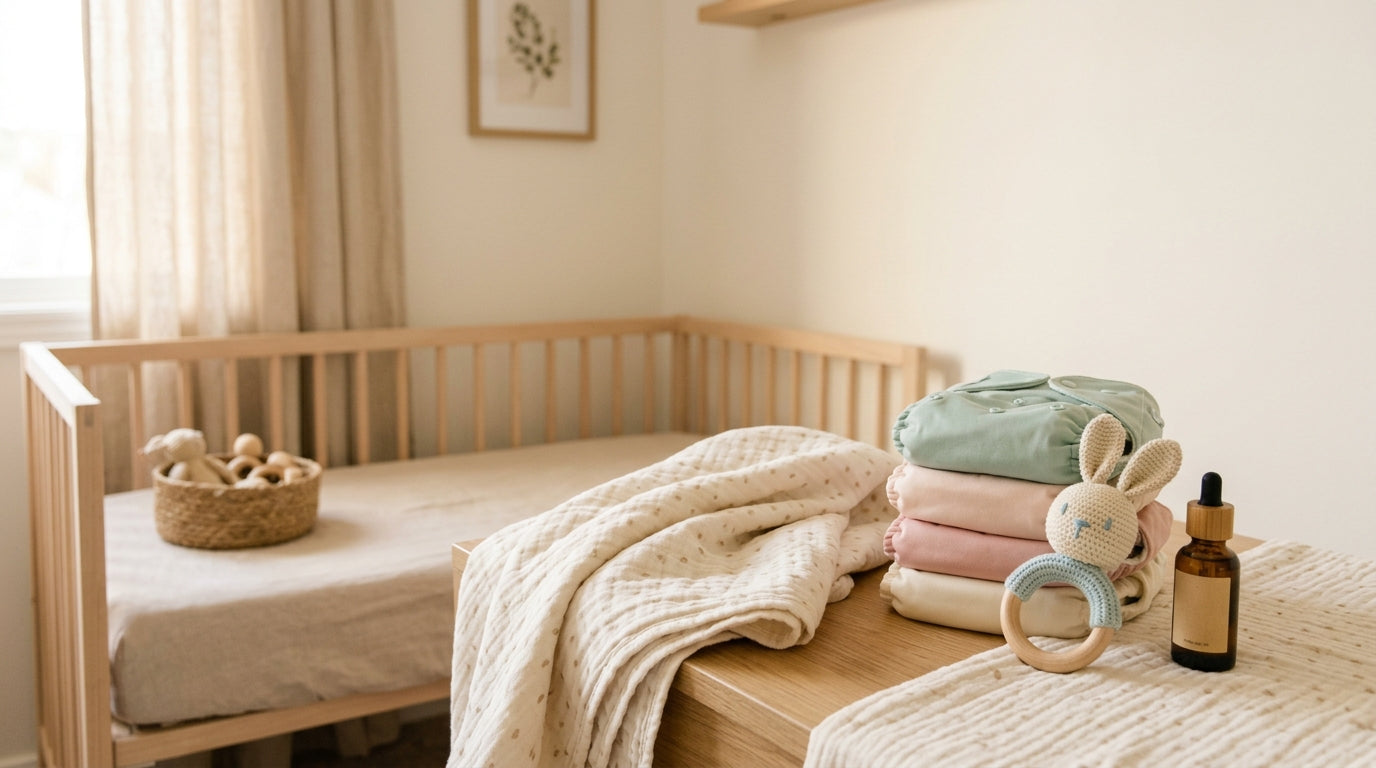
But honestly, the thing that has actually worked the best, and doesn't make my living room look like a radioactive nursery school, is the Bunny Teething Rattle. I genuinely love this thing. It's just untreated beechwood and a crochet cotton bunny. The wood is apparently the perfect hardness for Maya to gnaw on like a beaver, and because it's just wood and yarn, I don't have to worry about what sort of chemical soup she's ingesting. Plus, it looks quite stylish, which is nice when you're wearing sweatpants stained with God-knows-what.
We also have the Squirrel Silicone Teether. It's completely fine. It does the job, and the silicone is soft on their gums. But I'll say this: food-grade silicone is a magnet for dog hair. If you've a golden retriever, or just a generally dusty floor, you'll spend half your life rinsing this squirrel under the cold tap at 4 AM because your baby dropped it behind the sofa. It's easy to clean, throwing it in the dishwasher is a breeze, but it's high maintenance on the dropping front.
Penny (Baby P) prefers the Koala Teething Rattle. It's basically the same wooden ring setup as the bunny, but it has a little rattle inside the crochet head. It's lovely during the day. At 3 AM, when you've just managed to get her eyes to close and she suddenly violently shakes the koala next to your ear, the rattling sound is enough to send your heart rate into the stratosphere. Use with caution after dark.
Putting them down without waking them up
The actual mechanics of getting the baby from your arms into the crib without waking them is a dark art that takes months to master. The safe sleep guidelines terrify you right out the gate. Dr. Evans practically pinned us to the wall making sure we understood: firm, flat surface, no blankets, no bumpers, absolutely nothing in the cot. It basically looks like a tiny, extremely boring padded cell.
So they're lying on a hard mattress in a stark empty box, and we wonder why they prefer sleeping on our warm, soft chests.
We couldn't afford those robotic smart bassinets that cost as much as a used car and rock the baby for you. Instead, we relied heavily on Velcro swaddles, because trying to perform infant origami with a loose blanket at 4 AM is a fool's errand. You wrap them up tight so their startle reflex doesn't punch them in the face, turn the white noise machine up loud enough to mimic a jet engine, and pray.
The transfer itself requires the physical control of a jewel thief. You lower them down inch by agonizing inch. You let their bum touch the mattress first, then the back, then the head. You keep your hand on their chest for an excruciatingly long minute, feeling the rise and fall, holding your own breath until you're dizzy. And then you back out of the room like you're retreating from a sleeping bear.
When it works, you feel like a god. You walk back into your bedroom, tap your partner on the shoulder, and smugly whisper the three sweetest words in the English language.
Your turn now.
Before your next night shift begins, make sure you're armed with the right gear. Check out Kianao's full range of organic teething toys to save your sanity.
The chaotic 3 AM FAQ
Is four hours of uninterrupted sleep actually enough to function?
Medically? Probably not. The human brain turns to a thick, unhelpful porridge somewhere around week three of this. But comparatively? Getting four solid hours after a week of waking up every forty-five minutes feels like waking up from a spa retreat. You learn to lower your standards for what constitutes a functioning adult. If I put my shoes on the correct feet, it's a win.
What if my partner sleeps through their shift?
You wake them up. You don't suffer in noble silence. I used to lie there seething, watching my wife sleep peacefully while Maya screamed, thinking I was being a martyr. Resentment builds faster than dirty nappies in a bin. Kick them under the duvet, hand over the monitor, and roll over.
How do I handle the baby screaming the second I leave the room?
From what I've haphazardly pieced together, they lack object permanence. When you leave the room, they literally think you've ceased to exist in the universe. It's terrifying for them. If I know they're fed, clean, and safe, I give it three to five minutes before going back in. Usually, by minute four, they've found their thumb and passed out. If I go rushing back in at the first whimper, we end up doing a terrible dance until dawn.
Can I just let them sleep in the baby carrier on my chest all night?
God, I wanted to. They sleep so quietly when strapped to you. But every doctor we spoke to looked absolutely horrified at the idea of sleeping while wearing the baby. The suffocation risks are real, and my anxiety was already high enough without worrying I was going to roll over on my own kid. If you're wearing them, you've to be awake. Drink some water, put on a podcast, and accept your fate.
When does the night shift phase end?
People love to tell you "it gets better by three months" or "they'll sleep through the night when they start solids." This is mostly a lie designed to keep you from walking into the sea. Every baby is entirely different. Ours started stringing together six-hour stretches around six months, and then promptly unlearned it all when their teeth came in. It's not a straight line, it's a jagged graph of minor victories and crushing defeats. Just keep splitting the night.




Share:
My Toddler Found the Lil Baby New Album on Our Smart Speaker
The Late Night Search History of a Clueless Dad