

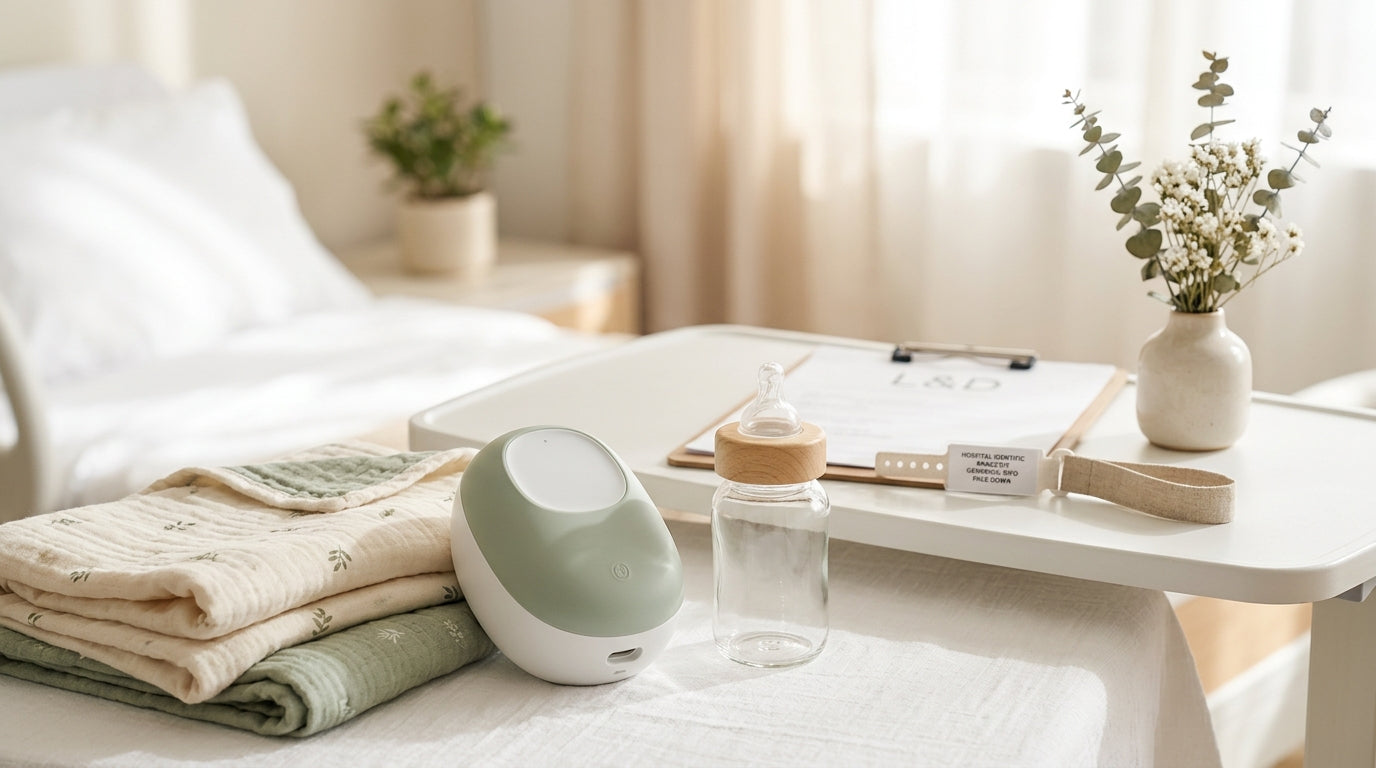
The machine strapped to my wife’s chest sounded exactly like a PlayStation 4 struggling to render a massive game file. It was a rhythmic, mechanical grinding noise that echoed off the sterile walls of our postpartum recovery room. We were operating on roughly 41 cumulative minutes of sleep over a 48-hour period. I was staring at a spreadsheet on my phone where I had been obsessively logging the exact timestamp and color hex-code of a baby's meconium outputs, because apparently, that data is highly relevant to pediatricians. My wife was crying because the vacuum suction on her wearable pump felt like it was trying to extract her soul. And right at that exact moment, a very cheerful woman holding a massive DSLR camera knocked on our door, asking if we wanted to capture the magic of our first days as a family.
This is the bizarre intersection of modern early parenthood. You're simultaneously trying to document aesthetic, glowing memories for the Bella-brand photo people while actively troubleshooting biological fluid extraction with budget-friendly Bellababy hardware you bought at 3 AM on Amazon.

The ambush of aesthetic photography when your system is down
The hospital contracted photographer was incredibly nice, which almost made it worse. She wanted to do one of those "Fresh 48" sessions right there in the room. My wife was wearing hospital-issue mesh underwear and a gown that had seen better days. I was wearing a flannel shirt that smelled distinctly of stale coffee and panic sweat. We looked like survivors of a minor localized apocalypse, not glowing parents ready for a magazine spread.
My mother-in-law had visited earlier and left this massive, terrifying dress for our daughter to wear for photos. It had tulle. It had lace. It looked like a miniature Victorian lampshade. Because my brain was functioning at a dial-up modem speed, I tried to put it on our tiny, fragile daughter. The baby immediately started screaming—a high-pitched, system-failure siren that pierced right through my skull. The tulle was scratching her skin, and the rigid fabric was bending her arms in ways that defied basic human physics.
My wife yelled at me to take it off her immediately. I fumbled with the tiny plastic snaps with my shaking, oversized hands, terrified I was going to snap a collarbone. We stripped her down and grabbed the Organic Cotton Baby Bodysuit Sleeveless Infant Onesie we had packed in our own bag. I had bought it from Kianao purely because it felt soft when I touched it, but in that moment, it became a literal rescue device. It’s 95 percent organic cotton with a little bit of stretch, and the second I pulled it over her head, the screaming stopped. Her firmware rebooted. The flat seams didn't dig into her back, and the lack of synthetic dyes meant her highly reactive, brand-new skin wasn't breaking out in red hives.
We took the photos with her wearing just that simple, undyed bodysuit. No props. No Victorian lampshades. Just a tiny, comfortable human sleeping on my wife’s chest. The photographer snapped away, and honestly, looking back at those pictures now, they're perfect. We look exhausted and terrified, but the baby looks peaceful.
Hardware specs for wearable breast pumps
Once the photographer left, we had to get back to the immediate crisis: the pumping hardware. If you're a dad reading this, let me save you a massive headache. Don't assume breast pumps are one-size-fits-all devices. They're highly calibrated vacuum chambers, and if the physical interface doesn't match the user's anatomy, it causes literal tissue damage.

My wife had purchased a wearable pump because the idea of being tethered to a wall outlet like a dying smartphone was depressing. The problem was the plastic flanges—the cone-shaped pieces that attach to the skin. The pump came with standard 24mm flanges. My wife was in agony. I ended up pulling out my digital calipers—the ones I use for 3D printing projects—and measuring her nipples in the harsh fluorescent hospital light to calculate the exact millimeter diameter required for a proper seal. Apparently, if the tunnel is too wide, the machine pulls too much areola into the plastic tube, causing swelling and blocking the milk ducts.
I ordered 21mm silicone inserts on my phone with next-day delivery. When they arrived, the difference was night and day. The machine stopped causing pain, the output metrics tripled, and my wife stopped dreading the 3 AM alarm.
But the hardware maintenance is a whole different beast. Our doctor, Dr. Lin, looked me dead in the eye and told me that because our baby was a newborn, every single part of that pump had to be sterilized constantly. Not just washed. Sterilized. Apparently, milk protein is a perfect breeding ground for bacteria, and an infant's immune system is basically non-existent. I spent the first three months of my daughter's life feeling like a hazmat technician. Every three hours, I was at the sink, dismantling tiny silicone duckbill valves, washing them with specialized soap, and tossing them into a microwave steam bag. If you drop a valve down the drain, your whole production line halts. Buy backup valves. Buy ten of them.
Survival metrics versus internet reality
Nobody actually looks like those perfectly curated social media reels unless they hired a professional lighting crew to hide the dark circles under their eyes.
The internet is a dangerous place for new parents. I found myself tumbling down rabbit holes at 4 AM, reading forums about why my baby was breathing weirdly. She would take three fast breaths and then pause for five seconds. Dr. Google told me it was imminent respiratory failure. I panicked and called the after-hours nurse line, only to be told that newborns have "periodic breathing" because they're literally still figuring out how to operate their lungs. They forget to breathe for a second, remember, and catch up. It’s terrifying, but apparently completely normal.
We were asking hundreds of questions a day. Is she too hot? Is she too cold? Why is her poop green today? Did the pump parts dry completely or is that a microscopic water droplet that will harbor mold? The anxiety is a heavy blanket that sits on your chest. You have to force yourself to stop looking at the internet and just look at the kid in front of you. If they're eating, outputting waste, and sleeping occasionally, you're mostly doing fine.
The weird timeline of teething and wooden toys
Fast forward a few months, and you think you've the system figured out. The pumping schedule is regulated. The baby is sleeping for a continuous four-hour stretch. You feel like a genius. And then, a new biological process initiates and ruins everything: teeth.

Around month five, our daughter turned into a rabid wolverine. She was gnawing on her own hands, my shoulder, the dog’s ear, the couch cushions. Her sleep metrics completely fell apart. We tried cold washcloths, but she would just drop them on the floor and then scream because they were dirty. That’s when we introduced the Panda Teether Silicone Baby Bamboo Chew Toy Soothing Gum Relief.
I'm generally skeptical of baby products that claim to be "soothing," but this thing is an absolute unit of a troubleshooting tool. I started keeping it in the refrigerator right next to my wife’s breastmilk storage bags. At 2 AM, when the baby woke up thrashing and crying because a sharp calcium deposit was pushing its way through her gums, I'd hand her the cold silicone panda. She would grab the flat, bamboo-detailed handle, shove the textured ear into her mouth, and instantly quiet down. The cold numbed the swelling, and the food-grade silicone was tough enough to withstand her aggressive chewing without degrading. We washed it in the dishwasher with the pump parts. It became standard issue gear for any trip out of the house.
We also got the Wooden Baby Gym | Rainbow Play Gym Set with Animal Toys around this time. I’ll be honest, it’s just okay. From an aesthetic standpoint, it looks fantastic in our living room. It’s made of actual wood instead of garish plastic, and it doesn’t play a horrific, compressed digital song when you bump it. But for the first month we had it, our daughter mostly just laid underneath it and stared blankly at the hanging elephant like it owed her money. Eventually, she figured out how to reach up and bat the geometric shapes around, which was cool to watch from a motor-development standpoint. But once she learned to roll over, she completely abandoned the hanging toys and just aggressively chewed on the wooden legs of the A-frame instead. It works, but maybe not in the way the designers intended.
Logging out of the panic cycle
If there's one thing I’ve learned in the past eleven months, it’s that you can't optimize a baby. They're messy, unpredictable, analog systems. You can track all the data you want, buy the most efficient pumping hardware, and hire someone to take beautiful photos, but the reality of parenthood happens in the unrecorded, chaotic moments in between. It’s the 3 AM sink-washing sessions. It’s throwing away the scratchy tulle dress. It’s realizing your kid just wants a cold silicone panda to chew on instead of a complex developmental toy.
Keep the gear simple, trust your doctor over a search engine, and try to get some sleep whenever the machine lets you.
Messy questions I googled at 3 AM
Do you actually have to sterilize pump parts every single time?
Dr. Lin told us that for the first three months, yes, apparently you do. I spent half my life boiling silicone valves and flanges. It feels like absolute overkill until you google what happens if you don't (which my wife did), and then you'll never trust a slightly damp piece of plastic again. Buy a microwave steam bag, it saves hours of boiling water.
Are the hospital photos worth the money when you feel like a zombie?
Honestly, yes. We looked like we had just survived a shipwreck, but when I look at the photo of my daughter in her simple white onesie, I don't see the dark circles under my wife's eyes anymore. I just see the tiny human. The hospital photographers are incredibly fast and used to working around medical equipment and exhausted parents.
How do you know what size pump flange to get?
I literally used digital calipers to measure my wife. If the pumping process hurts, the hardware is configured wrong. The vacuum seal needs to pull the tissue smoothly without scraping the sides of the plastic tunnel. Your body also changes size after birth, so the size you need on day two might be totally different from the size you need on day thirty.
Why do babies hate cute outfits?
Because cute usually means stiff, synthetic, and itchy. A newborn's skin is hyper-sensitive and reactive to everything. We put our daughter in a fancy lace dress and she broke out in a rash in four minutes. Stick to plain, organic cotton that stretches. Save the fancy clothes for when they're old enough to complain with words instead of sirens.
Is it normal for my baby to stop breathing for a few seconds while sleeping?
Our doctor laughed at me when I called about this. It's called periodic breathing. Newborns haven't quite mastered the continuous rhythm of respiration yet, so they take a few fast breaths, pause for a terrifying five seconds, and then start again. It’s completely normal, even though it'll spike your heart rate every single time you watch the baby monitor.




Share:
The Truth About Beechnut Baby Food When You Have Twin Girls
My Search for the Best Baby Books (A Warning to Past Marcus)