

Before our son was born, I asked three different people what we needed for the nightly bath routine, which resulted in three entirely conflicting data points. My mother-in-law excitedly handed me a vintage, hollow plastic rubber duck she’d saved from 1993. A guy on a dad subreddit warned me that anything touching municipal tap water would immediately spawn a localized bio-hazard and recommended bathing the child in a sterile, empty bucket. Then, our doctor, Dr. Miller, just sighed, waved her pen, and told me a plastic cup and a wet washcloth were all the entertainment an infant needed. I was left standing in the bathroom at 7 PM holding a digital thermometer, staring at an eleven-month-old who currently looked like a shivering, wet baby bat, wondering how something as simple as washing a tiny human had become a complex systems failure waiting to happen.
When I finally sat down and searched for recommended baby bath toys online, my feed flooded with hollow squirt toys, foam letters, and motorized submarines. None of the descriptions mentioned the fact that keeping these things hygienic requires the same maintenance schedule as a commercial aquarium.
The squirt toy is actually a biological weapon
I'm going to rant about this because it still keeps me up at night. About two months ago, my son was chewing on a cute little rubber frog while splashing in his baby bath. I squeezed it to make it squirt water, and a chunk of gray, sludgy particulate shot out into the warm water. I panicked, obviously, and grabbed my phone to google what I had just exposed my child to. Apparently, there was this massive study funded by the Swiss National Science Foundation that looked inside these hollow plastic bath toys, and the results read like a horror movie script.
The dark, warm, wet void inside a standard squirt toy is basically a luxury resort for bacteria and fungi. Because you can never fully squeeze all the water out, the inside never dries, which leads to a massive buildup of black mold and something called Pseudomonas aeruginosa, which I still can't pronounce. My doctor told me later that while drinking a little tub water usually just results in a gross diaper, the real bug we've to worry about is Staphylococcus aureus getting into an eye or a scratched mosquito bite. I spent the rest of that evening aggressively cutting open every hollow toy we owned with kitchen shears, finding varying levels of black slime in almost all of them, and throwing the entire contaminated batch directly into the garbage.
Updating our hardware to solid silicone and recycled plastic
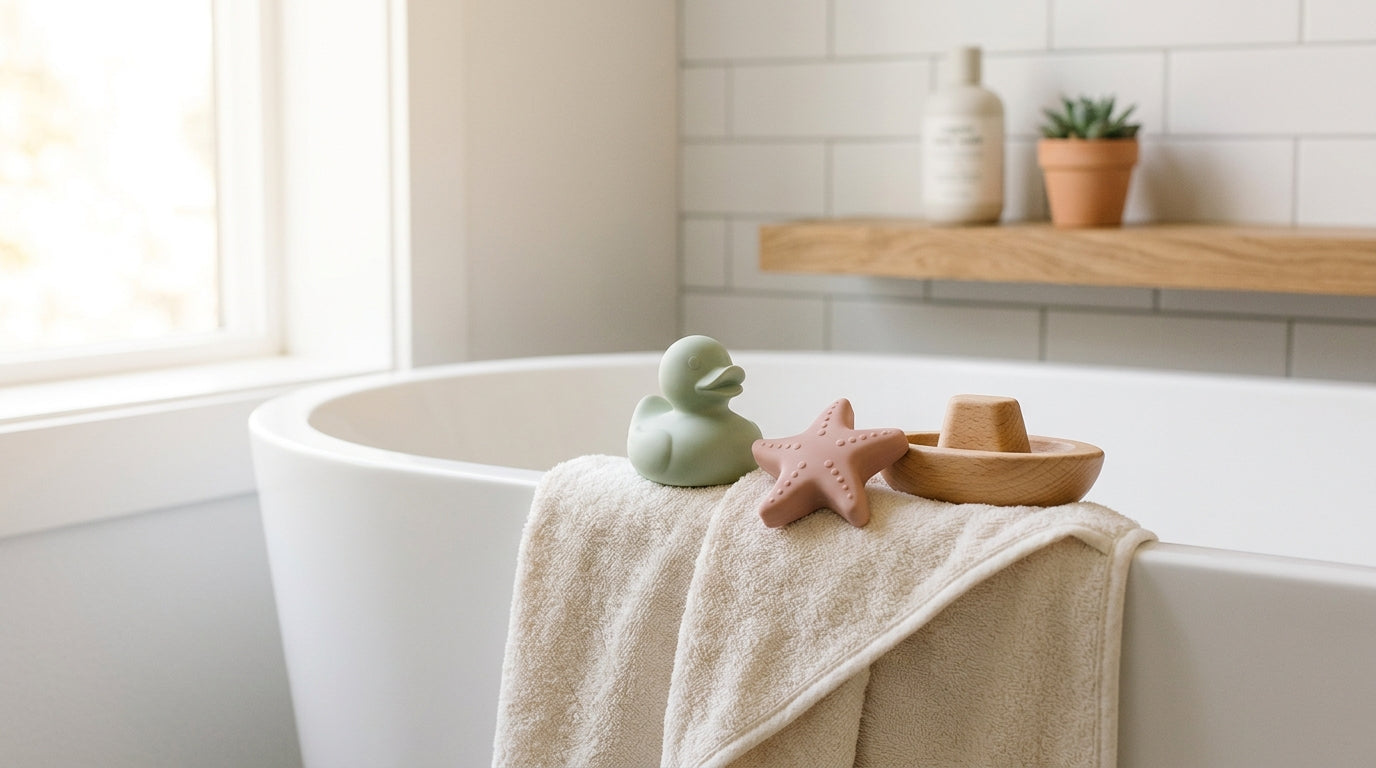
Once you realize you can never unsee the mold sludge, you've to completely overhaul your approach to bathtub entertainment by switching out the hollow junk for solid materials that actually dry. For us, that meant pivoting hard to food-grade silicone and solid, hard plastics. Silicone is great because, from what I understand, it doesn’t leach weird endocrine-disrupting chemicals when exposed to the warm 98-degree water, and it can survive the top rack of the dishwasher without melting into a toxic puddle.

My absolute favorite upgrade has been the Gentle Baby Building Block Set. These are technically designed as soft, early-education math and stacking blocks, but because they're made of solid, non-toxic rubber with zero hollow voids, they're completely waterproof and float. My son spends the entire bath trying to stack them on the slippery edge of the tub, getting incredibly frustrated when they fall back into the water with a splash. It occupies him long enough for me to actually wash the shampoo out of his hair without him trying to stand up and slip.
We also keep the Squirrel Teether Silicone Baby Gum Soother on the edge of the tub. I’ll be honest, this is just okay as a bath toy specifically. It’s an amazing teether when we’re in the living room, but in the water, he mostly just uses the little acorn texture to trap soapy water and attempt to drink it before my wife intercepts his hand. But it’s made of that solid, one-piece food-grade silicone, so I never have to worry about hidden mold growing inside it. If you're trying to upgrade your own bathtub hardware without introducing black mold to your bathroom ecosystem, definitely check out Kianao’s collection of sustainable baby gear to find solid, easily washable options.
The incredibly specific cleaning protocol my wife enforces
Even if you buy the safest solid silicone toys, you still have to clean them, which is a reality I foolishly thought the dishwasher would entirely solve for me. I initially assumed I could just nuke everything in bleach for an hour, but my wife kindly informed me that I was going to ruin the silicone and probably poison our baby if I kept guessing at the chemistry. We ended up reading some advice from a home care expert named Carolyn Forté, and I honestly put a recurring reminder on my calendar to run the toy cleaning protocol.

Apparently, if you're trying to be somewhat eco-friendly and just do a weekly maintenance wash, you've to submerge the toys in a fifty-fifty mix of warm water and cleaning vinegar for exactly 15 to 30 minutes, followed by a heavy rinse and air drying. If there has been a biological incident in the tub—which happens more often than I care to admit—you've to run the deep-disinfecting bleach method. This requires precisely one tablespoon of bleach per gallon of water, and you only soak them for 5 to 10 minutes before rinsing them like they owe you money. I messed the timing up once and left a silicone teether in the bleach solution for an hour while I was fixing a broken code deployment, and it smelled like a swimming pool for a week. So stick to the actual timestamps.
Trying to maintain bath safety without losing my mind
The toys are honestly secondary to the absolute panic of keeping the environment physically safe. I track data obsessively, and the water temperature is my daily stressor. Our doctor told us babies have paper-thin skin that burns way faster than ours, so the water should always hover between 95 and 100 degrees Fahrenheit. I bought a little digital floating turtle thermometer to track this because I don't trust my elbow to gauge thermal dynamics accurately. We also went down to the basement and capped our home water heater at 120 degrees so I can't accidentally scald him if I bump the faucet handle the wrong way.
But the most terrifying stat I stumbled across was that infants can drown completely silently in just an inch or two of water. Dr. Miller instituted a policy she called "touch supervision," meaning either my wife or I must have at least one physical hand on him the entire time he's in the water, which makes reaching for the Panda Teether or the shampoo bottle a weird game of bathtub twister. Oh, and also skip those colorful fizzing bath bombs entirely because my doctor said the dyes and perfumes severely alter the pH balance of the water and cause massive urinary tract infections.
Ultimately, bath time has shifted from a relaxing evening wind-down into a highly monitored hygiene sprint. We ditched the hollow toys, set strict timers for vinegar soaks, and accepted that solid blocks are infinitely better than a cute rubber duck that harbors an infectious sludge monster. If you're currently staring at a mesh bag full of mysterious squirt toys, throw them out and grab some solid silicone alternatives from Kianao before you start your next bedtime routine.
Messy questions I had to google at 2 AM
How do I know if my baby's bath toys are growing mold?
If the toy has a hole in it and you can't open it completely to dry the inside, it's probably already growing mold. I tried holding our old squirt toys up to a bright flashlight, and you can usually see dark, shadowy clumps stuck to the inner walls. If it smells faintly like an old basement or shoots out water that looks even slightly cloudy, just throw it away. It’s not worth trying to salvage.
Can I just plug the holes in squirt toys with hot glue?
I genuinely tried this. I spent an hour drying out a new set of rubber ducks and sealing the bottom holes with a hot glue gun. It worked for about two weeks until my son gnawed the glue plug right off, nearly choked on the glue bead, and the toy filled with bathwater anyway. It's much easier to just buy solid silicone toys from the start rather than trying to reverse-engineer cheap plastic.
Are natural rubber bath toys safe?
They're definitely a better eco-friendly alternative to weird plastics, but they've their own bugs. My wife pointed out that you can't put natural rubber in the dishwasher or use high heat to sanitize it because it degrades and gets super sticky. Plus, you've to watch out for latex allergies. If you buy them, you've to commit to hand-washing them and making absolutely sure they don't have squeaker holes that trap water.
Why does my baby try to drink the bathwater out of their toys?
Because they lack any sense of self-preservation. My son treats every cup, block, and silicone teether in the tub as a soup spoon for soapy water. Dr. Miller told us it's just normal cause-and-effect exploration, but it's exactly why we've to be so paranoid about mold and keeping the toys sanitized. Just gently redirect them or swap the toy for a dry washcloth to chew on.
Where am I supposed to store wet bath toys?
Not in the bathtub. I used to just leave them piled in the corner of the tub, but the residual humidity meant they never seriously dried. Now we use a mesh bag that hangs on a suction cup high up on the tile wall, as far away from the showerhead as possible. As long as it has giant drainage holes and gets decent airflow, your solid silicone toys will dry out perfectly before the next night's bath.




Share:
The Great Baby Basket Delusion: From Wicker Beds to Foam Hoops
Finding a baby bat in your house and other midnight terrors