

I was lying flat on my back on the reasonably clean portion of the nursery rug, my cheek pressed against a discarded Calpol syringe, watching a plastic hippo spin furiously at forty revolutions per minute while a tinny, slightly off-key version of 'Für Elise' battered my eardrums. It was 3:18 in the morning. Above me, my twin daughters were entirely rigid, eyes wide as saucers, utterly mesmerized and absolutely, unequivocally awake. We had installed this rotating discotheque because someone at a pub told me it would soothe them to sleep, which just goes to show you should never take parenting advice from a bloke named Baz who hasn't slept since 2018.
We bought into the myth that an electronic light-and-sound show suspended above the cot was the silver bullet for infant sleep. My logic, if you can call the sleep-deprived firing of three lonely neurons "logic," was that if I bored them with a repetitive motion, they would simply pass out. Instead, I accidentally built an all-night baby rave.
The problem with these battery-operated monstrosities is that they're actively trying to entertain someone who just arrived on the planet. When you're only a few weeks old, your nervous system is basically a frayed wire. You don't need flashing LEDs and a robotic voice singing about stars to feel tired. You're already exhausted from the sheer physical effort of digesting milk. Sticking a loud, brightly coloured carousel in their face just pumps them full of adrenaline. I watched my girls go from mildly drowsy to hyper-alert, their little fists punching the air as if they were raving at a muddy festival.
And let's talk about the sound quality for a moment. These devices eat batteries at a frankly alarming rate, and when the power starts to wane, the cheerful lullaby morphs into a sluggish, demonic dirge that sounds like it's summoning spirits from the underworld. Try drifting off to sleep while a dying plastic toucan groans a slow-motion nursery rhyme in the dark. It's genuinely terrifying.
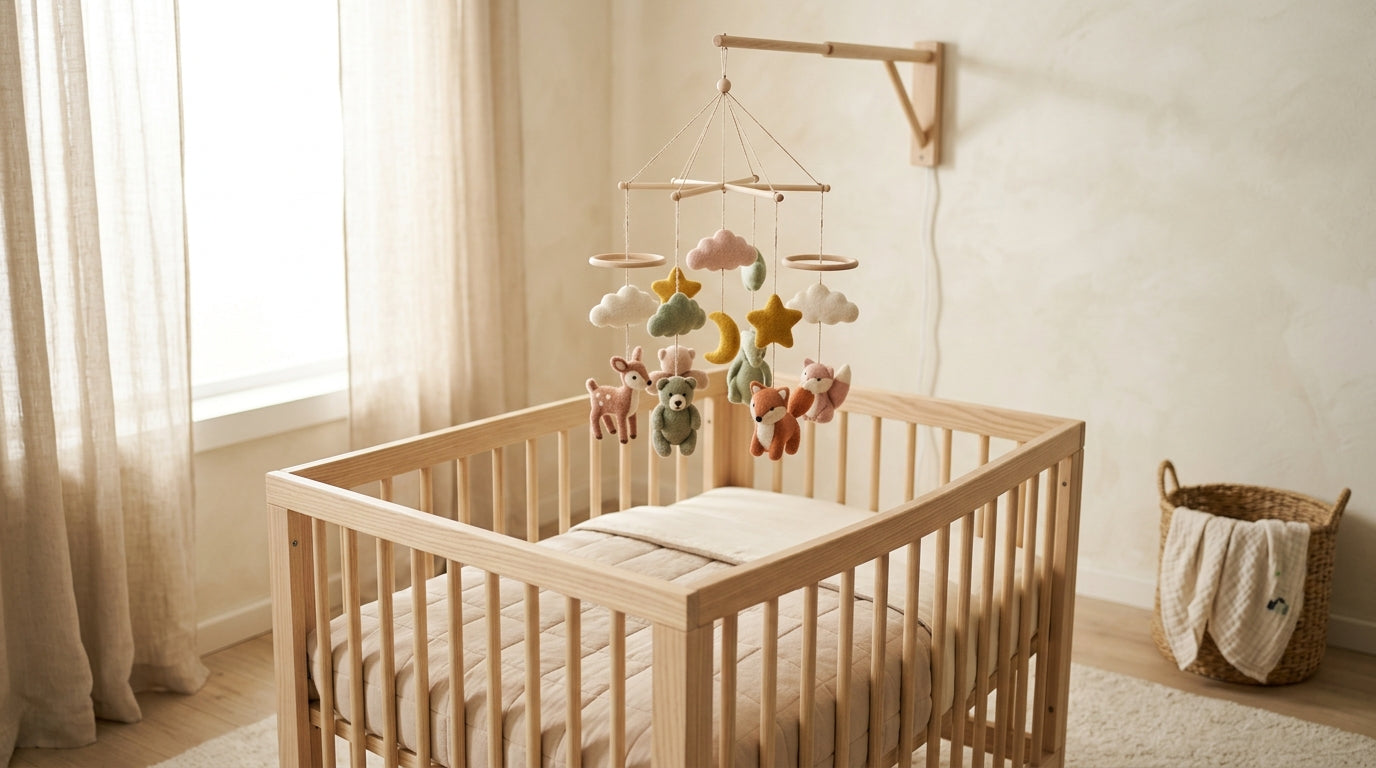
Meanwhile, the beautifully delicate pastel felt hanging toys you see all over Instagram are entirely useless since newborns are practically blind and can't even see washed-out beige.
They're looking at fuzzy bottoms
Our NHS health visitor, a lovely but intimidating woman who always looked at my coffee-stained jumper with mild despair, explained that a newborn's eyesight is fundamentally rubbish. Apparently, babies can only focus on things that are roughly eight to twelve inches from their face, and anything beyond that's just a murky blur. They also don't process subtle colours at all, which makes shopping for a baby m—which is what my phone mysteriously autocorrects the word "mobile" to these days—an exercise in aesthetic compromise.
This means those tasteful, muted mustard and sage green fabric shapes we bought to match the expensive wallpaper were completely invisible to the twins. It's like hanging a watercolor painting in a dark room and expecting an art critique. What they actually need, or so my chaotic understanding of pediatric ophthalmology goes, is high-contrast stuff. Stark black and white patterns, or violently bold shapes that grab their developing retinas. We eventually taped some highly contrasting black-and-white flashcards to a wooden coat hanger, which looked like a ransom note but fascinated the girls immensely.
There's another absurd design flaw with most commercial cot decorations that nobody warns you about. Have you ever actually lain in the bed and looked up at them? We buy these things because the little lions and bears look adorable from the side, which is where we stand as tall adults. But the infant is underneath. From their perspective, they're just staring at the undercarriages of stuffed animals. It's an endless parade of fuzzy bottoms floating past in circles. You want something where the interesting visual bits—the patterns, the contrasting shapes—are actually painted or sewn onto the underside so they can be seen from below.
If you're trying to create a high-contrast environment that isn't entirely chaotic, you sort of have to balance the ugly-but-works well developmental tools with things that don't make your eyes bleed. We had the Colorful Swan Bamboo Baby Blanket draped over the nursing chair for a while to soften the room's look. It's fine. The organic bamboo is genuinely soft, and the breathability meant it didn't turn into a sweat-lodge when one of the twins inevitably fell asleep on me after a feed. But if I'm being brutally honest, the pale pink swan pattern, while lovely for a nursery aesthetic, was completely lost on the girls in those early months. It mostly served as an incredibly luxurious, temperature-regulating burp cloth to catch the endless tide of posset.
The five month countdown clock
Here's something nobody tells you when you're excitedly assembling flat-pack nursery furniture while eating biscuits: that spinning contraption is essentially a ticking time bomb. According to our paediatrician, who delivered this news with the casualness of someone commenting on the weather, you've to rip the entire thing down the absolute second they figure out how to sit up or get on their hands and knees.

For us, that was right around the five-month mark. The moment they can grab hold of those dangling objects, it ceases to be a helpful developmental tool for visual tracking and immediately becomes a terrifying strangulation hazard. I spent an entire Sunday morning measuring the distance from the mattress to the lowest hanging zebra with a tape measure like a deranged health and safety inspector.
- The absolute height limit: Keep the lowest point roughly 12 to 16 inches above the sleeping surface. It needs to be close enough for them to really see it with their blurry vision, but high enough to prevent tiny, surprisingly strong fists from yanking it down onto their own faces.
- The string measurement: Any string or ribbon hanging down can't be longer than seven inches. Not eight. Seven. If they wrap it around a finger or a neck, it's game over.
- The structural integrity check: If it has small detachable parts, throw it straight in the bin. You would be amazed how quickly a bored infant can detach a plastic eyeball from a cheap felt frog and attempt to swallow it whole.
I found out later that neonatal hospital wards basically only use medical-grade, phthalate-free plastic models because those lovely, trendy woven fabric ones you get on craft websites can harbor an alarming amount of bacteria and dust. I just took ours down completely when one of the twins managed to sit up unassisted, grabbed a wooden ring, and pulled the entire arm bracket down in a clatter of wood and screaming. It was a very stressful Tuesday afternoon.
Before we dive into what seriously works instead of what induces parental panic attacks, if you're trying to figure out how to furnish a room that's both safe and doesn't look like a primary-coloured plastic explosion, you might want to casually browse some organic baby essentials that won't give you a headache.
Ditching the motor for an open window
Once we abandoned the electronic baby rave, we pivoted to something entirely analog. I'm convinced that the human brain, even one that's only twelve weeks old, isn't built to process the aggressive, jerky movements of a cheap mechanical motor. What finally worked for us was a ridiculously simple, un-powered hanging frame made of high-contrast geometric shapes that just moved gently with the air currents in the room.

It was an absolute revelation. When we opened the bedroom door or when a breeze came through the slightly cracked window, the shapes would drift and rotate slowly of their own accord. It was hypnotic, rather than stimulating. The girls would practice their visual tracking—following the slow, unpredictable movement with their eyes—without getting amped up. It felt like watching leaves blow in the wind, which is something our ancestors probably did, unlike staring at a neon plastic hippo vibrating on a plastic stick.
This shift toward things that just naturally do what they're supposed to do without needing fresh batteries extended to the rest of the cot, too. Take the Colorful Leaves Bamboo Baby Blanket. This is the one item we honestly fought over in our house. It's brilliant. The watercolour leaf pattern provided just enough visual interest for the twins when they were lying on it during tummy time, but the real magic is the fabric itself. It has this uncanny ability to adapt to whatever the temperature is doing. When our flat in London turned into a humid greenhouse last July, the moisture-wicking bamboo meant I could drape it over them without them waking up soaked in sweat. It has been washed roughly four hundred times to remove various horrifying bodily fluids and sticky Calpol stains, and it somehow just gets softer every single time.
The great sleep association blunder
Our final hurdle was realizing that we were sending wildly mixed messages to our children. The cot is supposed to be for sleeping. By hanging a highly entertaining, visually captivating toy directly over their heads, we were essentially putting a television in their bedroom and then getting annoyed when they wouldn't go to sleep.
My entirely unprofessional conclusion, backed only by my own desperate late-night reading, is that these hanging objects are strictly daytime toys. We started using ours purely for short bursts of awake-time entertainment. When I needed to put clothes away or just stare blankly at a wall for fifteen minutes to remember what silence sounded like, I'd put them under the floating shapes. But when it was time to really sleep, the entertainment went away. The area above the bed became intensely boring. Shockingly, making the sleeping area incredibly boring makes babies want to close their eyes.
If you want to introduce a bit of visual flair that doesn't actively prevent sleep, keeping the patterns on the bedding rather than suspended in the air is a much safer bet. We used the Colorful Universe Bamboo Blanket, which has these lovely orange and yellow planets on it. It gives them something interesting to look at during the wind-down routine while they roll around, but because it's laying flat on them rather than dancing above them in the dark, it doesn't trigger that primal 'must stay awake and party' instinct. Plus, the hypoallergenic bamboo cotton blend is an absolute godsend when you're trying to manage random, unexplained baby rashes that pop up out of nowhere.
The golden rule is this: if the thing suspended above the bed requires an instruction manual thicker than a pub coaster, it's probably too complicated. Keep it simple, keep it analog, and for the love of everything holy, take it down before they learn to sit up. If you're currently reconsidering your entire nursery setup and want fabrics that seriously help them rest, take a look at our full range of sustainable baby blankets that provide comfort without the overstimulation.
Questions I frantically googled at 4 AM
Do I absolutely have to take the hanging toys down at five months?
Yes, you absolutely do. My paediatrician was terrifyingly clear about this point. The exact moment your baby can push up on their hands and knees, that innocent hanging decoration becomes a genuine hazard. They'll grab it and pull it down onto themselves. It's only not worth the risk, no matter how much you paid for it or how perfectly it matches the curtains.
Is white noise from a spinning overhead toy really helpful?
In my messy experience, yes, but not if it comes from the toy itself. The tiny mechanical speakers on those things are universally terrible. We found that a standalone sound machine shoved in the corner of the room worked a million times better than the tinny, repetitive static coming from the spinning plastic thing above their heads.
What colour should the hanging objects be for a newborn?
Forget the lovely muted pastels you see online. Babies have terrible vision for the first few months. You need aggressive, high-contrast colours. Black and white geometric patterns, or stark dark blues against white. It looks slightly less cute on your social media feed, but it's the only thing their little developing retinas can seriously process and track.
Can I just leave them under it to get some peace?
For about fifteen to twenty minutes, sure. I definitely used ours as a temporary babysitter so I could brush my teeth and pretend to be a functioning adult for a moment. But if you leave them staring at it for too long, they get massively overstimulated and will punish you with inconsolable, jagged crying later. Think of it as a brief, intense distraction, not a permanent nursery fixture.




Share:
Throw Away the Weekly Milestone App Before You Lose Your Mind
The Midnight Madness of Baby MORI Sacks and Tog Ratings