

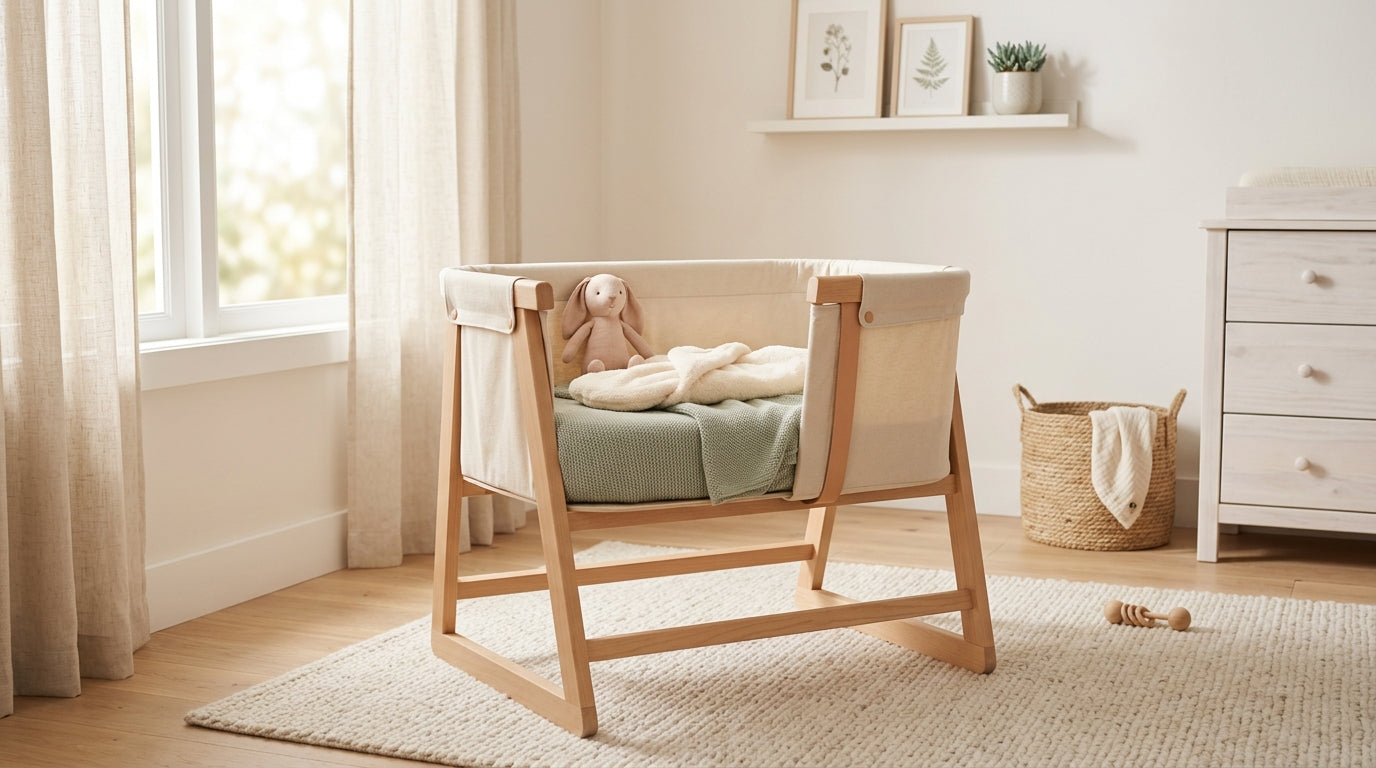
I was staring at the ceiling fan at three in the morning, calculating how many consecutive minutes of sleep I had logged since Tuesday. It was twenty-eight. Next to me, my daughter was grunting like a tiny, angry pug in her mesh sleeper.
Before having my own kid, I judged the parents who walked into the pediatric clinic obsessed with infant sleep gear. As a nurse, I thought I had it all figured out. You just put them on a firm, flat surface. That was the whole list. I'd sit there with my clipboard, nodding politely while exhausted mothers asked me about specific mattress thread counts and white noise frequencies, silently thinking they were overcomplicating a basic biological process.
Then I gave birth. Sleep deprivation hit me like a truck, and suddenly I was the one googling the structural integrity of spun plastic at two in the morning. I get it now. When you haven't slept in three days, you'll pay any amount of money to fix the problem.
I also realized that when parents start frantically searching for a baby bass, they're usually having one of two distinct middle-of-the-night panics. Half of you're trying to find a baby bassinet that will magically make your child sleep until dawn. The other half just realized your partner's car subwoofer might be scrambling your newborn's brain and you're looking for permission to cut the wires. We should probably talk about both.
The thousand dollar robotic bed
Let's start with the furniture. If you spend more than five minutes looking up infant sleep, the algorithm will serve you the snoo baby bassinet. It's the holy grail of modern parental desperation.
I had parents at the clinic who talked about this thing like it was a religious artifact. The premise is that it clips your kid into a straightjacket sleep sack and then robotically shakes them while blasting white noise whenever they cry. It costs roughly the same as my first car.
I'm highly skeptical of outsourcing basic parenting to a wifi router. In the hospital, I've seen a thousand of these high-tech soothing devices come and go. When we had fussy babies in the ward, we just rocked them. We did triage. If they were breathing and stable, we did the work manually.
My own pediatrician told me that babies are supposed to wake up. It's a protective reflex. The idea of strapping my kid down so a machine could aggressively jiggle her back to sleep felt slightly dystopian to me. Plus, I heard from too many moms that weaning a six-month-old off the robotic shaking is like negotiating with a tiny, angry hostage taker. If you've infinite money, fine, but it's not the magical fix the internet says it's.
Breathing through the mattress anxiety
What I actually ended up caring about was breathability. Postpartum anxiety is a strange beast, yaar. You know the medical guidelines. You know bare is best. But you still wake up in a cold sweat convinced your baby is suffocating on regular room air.

This is where the newton baby bassinet comes up. Dr. Patel told me the only thing that matters is that the mattress is firm and flat. But the Newton people made a mattress out of what's basically spun polymer air. You can literally smash your face into it and breathe normally.
I tested this myself on the floor of a baby store because I'm insane. It actually works. For my own peace of mind, knowing she was on a surface that was fully permeable meant I could sleep for forty minutes instead of twenty-eight. It was probably the best baby bassinet option for my specific flavor of neurosis. It doesn't plug into the wall, it doesn't track her data, and I could throw the entire core in the shower to wash off the inevitable 3 AM blowout.
Speaking of things that need to breathe, this logic applies to what they wear inside the bed, too. I spent so much time worrying about the mattress that I put her in these cheap, synthetic fleece zip-ups that made her sweat like a marathon runner. Her skin broke out in this horrible angry red rash. Listen, if you want them to sleep, you've to dress them in something that breathes, wash the bed sheets, and stop overthinking the room temperature.
I eventually tossed the fleece and bought the Organic Cotton Baby Bodysuit. This is actually one of my favorite things we own. It's just plain organic cotton and a little bit of elastane. No weird chemical smells, no rough tags rubbing against her eczema. When she had a massive diaper failure at 4 AM, the envelope shoulders meant I could pull the whole thing down over her legs instead of dragging a mustard-colored mess over her face. It's simple, it breathes, and it just works.
Stop taking your infant to fast and furious movies
Now we've to address the audio problem. The other reason parents look this up is because of bass frequencies. Specifically, the heavy, vibrating sounds from home theaters, concerts, and aggressively loud car stereos.
I get asked constantly if loud bass will hurt a baby. The short answer is yes.
The science is a bit messy, but from what I understand, the tiny hairs in the inner ear are like delicate grass. High sound pressure levels just flatten them. When I was pregnant, my doctor mentioned that amniotic fluid supposedly amplifies low-frequency sounds. Your uterus essentially becomes a giant acoustic chamber. I used to think the baby was kicking to the beat of the music in the car, but she was probably just trying to escape the noise.
Once they're born, those deep bass vibrations are even worse. If the bass is loud enough that you feel it vibrating in your own ribs, it's absolutely frying your baby's ears. I've seen parents bring four-month-olds to movie theaters with surround sound subwoofers rattling the seats. Just leave them at home.
If you need something to distract them at home so you don't have to take them to a loud theater, just give them some blocks. We have the Gentle Baby Building Block Set. They're just soft rubber squares. They don't make noise, they aren't smart toys, but my daughter chewed on them for hours. They also float in the bathtub, which is mildly convenient when you're trying to wash them.
The only good kind of low frequency
There's a massive difference between a subwoofer and a sound machine. Not all bass is bad.

My pediatrician explained that low-frequency sound is honestly what they hear in the womb. Not music, but the deep, rhythmic whoosh of maternal blood flow and digestion. It's a very specific type of organic bass.
And that's why white noise or pink noise works so well. It mimics that low, deep rumble. The mistake everyone makes is turning the sound machine up until the room sounds like an active runway at O'Hare. It only needs to be around fifty decibels. If it's louder than a warm shower running in the background, you're overdoing it. Turn it down, place it across the room, and let the low frequencies do their job.
If you're looking for more ways to keep their environment calm and sustainable without losing your mind, you can browse Kianao's organic nursery collection here.
Where we ended up
I used to think there was a perfect formula for infant care. I thought if I had the right medical knowledge, the right breathable mattress, and the exact right decibel of pink noise, my baby would sleep through the night and I'd be back to feeling human.
The truth is, the first six months are just triage. You do whatever you can to keep them safe and flat, and you accept that you'll be tired.
When they finally wake up and you've to take them out of the tiny bed, you need a safe place to put them on the floor so you can go make coffee. We started using the Wooden Rainbow Play Gym. It's just a simple wooden frame with some hanging animals. No flashing lights, no robotic shaking. She just lay there, reaching for the little wooden rings, figuring out how her hands worked. It was quiet. It was analog. After spending all night worrying about sleep tech and acoustic physics, a simple piece of wood on a rug was exactly what we both needed.
Get a flat bed, turn down the car stereo, and try to rest. If you need some actual, non-robotic gear to get you through the day, explore Kianao's full baby collection.
Questions I genuinely get asked
Do I really need a bassinet?
Honestly, no. You need a safe, flat sleep space. A crib works just fine if it fits in your room. The only reason I liked the smaller bed was because I could reach over and aggressively check her breathing without getting out from under my blankets in the dead of winter.
Is the expensive robotic bed really worth it?
Ask someone who has venture capitalist money. For me, it was a hard pass. I don't want a machine doing the soothing, and I've seen too many parents lose their minds trying to transition their baby out of it at six months. Just rock them yourself, beta.
Will loud car bass hurt my unborn baby?
My doctor told me yes, consistent loud noise is bad news. The fluid in your belly amplifies deep sounds. If your car is vibrating, your baby is basically inside a bass drum. Turn it down. They can listen to your terrible music when they're teenagers.
How long do they stay in the tiny bed?
Usually until they start rolling over or pushing up on their hands and knees. For us, that was around five months. Once they figure out how to flip over, the walls of the small bed become a liability and they need to go to a full crib.
What if my baby hates sleeping flat?
Listen, they all hate it. They spent nine months curled up in a warm, dark fluid sac, and now you're putting them on a flat surface in a bright room. It sucks for them. But inclined sleepers are incredibly dangerous, so you just have to tough it out. They eventually get used to it. You just have to survive until they do.




Share:
Searching for a Baby Girl Film? Read This First
The Emmanuel Haro Case: Facing The Real Threat To Our Babies