

I was thirty-eight weeks pregnant sitting on the floor of the nursery folding a pair of microscopic stiff denim jeans. I actually ironed them. I think about that night a lot. I think about how profoundly stupid I was to fold heavy denim for a human who was going to spend the next six months living entirely in a state of semi-liquid excretion. I had this vision of my son looking like a tiny artisanal lumberjack. I bought the aesthetic lies hook, line, and sinker.
Listen. You come home from the hospital and the reality of the situation hits you like a wet sack of cement. Your baby is not an accessory. Your baby is a highly permeable, leaky membrane of a creature who hates being cold, hates being changed, and will develop a mysterious angry red rash if you look at them the wrong way. The triage begins on day one.
In the pediatric ward, we used to see a thousand of these cases. Panicked first-time parents bringing in a newborn with full-body contact dermatitis. They always thought it was an allergy to their breastmilk or the dog. Nine times out of ten it was the trendy fast-fashion bodysuit they bought on sale. It's wild to me that we treat clothing like a fashion choice for infants when it's actually a medical boundary.
The great polyester betrayal
Our doctor took one look at my son's angry eczema patches during his two-week checkup and sighed. She asked what he was sleeping in. I proudly showed her this plush fuzzy synthetic sleep suit that looked like a little bear. She told me to throw it in the garbage. It turns out infant skin is incredibly thin, maybe five times thinner than adult skin, though I guess the dermal layer doesn't really fuse properly or build its barrier for a few months so everything just seeps right in.
Polyester is essentially wearable plastic. When you put a baby in a synthetic onesie, you're trapping their body heat and their sweat against their skin in a closed system. It creates this humid micro-climate of absolute misery. The moisture has nowhere to go. The skin breaks down. The friction of the cheap plastic fibers rubs against the compromised skin barrier, and suddenly you've a weeping rash that takes three weeks and a prescription steroid cream to clear up.
And that's just the physical mechanics of it. We haven't even talked about the formaldehyde and the heavy metal dyes they use to process conventional fast fashion. I read some terrifying study late one night about how residual manufacturing chemicals don't fully wash out even after ten cycles in hot water. You're essentially marinating your newborn in industrial run-off. It makes you feel insane once you start thinking about it.
Shoes are just tiny foot-prisons for Instagram and babies don't need them.
Shifting to the European standard
I threw away the lumberjack jeans and the bear suit and started treating his wardrobe like sterile hospital supplies. I wanted breathable, organic, medical-grade boredom. When I started researching what the Swiss and the Germans do, I found this whole world of sustainable babykleidung that actually made sense. They don't mess around with synthetic blends. They treat clothing as a health issue.
My entire strategy shifted to natural fibers. Organic cotton and bamboo viscose. That's it. I stopped buying things with cute graphics painted on the chest because that paint is just plastic that cracks and off-gasses into their face while they sleep. I learned to look for the GOTS certification because it meant someone with a clipboard really verified the supply chain wasn't dumping toxins into the fabric.
If you want to save yourself the 3 AM panic attacks, you need a properly rated sleeping bag that replaces loose blankets and keeps the micro-climate stable. I bought the Kianao organic cotton sleep sack because it has a medical-grade zipper that doesn't bunch up near the airway and the TOG rating takes the guesswork out of the ambient room temperature. It's probably the only thing keeping my anxiety in check between the hours of midnight and dawn.
They also make these organic washcloths that are fine. They wipe spit-up off a chin just like any other piece of cloth. You don't need to overthink a washcloth.
Everything is food now
Right around four months old the oral phase kicks in and your life gets significantly worse. Beta, everything goes in the mouth. It's a biological imperative. They explore the world by tasting it.

My well-meaning aunt came over one afternoon and handed my son this brightly colored plastic toy piano that played a distorted electronic tune. I watched him immediately shove the plastic handle into his mouth and start gnawing on it. My nursing brain just snapped. I realized in that moment that toys are not playthings. Toys are food. Toys are utensils. If you wouldn't let your baby lick the floor of a chemical factory, you probably shouldn't let them chew on cheap polyvinyl chloride.
The plasticizers they use to make cheap toys soft are often endocrine disruptors. Phthalates and BPA. I don't totally understand the cellular mechanism, but my old charge nurse used to say those chemicals basically impersonate hormones and scramble a baby's developmental signals. You hand them a plastic teething ring and their body thinks it just received a dose of synthetic estrogen. It's a nightmare.
And then there's the mechanical stability issue. We saw so many choking hazards in the ER. Glued-on buttons, cheap stitching, glass eyes on stuffed animals. A baby's jaw strength is surprisingly terrifying. If a piece can break off, they'll break it off, and they'll inhale it.
The wooden purge
I did a massive purge of the toy box. I threw out anything that required a battery. I threw out anything shiny. I basically reduced his worldly possessions to the equivalent of a medieval peasant infant. Unfinished wood, food-grade silicone, and natural rubber.
You have to be careful with wood too, yaar. You can't just hand them a stick from the yard, and you can't buy cheap wooden spielzeug from unknown overseas sellers because it's usually coated in toxic lacquer. You need FSC-certified wood with zero chemical finish.
The Kianao untreated wooden teether is my favorite thing we own because it's virtually indestructible and smells faintly like a clean forest. He spent three months trying to destroy it with his bare gums and it held up beautifully. No splinters, no chemical taste, just reliable mechanical stability. It gave me twenty minutes of peace to drink my lukewarm coffee every morning.
The minimalist math
The secret to surviving the first year is buying less than you think you need. You don't need thirty outfits. They outgrow the newborn size in a matter of weeks.

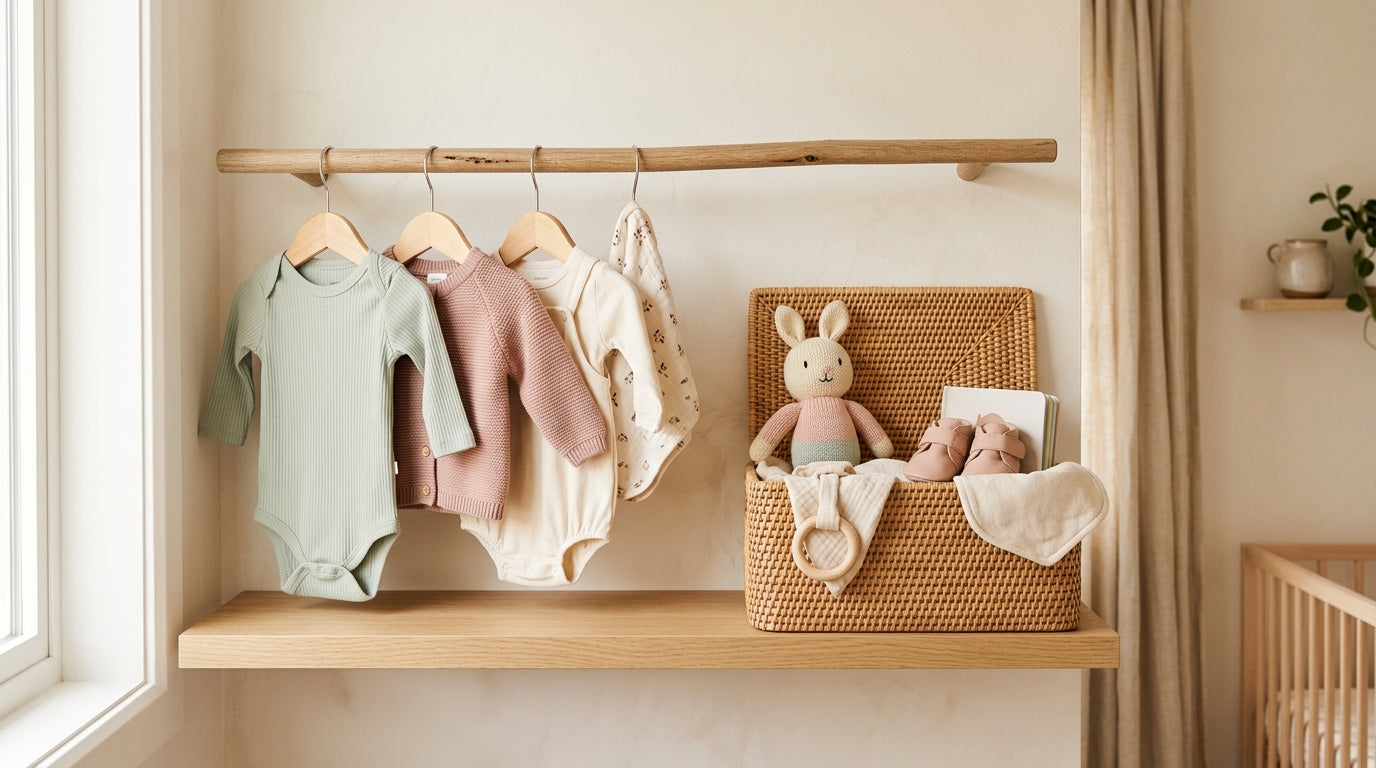
My doctor recommended an incredibly boring approach and I followed it to the letter. You need maybe eight basic long-sleeve bodysuits, five pairs of soft pants, three layering sweaters, and two sleep sacks. You do laundry every two days anyway because they're constantly leaking fluids. A small rotation of high-quality organic cotton is so much easier to manage than a sprawling drawer of toxic fast fashion.
You wash the new clothes before they ever touch the baby and you check the tags for the OEKO-TEX standard and you toss anything that smells vaguely like a tire fire because nobody has time for heavy metal poisoning.
Build a safe capsule wardrobe and sort out your nursery essentials before the sleep deprivation fully ruins your cognitive function.
Stuff you're probably wondering
Why does my baby break out in a rash every time they wear new clothes?
Because you probably didn't wash them first. Factories treat fabrics with formaldehyde to prevent mildew during shipping across the ocean. Your baby's thin dermal layer absorbs those chemicals immediately. Wash everything twice in hot water with a fragrance-free detergent before it touches their body. If it still causes a rash, the dye or the synthetic fiber is the problem and you need to throw it away.
Are cheap wooden toys honestly dangerous?
Yes. Just because it's made of wood doesn't mean it's safe. Cheap wooden items are often glued together with formaldehyde-based adhesives or painted with lead-contaminated paints. The wood itself might be fine, but the clear varnish they spray on it to make it shiny is toxic. If the brand can't show you an FSC certification or an OEKO-TEX seal, assume it's garbage and don't let your kid chew on it.
How many clothes do I realistically need in size 56?
Barely any. I bought twenty newborn outfits and my son wore maybe four of them before he hit a growth spurt at week three and none of them zipped up past his belly button. Buy a tiny capsule. Five onesies, a couple of footie pants, and a good sleep sack. Spend your money on the larger sizes because they stay in those slightly longer.
What's the deal with the GOTS certification?
It stands for Global Organic Textile Standard. It basically means the cotton was grown without synthetic pesticides and the people who sewed the garment weren't exposed to toxic chemicals either. It's the only label I really trust because third-party inspectors verify it. Most brands just slap the word natural on a tag and call it a day. GOTS requires actual paperwork.
How do I clean wooden teething toys?
Don't boil them. I boiled a wooden ring once and it splintered into a dozen tiny daggers. Wood is naturally antimicrobial. You just wipe it down with a damp cloth and some mild soapy water, then let it air dry completely. If it gets really dry over time, rub a tiny bit of organic coconut oil on it to condition the wood.




Share:
The Freezing Car Seat Meltdown And The Winter Gear Fix
The 3 AM Pajama Panic (And How I Finally Figured Out Baby Sleepwear)