

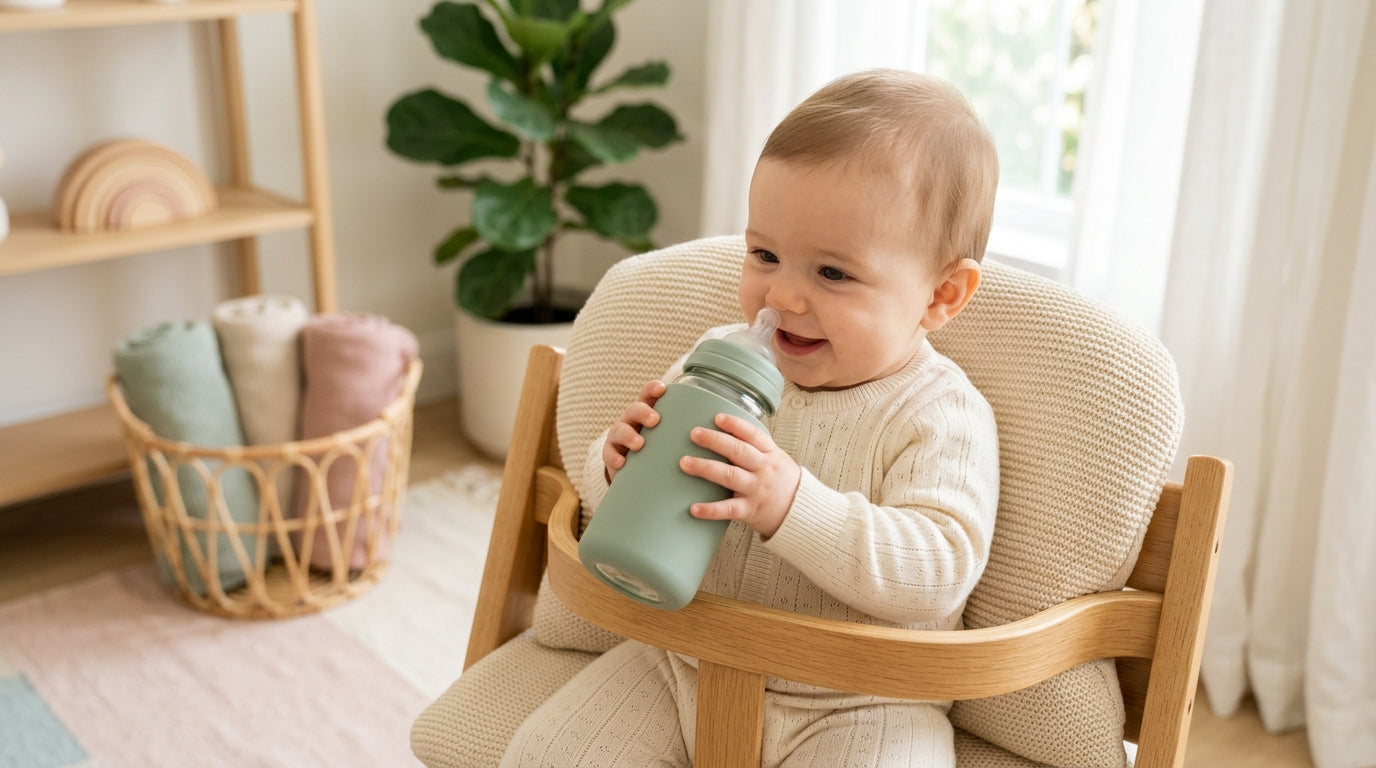
It was 3:14 AM on a Tuesday, and I was wearing a stained College of Charleston t-shirt that smelled heavily of sour milk and sheer exhaustion. Leo, who was about five months old at the time, was doing this infuriating thing where he would violently smack his bottle out of my hand while simultaneously screaming because the milk had stopped flowing. My husband, Dave, rolled over in his sleep, mumbled something into his pillow like "can't he just hold it himself yet," and went right back to snoring. I almost threw the lukewarm formula at his head.
I used to have this wild fantasy about independent feeding. Before I actually had babies, I genuinely thought that around three or four months, a switch would flip. I pictured myself sitting on a velvet armchair, sipping a steaming hot cup of coffee, reading a paperback novel while my sweet, angelic infant just rested on a pillow next to me, casually holding their own bottle like a tiny adult at a pub. I thought it was a definitive before-and-after moment. I was so incredibly wrong.
The reality is so much messier, and honestly, a lot heavier on the forearms than anyone ever tells you.
The timeline is completely made up anyway
If you're frantically googling when do babies hold their own bottle while your arm falls asleep under the weight of an eight-pound infant, you're going to see a lot of aggressive parenting blogs telling you it happens at six months. Or eight months. Or ten months.
My pediatrician, Dr. Aris, who has seen me cry over everything from a diaper rash to a weird-looking toe, told me that the window is usually somewhere between six and ten months. But like, what does that even mean? Six to ten months is a lifetime in baby years. At six months Leo was practically still a potato, and at ten months he was trying to eat my car keys. I remember Dave texting me from work one afternoon when Leo was seven months old, typing with one thumb during a meeting, "did the babi hold it today?" Yes, he spells it babi when he's rushing. And no, the sweet little babie didn't hold it that day. Or the next week.
Maya, my second, didn't even attempt to hold her own bottle until she was almost a year old. She just flat-out refused. She knew I'd do it for her. She had me completely trained. I'd offer it to her, and she would just drop her arms to her sides like wet noodles and stare at me until I caved. Every baby is so wildly different, and I spent way too much time stressing over an invisible deadline that I'm pretty sure some expert just guessed at anyway.
What Dr. Aris actually told me about safety
So, because I was desperate for my hands back, I tried to take shortcuts. I confess this with deep shame, but I definitely tried to prop Leo's bottle up with a rolled-up swaddle blanket one morning just so I could butter a piece of toast. It was a disaster.

When I casually mentioned this hack to Dr. Aris, he looked at me like I had just suggested feeding my kid espresso. He went into this whole long explanation about how dangerous bottle propping is. Apparently, when you just shove a pillow under a bottle, the milk keeps flowing whether the baby is ready to swallow or not. I guess their little anatomy isn't set up for it, and the milk can actually pool in the back of their throat and seep into their Eustachian tubes. Because their ear tubes are like, perfectly horizontal at that age or something? I don't know the exact science, but the point is, it causes horrific ear infections. Not to mention the terrifying choking risk because you aren't honestly controlling the flow.
So instead of stressing out and comparing your kid to your neighbor's genius baby and trying to rig up some dangerous blanket contraption just to free up your hands, maybe just accept that you're going to be awkwardly holding a bottle at a 45-degree angle for a few more months while your coffee gets cold.
Oh, and it ruins their emerging teeth too if you leave them alone with milk.
Tiny hands and terrible coordination
Have you ever honestly stopped to think about how heavy eight ounces of liquid is for a small human? We get frustrated when they drop the bottle, but we're basically asking them to bench press a water cooler jug.
It requires an insane amount of core strength just to sit up, plus shoulder stability, plus this specific thing called a palmar grasp where they honestly have to coordinate both hands to meet in the middle of their body. It's an Olympic sport for an infant. And they're trying to do all this while also trying to coordinate sucking and breathing. It's genuinely a miracle they ever learn to do it at all.
We did so much tummy time to try and build up Leo's back and shoulder muscles so he could eventually lift things. It felt like a full-time job. We would lay him down on his stomach and he would just scream into the carpet for ten minutes straight until I flipped him over. Every single day. I hated tummy time almost as much as he did.
If you're currently deep in the trenches of trying to get your kid to just hold SOMETHING independently, you can browse Kianao's baby essentials collection, though honestly nothing will magically fast-forward these milestones.
Gear that genuinely helps and stuff I hate
When I finally realized that Leo just didn't have the grip strength or the coordination to manage a smooth, slippery plastic bottle, I started focusing on giving him smaller things to hold first just to practice bringing his hands to his mouth.

My absolute favorite thing for this was the Squirrel Teether. I'm obsessed with this thing. It has this big, perfect ring shape that's so much easier for a clumsy baby to grab than a cylindrical bottle. Leo would just death-grip that little mint green squirrel while we sat on the floor, and I could physically see him figuring out the mechanics of moving his arm from his lap up to his face without punching himself in the eye. It was like a training wheel for bottle holding. I still buy it for every baby shower I go to.
We also did all that agonizing tummy time on the Organic Cotton Zebra Blanket. I bought it because the internet convinced me that the high-contrast black and white pattern would stimulate his brain and make him develop faster so he could sit up and hold his bottle. Honestly? It's a nice blanket. It's super soft and organic, but it essentially just became a really beautiful, really expensive burp cloth because Leo spit up on it constantly while struggling to lift his heavy head. It did wash incredibly well, though, so there's that.
We also had the Panda Teether around the house when Maya was going through her teething phase. It was okay. She liked gnawing on the little bamboo part of it, and it's super easy to throw in the dishwasher when it gets covered in dog hair, but it didn't magically make her want to hold her bottle any sooner.
The transition no one warns you about
Here's the funniest, most cruel joke of parenting: right when they finally figure out how to hold the heavy bottle, right when you finally get to sit back on the couch and drink your coffee while they feed themselves... Dr. Aris tells you it's time to take the bottle away and switch to a cup.
It's maddening. You spend eight months begging them to hold the thing, they finally do it, and then at 12 months you've to pry it out of their hands and hand them a silicone transition cup that they immediately throw at the wall.
But whatever, we survive it.
Before you go obsess over another milestone and drive yourself crazy wondering if your kid is behind, grab some coffee, take a deep breath, and check out our full collection of things your baby can practice grabbing (and throwing) at Kianao.com.
Wait, I've questions about this
Is it bad if my 9-month-old completely refuses to hold their bottle?
Oh god, no. Maya wouldn't hold hers until she was nearly one. Some babies just really like being held and having you do the work for them. Dr. Aris told me that as long as they're grabbing toys and bringing *those* to their mouth, their motor skills are totally fine. They just prefer room service.
Can I just use a rolled up blanket to hold the bottle while I pee?
Please don't. I know it's so tempting when you're desperate and alone in the house, but the risk of the milk pooling and going into their ear tubes or them choking when you turn your back for literally two seconds is just not worth it. Take them to the bathroom with you. It's glamorous, I know.
What if they only hold it for a minute and then start screaming?
This happens constantly. The bottle is heavy! Their little arms get tired so fast. Usually, they take a few gulps, their biceps give out, the bottle drops, they lose the nipple, and then they scream because the food stopped. You just have to swoop in and finish the job. It's a very slow transition.
Do those attachable bottle handles genuinely help?
Sometimes! Leo hated them because they confused him, but my friend's kid loved them. It gives them something narrower to wrap their little fingers around. If you're going out of your mind waiting for them to hold it, it's worth spending the six bucks to try the handles.
When do we just give up and move to a sippy cup?
Honestly, by the time they're a year old, you're supposed to be fading the bottles out anyway. If they never master holding the bottle, whatever. Just hand them a straw cup or a two-handled transition cup at six or seven months with some water in it and let them practice with that instead.




Share:
When Do Babies Roll: A First-Time Dad's Guide to the Midnight Flip
The Unvarnished Truth About Your Infant's Shifting Eye Colour