

My oldest son, bless his heart, came out of the womb clutching the collar of my hospital gown like he owed somebody money. He had this vice grip that left tiny red half-moon fingernail marks on my chest, and if a stray piece of my hair managed to fall into his open palm, I was basically held hostage for the next forty-five minutes. You try prying open a newborn's fist when you're running on two hours of sleep and hospital ice chips. It's like trying to pry open a clamshell with wet noodles.
When you've a newborn, everybody wants to test out that little finger grab. My grandma was visiting when my son was about three weeks old. I walked into the nursery just in time to see her wrap his tiny fists around her index fingers and start to pull him up off the mattress to show me how "strong" he was. I nearly threw myself across the bassinet. I'm just gonna be real with you, I snatched him back so fast I probably gave the poor woman whiplash.
Because thing is about that crazy infant strength—it's completely fake. Well, the strength is real, but the control is totally non-existent, and treating your baby like a tiny gymnast is a recipe for disaster.
The monkey cling instinct
I'm fairly certain my pediatrician called this the Palmar grasp reflex. From what I understand, evolutionary biologists think this is some leftover instinct from back when we were basically monkeys and babies had to cling to their mothers' fur so they wouldn't fall out of a tree while she was foraging for berries. I don't know if that's entirely true or just science folks guessing, but watching my youngest son latch onto my husband's chest hair and refuse to let go, I absolutely believe it.
But Dr. Evans, my pediatrician, told me that this newborn death grip is completely involuntary. They literally can't let go until their brain randomly decides to release the tension. It's a reflex, just like when the doctor hits your knee with that little rubber hammer and your leg kicks. They have zero voluntary control over those muscles yet.
This brings me back to my grandma trying to pull my kid up by his hands. Don't do this, y'all. The doctor explained to me that babies will just randomly release that reflex without warning, and they'll drop like a sack of potatoes. Plus, their joints are basically made of rubber bands and good intentions at that age. Lifting a newborn by the hands or arms is a fantastic way to cause a shoulder dislocation or cause their heavy little heads to flop backward and injure their neck. Instead of trying to test their strength like they're training for the baby Olympics, just toss them on the floor for some tummy time so they can practice building their core on their own schedule.
When their hands finally wake up
Watching your baby figure out that their hands are actually attached to their body is hilarious. For the first couple of months, they just stare at their fists like they're foreign objects that mysteriously floated into their line of vision. But then, as the higher parts of their brain start wiring up, those primitive reflexes fade out and they start actually trying to grab stuff on purpose. It usually happens in a messy, clumsy timeline.

- The sleepy fist phase (0-4 months): This is the reflex stage. Hands are mostly kept in little tight fists. You'll spend an embarrassing amount of time trying to dig lint and dog hair out from between their sweaty little fingers.
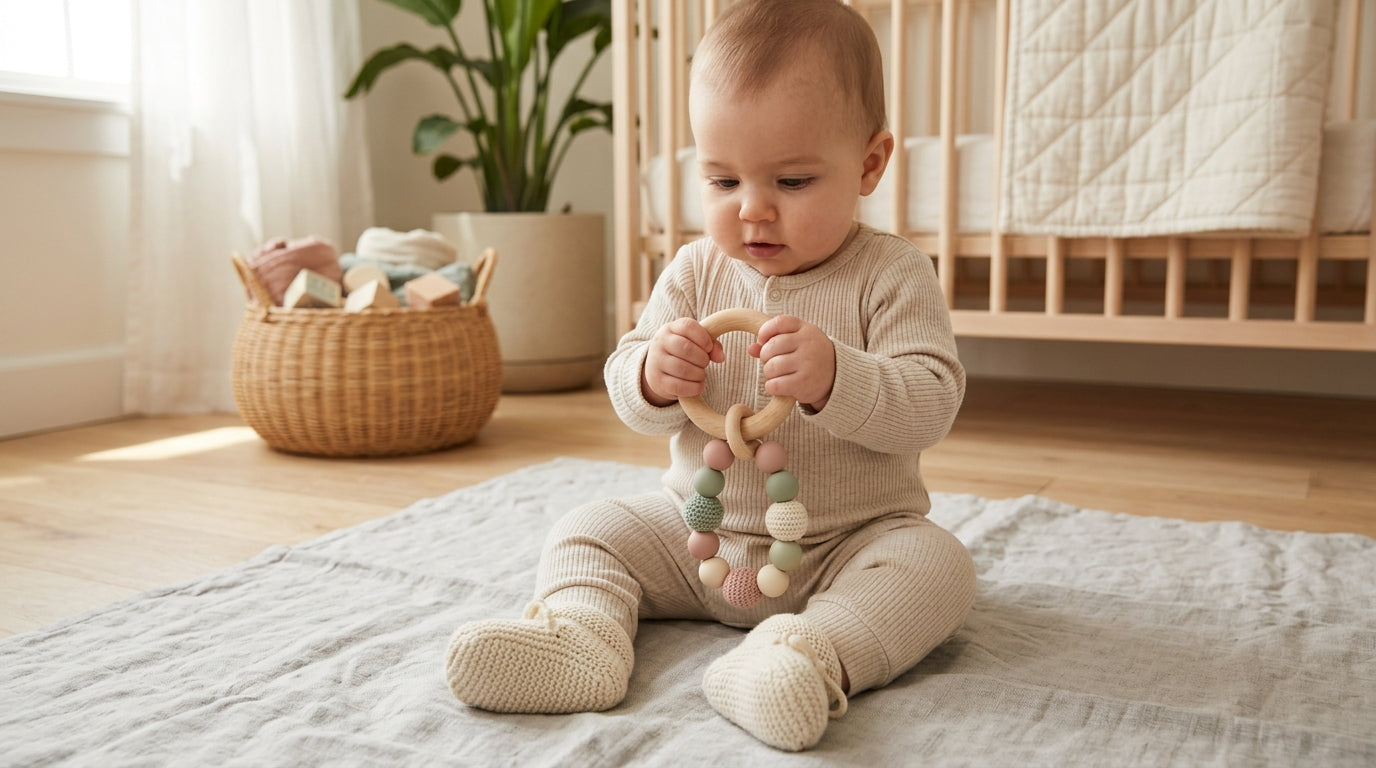
- The clumsy power grab (4-6 months): The automatic reflex goes away, and they start batting at things. When they do grab something, it's a whole-hand operation. They don't use their thumbs yet. It's basically a meat-hook maneuver.
- The messy raking stage (6-9 months): They start dragging toys toward them using all their fingers like a little garden rake. This is also when they figure out how to pass a toy from one hand to the other, which apparently takes a massive amount of brainpower.
- The cheerio pinch (9-12 months): The holy grail of hand skills. The thumb and forefinger finally team up to pick up tiny things. This is when you've to start vacuuming twice a day because they'll find every single crumb on your floor and put it straight into their mouth.
If you're looking for ways to entertain them without filling your house with plastic junk, checking out a minimalist play gym collection is a lifesaver for these early reaching stages.
Toys that actually survive the meat hook phase
When my oldest hit the four-month mark, we had this loud plastic activity mat that sang a song about a purple monkey in a bubblegum tree. That song still haunts my nightmares, I swear. By the time my third baby came along, I had wised up and thrown out anything that required batteries.

For the whole-hand grab phase, we invested in the Fishs Play Gym Set, and I honestly wish I'd had it from the start. It's just smooth, sustainably sourced wood with these little hanging rings that are the absolute perfect size for a clumsy baby to hook their fingers through. It doesn't overstimulate them, it doesn't blink lights in their face, and best of all, it seriously looks nice sitting in my living room instead of looking like a carnival exploded. You can lower the rings so they can bat at them during tummy time, which really helps build those shoulder muscles they need for crawling later. It's definitely pricier than the plastic mats at big box stores, but it's heirloom quality, meaning I won't have to throw it in a landfill when we're done with it.
Now, when they hit that 6-to-9-month mark, everything they grab goes directly into the mouth. It's just how they explore the world, which is fun until they start teething and chewing on your expensive throw pillows. We tried a lot of teethers. We had the Silicone Cactus Teether, and I'll be honest, it was just okay for us. It's completely safe, BPA-free, and super easy to throw in the dishwasher, but the shape was a little awkward for my middle child to hold. He ended up throwing it at the dog more than he chewed on it. The chunky pot base is good for them to practice their grip, but it just wasn't his favorite.
But the Sushi Roll Teether? That one is brilliant. Mostly because it's hilarious to watch a toothless seven-month-old aggressively gnawing on a fake piece of nigiri, but also because the texture is incredible. The little silicone "rice" bumps give them something to really grind their sore gums against. It's lightweight enough that when they inevitably drop it on their own face while lying on their back, it doesn't hurt them.
When to really worry and call the doctor
I'm the queen of 2:00 AM Google spirals, so I know how easy it's to convince yourself your baby is behind on milestones. But Dr. Evans always reminded me that babies don't read the parenting textbooks, so they all do things on their own weird timeline.
That said, there are a few things regarding their grip that you probably shouldn't ignore. Instead of waiting it out to see if it fixes itself, shoot your pediatrician a message if you notice any of these weird quirks.
- If the reflex is only happening on one side. If one hand is death-gripping your finger and the other is just hanging there like a wet noodle, that can be a sign of a neurological issue or nerve damage from birth.
- If they still have that super tight, involuntary fist reflex past 6 months. By then, their hands should be relaxed and open most of the time.
- If they show absolutely zero interest in reaching out or swatting at dangling toys by the time they're half a year old.
Honestly, the best thing you can do for their hand development is just let them play in the dirt, let them grab your face (even when they scratch your nose), and let them make a massive, horrific mess during mealtime. The sooner they master that pincer grasp, the sooner they can feed themselves Cheerios so you can finally drink your coffee while it's still hot.
Ready to upgrade your baby's sensory play? Explore our full collection of safe, sustainable baby toys before those little hands get strong enough to grab your car keys.
Stuff I always get asked about baby hands
Why are my newborn's hands always freezing cold?
Because their circulation is terrible, basically. It used to freak me out so bad with my first kid, I'd put those little scratch mittens on him even in the Texas summer heat. But my doctor laughed and told me it's totally normal. Their bodies prioritize sending blood to their vital organs first, so their little fingers and toes get left off the priority list. As long as their chest and the back of their neck feel warm, they're perfectly fine.
How do I safely cut the nails of a baby who won't stop grabbing?
You wait until they're in a dead, milk-drunk sleep. Seriously, don't try to negotiate with a squirmy awake baby while holding tiny sharp scissors. I wait until they're totally passed out, then I gently peel one finger out of their little fist at a time. If they wake up and start clenching, I just abort the mission and try again tomorrow. It's not worth the stress.
Is it okay if my baby skips the reaching phase and just wants to be held?
Some babies are just Velcro babies. My youngest was like this. He didn't want to bat at wooden rings; he wanted to pull my hair and chew on my collarbone. But they do need floor time to figure out their gross motor skills. I had to force myself to put him down on his play mat for just five minutes at a time, a few times a day, even if he fussed a little. They eventually figure out that toys are honestly pretty fun.
When do they stop putting everything they grab into their mouth?
I'll let you know when it happens, because my four-year-old just licked a shopping cart yesterday. But really, the intense mouthing phase usually peaks around 9 to 12 months when they're teething hard and figuring out textures. Once they get better at manipulating objects with their hands and thumb, they don't need to use their mouth as their primary sensory tool quite as much. But definitely keep the small choking hazards put away for a long, long time.
Why does my baby drop things immediately after grabbing them?
Because opening their hand is a completely different brain skill than closing it. Closing is easy. Voluntarily opening the fingers to let go of something is like advanced calculus for a six-month-old. They usually just relax their hand by accident, the toy drops, and then they cry because it's gone. It's frustrating for everybody, but they usually get the hang of intentional dropping around 9 months (which is right when they discover the joy of throwing food off the highchair tray).




Share:
The Great Green Baby Panic: A Father's Descent Into Eco-Parenting
What the Greg Gutfeld Baby News Taught Me About Newborn Chaos