

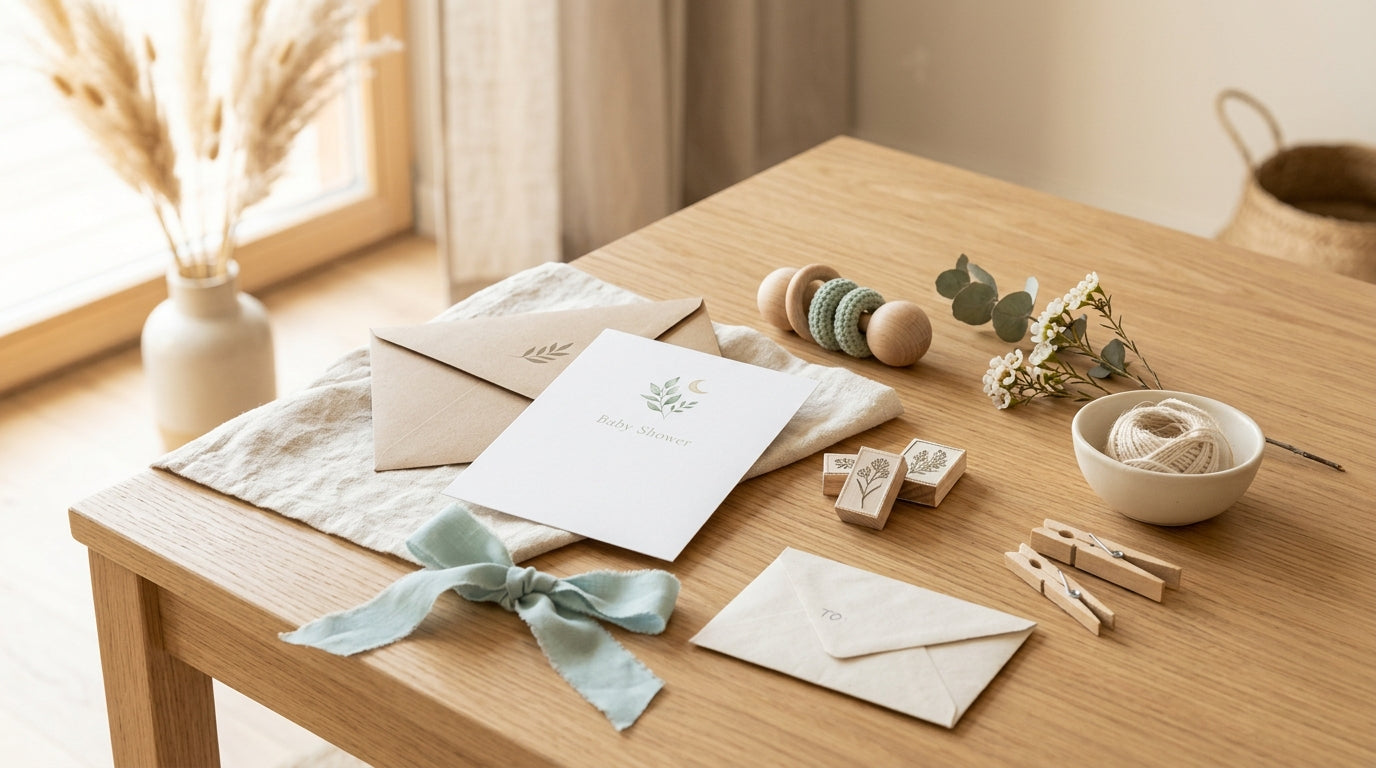
It was 11 PM on a Tuesday. I had a Google Sheet open with column headers for "Paper Weight (GSM)" and "Postage Cost Variance." My wife, Sarah, who was seven months pregnant at the time, walked into the kitchen holding a lukewarm cup of raspberry leaf tea. She looked at my screen, looked at me, and sighed the heavy sigh of a woman who realizes her husband is entirely missing the point.
"Marcus," she said. "It’s a piece of cardboard with a date on it. Stop trying to A/B test the baby shower invitations."
She was right, obviously. But at the time, I didn't see it as a party. I saw it as a massive deployment. We were launching a human into the world in roughly sixty days, and the baby shower invitation felt like the final critical path before release. I was desperately trying to control the variables.
I thought hosting a party for our incoming son would be straightforward. You tell people to show up, they eat tiny sandwiches, and someone gives you a diaper genie. But apparently, a baby shower is a highly orchestrated social protocol. It felt less like a celebration and more like a high-stakes baby show where we had to perform competence for our extended family.
Here's how my brain broke trying to engineer the perfect invite, and what actually matters when you're trying to get people into a room to celebrate your kid.
The timing algorithm failed me
If you search the internet for when to send these things out, you'll find a chaotic mess of contradictory data. Some people say four weeks. Some say eight weeks. My wife’s OB vaguely suggested we get the party over with by week 32 so Sarah wouldn't have to sit in a folding chair while heavily pregnant, which seemed like the most logical data point we had.
I decided to send our digital invites exactly six weeks before the event. This was a catastrophic miscalculation of human behavior. Six weeks is exactly the amount of time required for someone to look at an email, think "I've plenty of time to respond to this," and then completely delete it from their working memory.
The RSVP deadline is the single most infuriating part of this entire process. I set our RSVP cutoff for two weeks prior to the date. I assumed this was a hard freeze. A code lock. You either compiled your response by midnight, or you were excluded from the catering array.
People don't respect the RSVP. My aunt texted me three days after the deadline to ask if she could bring her golden retriever. A former coworker responded via LinkedIn message. I spent an entire weekend manually chasing down twenty different adults who somehow manage to hold down mortgages but can't click a button that says "Yes" or "No." Next time, I'm sending the invites three weeks out and setting the RSVP deadline to "literally right now."
As for dress codes, just tell people to wear clothes. No one wants to decode what "lumberjack casual" means on a Sunday afternoon.
Hacking the registry payload
The actual party details—time, location, date—are just the wrapper. The core payload of any baby shower invitation is the registry link. This is your one and only firewall against a massive influx of battery-operated plastic garbage that will eventually destroy your sanity.

I realized very quickly that if you don't explicitly route your guests to specific URLs, they'll go rogue. They'll buy things that light up and buy things that play tinny, distorted MP3s of public domain nursery rhymes at 120 decibels.
I used our digital invite to essentially run a script on our guests' purchasing habits. I linked directly to sustainable, low-tech items. I treated it like a strict dependency list for our nursery.
My proudest inclusion was the Wild Western Play Gym Set. I explicitly flagged this on the invite because I'm obsessed with the structural engineering of it. It’s an A-frame wooden chassis with hanging objects—a horse, a buffalo, a cactus. There are no batteries. There's no firmware to update. It’s just gravity and wood and crochet. Apparently, the varying weights of the wooden buffalo versus the lighter crocheted pieces help develop tactile discrimination in a baby's brain. I don't totally understand the neurological science behind it, but I do know that my son spends forty-five minutes a day staring at that wooden buffalo, which is essentially forty-five minutes of free time for me. It's the most efficient piece of hardware in our house.
We also put a request for the Calming Gray Whale Organic Cotton Blanket on the registry. I’ll be honest, I'm somewhat indifferent to the marine biology theme. It's a gray square with whales on it. But Sarah absolutely loves it, and she insisted it matched the nursery’s "soothing color palette." I'll admit that the GOTS-certified double-layer cotton construction is technically impressive. It does its job of preventing infant thermal loss without causing overheating, which is the exact performance metric you want from a blanket.
If you want to casually inject some actual style into your nursery without letting guests buy you neon polyester nightmares, you might want to look at Kianao's organic blanket collection. Just a thought.
Dealing with the paper versus digital debate
There was a tense forty-eight hours where my mother-in-law campaigned heavily for physical paper invitations. She argued that a baby shower invitation for a boy required a specific, tactile gravitas. She wanted heavy cardstock. She wanted embossed foil.
I looked at the logistics of physical mail. You have to acquire the addresses, format them, print them, lick adhesives, buy specialized government stickers, and trust a third-party logistics network to hand-deliver paper to physical coordinates. The failure rate is staggering.
I vetoed it. We went fully digital. I told my mother-in-law it was to reduce our carbon footprint, which is partially true, but mostly I just wanted access to real-time analytics. A digital invite lets you see exactly who opened the email and who's currently ignoring you. It's a beautiful, if anxiety-inducing, dashboard of your social network.
Interestingly, going digital allowed us to append a note about our eco-friendly preferences. I originally wrote: "Please don't bring plastic toys; our house is small and I'll throw them away." Sarah made me delete this. She rewrote it as: "We're trying to be mindful of our environmental impact and would love sustainable, natural gifts to welcome our little boy."
It’s the exact same message, just wrapped in better front-end styling.
Themes are just front-end styling
Speaking of styling, people get incredibly worked up over themes. I spent hours researching what a boy baby shower should look like. The internet suggested everything from "Nautical Ahoy" to "Little Lumberjack" to something involving moustaches, which I found deeply unsettling for an infant.

Here's what I learned: the theme doesn't matter. The theme is just a user interface layer applied to a room full of people eating cake. You pick one simply so the napkins match the digital invite header, and then you never think about it again.
We defaulted to "woodland." It required the least amount of effort. I put a pine tree emoji in the email subject line, bought some brown paper plates, and considered the project complete.
Because we had a vague nature theme, one of my coworkers bypassed the registry entirely and brought us the Colorful Dinosaur Bamboo Baby Blanket. Initially, I was annoyed that a rogue variable had entered my carefully curated inventory system. But this blanket turned out to be a thermal superconductor. Apparently, bamboo fabric keeps stable temperature through some sort of cellular moisture-wicking voodoo. Our son runs hot—he's basically a tiny, angry radiator when he sleeps—and this blanket is the only thing that keeps his system from overheating. Plus, the dinosaurs are anatomically stylized rather than annoying cartoon characters, which my nerdy brain appreciates.
Variables you actually need to define
If I had to rewrite the code for our baby shower planning, I'd strip out 90% of the features I obsessed over. You don't need to track paper weights. You don't need to spend three days selecting a font that screams "masculine but cute."
You just need to clearly define these parameters:
Who's the primary contact? Don't put both your numbers. Pick one person to be the server receiving all the pings. I took on this role so Sarah could nap. It was a mistake, but a noble one.
Where are people parking? If you live in a city like Portland, tell people exactly where to put their cars. A confused guest is a late guest.
What's the exact URL of the registry? Hyperlink it. Make the button massive. Reduce the friction between the user and the sustainable items you actually want in your house.
Eventually, the day of the shower arrived. People showed up. Some of them wore flannel because of my pine tree emoji. We ate tiny sandwiches. My son received an assortment of natural wood toys and organic fibers, mostly avoiding the plastic apocalypse I had feared. Looking back at my spreadsheet, the only metric that genuinely mattered was that Sarah felt supported, and we got through it without me completely short-circuiting.
Before you send out that digital blast to your entire contact list, make sure your registry is seriously locked and loaded with things that won't make you miserable. Finalize your deployment over at Kianao's baby gear section.
Troubleshooting the Baby Shower (FAQ)
When do we honestly have to send these invitations?
I tried six weeks and it was a disaster because people have zero object permanence for emails. Honestly, I think four to five weeks is the sweet spot. It's close enough to the date that it feels urgent, but far enough out that they haven't booked a weekend trip to Bend. Just mentally prepare yourself to track down at least five people manually.
Is it okay to only send digital invites?
Yes. Sending physical paper through the postal service for a four-hour party is an archaic use of resources. Digital invites give you click-tracking and automated reminders. If your older relatives complain, tell them you're saving trees for the baby's future. They can't argue with that logic without sounding like cartoon villains.
How do we politely say "no plastic garbage"?
Don't use my method of explicitly threatening to throw things away. Instead, use the registry as a strict whitelist. Then add a gentle note on the invite saying, "In lieu of cards, please bring a favorite book, and we'd love if you could stick to our registry as we're trying to keep our nursery natural and minimal." Most people will just click the link you provide because it's the path of least resistance.
Should we specify a theme on the boy baby shower invitation?
Only if you want guests to buy off-registry items that vaguely match that theme. If you say "Nautical," prepare to receive an alarming amount of tiny sailor suits that are impossible to snap over a squirming baby at 3 AM. Keep the theme vague or non-existent on the invite if you want to control the incoming inventory.
What if someone completely ignores the registry link?
It will happen. It's an unavoidable edge case in the system. Smile, say thank you, and quietly place the giant, battery-powered drum set in the closet. You can always donate it later. Or, if you're lucky, they'll go rogue and buy you a bamboo dinosaur blanket that seriously turns out to be a massive functional upgrade.




Share:
What to Look for in a Baby Shower Guest Dress (Without Losing Your ...
The brutal reality of picking baby shower invitations for a girl