

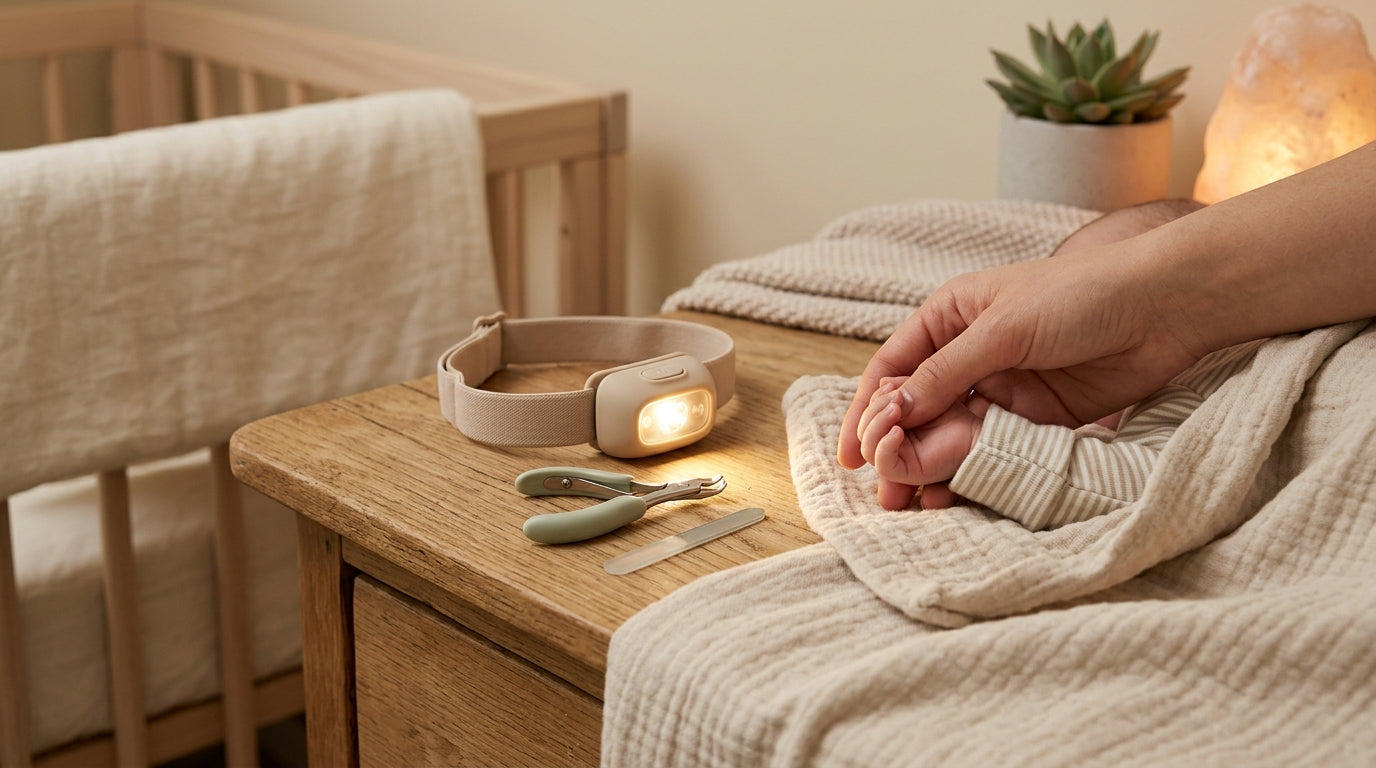
I'm hovering over Maya's cot like a deeply unqualified jewel thief. It's 3:14 AM. I'm wearing a 400-lumen camping headlamp, holding my breath so hard my vision is blurring, and my hands are hovering over a sleeping toddler with a pair of terrifyingly sharp metal shears. Zoe, her twin sister, is asleep in the adjacent cot, meaning if Maya wakes up and screams, the entire house goes up like a powder keg.
I'm here because earlier that afternoon, Maya had scratched her own cheek so profoundly she looked like she had been on the losing end of a pub brawl in Camden. Babies, for reasons science has yet to adequately explain to me, are born with the ability to grow keratin at a speed that rivals invasive bamboo.
Before you've children, nobody sits you down and explains that a significant portion of your early parenthood will be spent performing microscopic maintenance on tiny, flailing extremities while terrified you might accidentally amputate a digit. You just assume they're soft all over. You don't anticipate the razor-sharp talons.
The absolute myth of scratch mittens
I need to spend a moment discussing the greatest grift in the modern infant apparel industry, which is the newborn scratch mitten. If you're currently pregnant, you probably have a drawer full of these things. They look like tiny, useless oven gloves. You will put them on your newborn’s hands with the naive hope that they'll stop the face-shredding.
Let me tell you what actually happens. You put the mitten on. You turn around to grab a wipe. You look back. The mitten is gone. It's not in the cot. It's not on the floor. It has vanished into another dimension, leaving your child free to gouge their own eyeball. The elastic on these things is a joke, the fabric is pointless, and babies possess a Houdini-like ability to rub them off against their own cheeks within seconds. Don't rely on mittens. You have to learn how to do the actual maintenance.
A standard emery board will just annoy everyone involved.
Why biting is a terrible idea
When I first complained about the sheer terror of infant grooming to a bloke at our local park, he leaned in conspiratorially and told me he just bites his son's nails off while watching the telly. He said it with the casual confidence of a man recommending a good mechanic.
Don't do this. I mentioned this strategy to our pediatrician, fully expecting a chuckle, and she looked at me with the cold, dead eyes of a medical professional who has seen too much. She explained that the human mouth is essentially a humid swamp of bacteria. When you bite a tiny nail, you risk tearing the delicate skin of the nail bed, and then you're just driving your mouth-bacteria straight into an open wound. This leads to something called paronychia, which is a nasty skin infection that requires antibiotics and makes you feel like the worst parent in London.
So, chewing is out. You have to use actual tools, which means facing your fear of the blades.
Tools that won't betray you
Using the metal clippers you keep in your own bathroom bag is a weapon-grade mistake because they're too wide, too sharp, and completely obscure your view of what you're actually cutting. You need gear designed for microscopic hands.

For newborns, who have nails with the structural integrity of wet tissue paper, those blunt-tipped baby scissors are brilliant. You sort of just peel the nail away along the curve. But once they hit about six months, the nails harden into proper claws, and the scissors just bend them uncomfortably. That's when you've to upgrade.
There are these magnificent little gadgets now that have a literal spy-hole in the top of the cutting mechanism. You slide the nail in, look through the hole to visually confirm that you're only trapping keratin and not skin, and then you press down. It reduces the sweating-profusely-while-praying aspect of the job by at least forty percent.
But if you're truly an anxious wreck (which I was for the first eight months), get a battery-operated rotary file. It's essentially an orbital sander for babies. It spins a soft, cushioned sandpaper pad that grinds the nail down slowly. If you accidentally hit the skin, it just stops spinning. The catch? It takes forever. You will be sitting there filing one thumb for what feels like an entire episode of Match of the Day, but you'll never draw blood.
The distraction protocol
If you miss the sleep window and are forced to attempt this operation during daylight hours, you absolutely must use the two-parent tag-team method. Attempting daylight trimming alone is like trying to put a fitted sheet on a mattress that's actively trying to kick you in the teeth.
One parent holds the child and operates the cutting implement. The other parent is the distraction monkey. You wave things, you sing off-key nursery rhymes, you make farm animal noises that would confuse an actual farmer. Our current heavy artillery for distraction is the Bubble Tea Teether. I've no idea what it's about this specific piece of silicone, but it's absolute witchcraft. Maya will aggressively gnaw on the fake boba pearls and stare off into space, granting me a precious forty-five-second window of total physical compliance to trim her left hand. It's completely BPA-free, which is great because she tries to dismantle it with her jaw.
We also have the Panda Teether, which is perfectly fine and completely functional, but for whatever reason, my twins just prefer the boba aesthetic. Maybe they're already preparing for teenage life in East London. Either way, shove something safe into their mouth or hands, and make your move while they're occupied.
The blood incident
I've to talk about the inevitability of failure. You're going to nick them eventually. It happens to literally everyone, though nobody posts about it on Instagram because it makes you feel like a monster.

It was a Tuesday afternoon. I got overly confident with the spy-hole clippers. Zoe jerked her hand because the postman rang the doorbell, and I clipped the very tip of her finger pad. The amount of blood that can exit a 12-month-old's finger is staggering.
She screamed. I panicked. My immediate instinct was to run to the bathroom and grab a plaster. Thankfully, my wife had just read an NHS pamphlet that specifically warned against this. You never put a bandage on an infant's finger. Babies explore the world by shoving their hands into their mouths. A loose plaster is a massive, immediate choking hazard.
Instead, the protocol is to grab a sterile gauze pad or a clean damp flannel, wrap it around the tiny finger, and apply gentle pressure until the bleeding stops. You will feel terrible. They will cry for exactly three minutes and then get distracted by a speck of dust on the rug, but you'll carry the guilt for a fortnight.
Timing your attack
Post-bath is historically the most successful time to attempt a trim. The warm water softens the nails significantly, making them less prone to sharp, jagged corners after a cut. They're also usually a bit lethargic from the warm water.
We usually wrestle them into their pajamas immediately after. I highly think something with stretch if you're going to attempt grooming right after dressing them. We use the Organic Cotton Bodysuit because the elastane blend means I can yank it over their massive, wet heads without starting a wrestling match that would ruin the calm post-bath vibe. Once they're dressed and mellow, I pin an arm gently under my elbow, press their tiny finger pad down and away from the nail to create clearance, and make the cut.
If you need gear to keep them busy while you perform this stressful hygiene routine, you might want to browse through Kianao's teething and toy collections for some highly works well distraction tools.
Toenails are a different beast
The good news is that toenails grow at about half the speed of fingernails, so you only have to tackle those feet a couple of times a month. The bad news is that infant ingrown toenails are ridiculously common, mostly because we stuff their feet into tight footie pajamas and socks that smash their toes together.
A podiatrist I ended up chatting with at a Sunday boot sale told me the trick is to cut them straight across. Don't try to curve the edges like you might on your own feet, and definitely don't cut them too short. Leave a little bit of the white line. If you start digging into the corners to make them look rounded, the nail will just decide to grow sideways directly into the flesh.
So here I'm, in the dead of night, headlamp blazing, trying to cut straight across a pinky toe that's roughly the size of a single grain of rice. Maya sighs in her sleep and twitches her foot. I freeze, holding my breath until my lungs burn, waiting for her to settle back into a deep REM cycle before I dare to lower the blades again.
It's absurd. It's terrifying. But then you run your thumb over their little hand the next morning and realize they can no longer accidentally blind themselves, and you chalk it up as a parenting victory. At least until next Tuesday, when the bamboo grows back.
If you're looking for ways to make these chaotic daily routines slightly more manageable, check out the full range of sustainable baby essentials before reading my wildly unscientific answers to your most pressing questions below.
The messy realities of tiny nails (FAQ)
How do I fix a sharp corner if I botch the cut?
If you make a cut and leave a jagged little spur that snags on everything, don't try to snip it again. You will just make it worse or catch the skin. Just grab a soft glass baby file and gently round it out. It takes three swipes. If they're awake and fighting you, do it while they're strapped into a highchair eating something messy.
What if they absolutely lose their minds when they see the clippers?
Some babies develop a phobia of the tool itself. If this happens, you've to pivot to the electric rotary sander. It looks like a toy, it buzzes softly, and it doesn't resemble scissors. Alternatively, do it exclusively when they're in the deepest phase of sleep. You know they're deep asleep when you lift their arm and it drops like a wet noodle.
Are you supposed to push the cuticles back?
Good grief, no. They're babies, not clients at a Mayfair salon. Their cuticles are incredibly thin and attached to the nail to keep out infections. Leave the skin alone entirely. Just focus on the overhanging white part of the nail and nothing else.
Is there a way to stop the trimmed nails from flying everywhere?
I read somewhere that you can dip the blades in water before you cut, and the water tension holds the trimmed piece of nail to the metal instead of letting it ping across the room into the carpet. I tried it once, and it mostly worked, though it made my hands slippery. I usually just accept that our nursery rug is 4% infant fingernail by volume.
Why do my baby's nails peel?
Both of my girls had this. Their nails would just sort of flake off in layers at the top. The health visitor told me it's totally normal because they've their hands in their mouths constantly, and the saliva breaks down the thin layers of the nail. Just file the peeling bits smooth so they don't catch on their clothes.
Can I just peel them off with my fingers?
I've accidentally done this when a nail was already torn, and I immediately regretted it. Sometimes it rips perfectly along the white line, but more often it tears down into the pink part of the nail bed, making them bleed and cry. It's incredibly tempting when you feel a snag, but resist the urge and go find the actual tools.




Share:
The Complete Nightmare of Choosing a Baby Girl Name
Spotting A Baby Mole: When To Panic And When To Just Chill Out