

It's 2:14 PM on a Tuesday and I'm wearing these absolutely hideous mustard-colored maternity leggings that I bought on clearance at Target, sweating through my third cup of lukewarm decaf. I'm sitting on that terrible crinkly paper of the exam table in my OB's office, just waiting for her to tell me everything looks fine so I can go pick up my four-year-old, Leo, from preschool.
The nurse puts the cuff on my arm. It squeezes. It beeps. She looks at the screen, makes a weird face, and hits the button again.
I hate that face.
She doesn't say anything, just sort of scurries out of the room. Two minutes later, my OB, Dr. Miller, walks in looking way too serious for a routine 34-week checkup. My blood pressure is sky-high. There's protein in my urine. I feel completely fine, maybe a little puffy, but it's August in Chicago, so who isn't? But Dr. Miller tells me I'm going straight to Labor and Delivery at the hospital across the street. Don't pass go. Don't go home to pack a bag.
My husband Dave meets me there. He does this thing when he's anxious where he paces in a perfect square, and he's doing it in the tiny triage room, practically wearing a groove into the linoleum. Meanwhile, I'm sitting in a horrible hospital gown, frantically typing into Google trying to figure out how preeclampsia affects the baby, because nobody is telling me anything and I'm absolutely terrified. I'm deep down the rabbit hole on some sketchy e baby forum where everyone is sharing their absolute worst-case scenarios, and I'm just quietly sobbing into my phone screen.
If you're sitting in a hospital bed right now, staring at a blood pressure monitor and terrified about what this means for your baby, take a breath. Here's what I actually learned when the panic subsided and the doctors finally sat down to talk to me.
The Garden Hose Situation
So, the big thing I didn't understand is that preeclampsia isn't just about the mother's blood pressure being a little high. Dr. Miller came in and basically drew me a diagram on a napkin because I'm a visual learner and also I was heavily medicated with magnesium at that point, which makes you feel like your veins are filled with hot lead.
She explained that my high blood pressure was damaging the blood vessels, which meant the placenta wasn't getting the right flow. She compared it to a kinked garden hose. Because the hose is kinked, the baby isn't getting a steady stream of the good stuff—oxygen, nutrients, all of it.
And that's why they get so worried about growth. If the baby isn't getting nutrients, they stop growing. They call it Intrauterine Growth Restriction (IUGR), which sounds terrifying. Basically, Maya was measuring super small. I felt so incredibly guilty, like my body was literally starving her, even though rationally I knew it wasn't my fault. You just can't help it. You sit there thinking, crap, I should have eaten more kale, I shouldn't have had that extra coffee, which is entirely ridiculous because that's not how a placental disease works.
The Oxygen Rescue Mission
Then there's the oxygen part, which is honestly the scariest thing to hear as a mother. Because the blood flow is restricted, oxygen drops. But babies are apparently these incredible little survivalists.
Dr. Miller told me that when Maya's oxygen dropped, her tiny body automatically shunted all the available blood to her brain and her heart. She literally cut off the supply to her own limbs and stomach to protect her vital organs. It's a miracle of biology, but it also causes a buildup of lactic acid in their blood, and if it gets too bad, it becomes an emergency.
Anyway, the point is, they were watching her heart rate on the monitor like hawks to make sure she wasn't getting into that danger zone.
Early Evacuation
Here's the harsh truth I learned at 2 AM on a Wednesday. The only "cure" for this whole mess is getting the baby and the placenta out of your body. That's it. There's no magic pill.

They told me we were having a baby. At 34 weeks.
I completely lost it. I hadn't even washed the newborn clothes yet. We didn't have the car seat installed. I was begging them to just let me stay pregnant a little longer, but Dr. Miller looked at me and said, "Sarah, your body is no longer the safest place for this baby. The safest place for her is out here with us."
Oof. That line still makes me cry.
So they pumped me full of steroids to try and speed up Maya's lung development in the next 48 hours, and then they induced me. The steroids hurt like hell, by the way. Nobody warns you about the shot in the hip.
When Maya was born, she weighed four pounds. She was so incredibly small, and her skin was almost translucent. They whisked her away to the NICU immediately because premature babies usually have respiratory distress, and she needed help breathing. I didn't even get to hold her. I just saw a flash of purple and a tangle of wires as they wheeled her out.
If you're looking for ways to prepare for an early arrival, or just need to stock up on things that won't irritate incredibly delicate newborn skin, you should really take a second to browse the organic baby essentials collection. It's a lifesaver when you're dealing with sensitive preemies.
The NICU Reality Check
The NICU is its own separate universe. There are no windows. It smells like aggressive hand sanitizer and fear. Every monitor beeps constantly, and you learn to distinguish between the "just adjusting" beep and the "nurses running" beep.
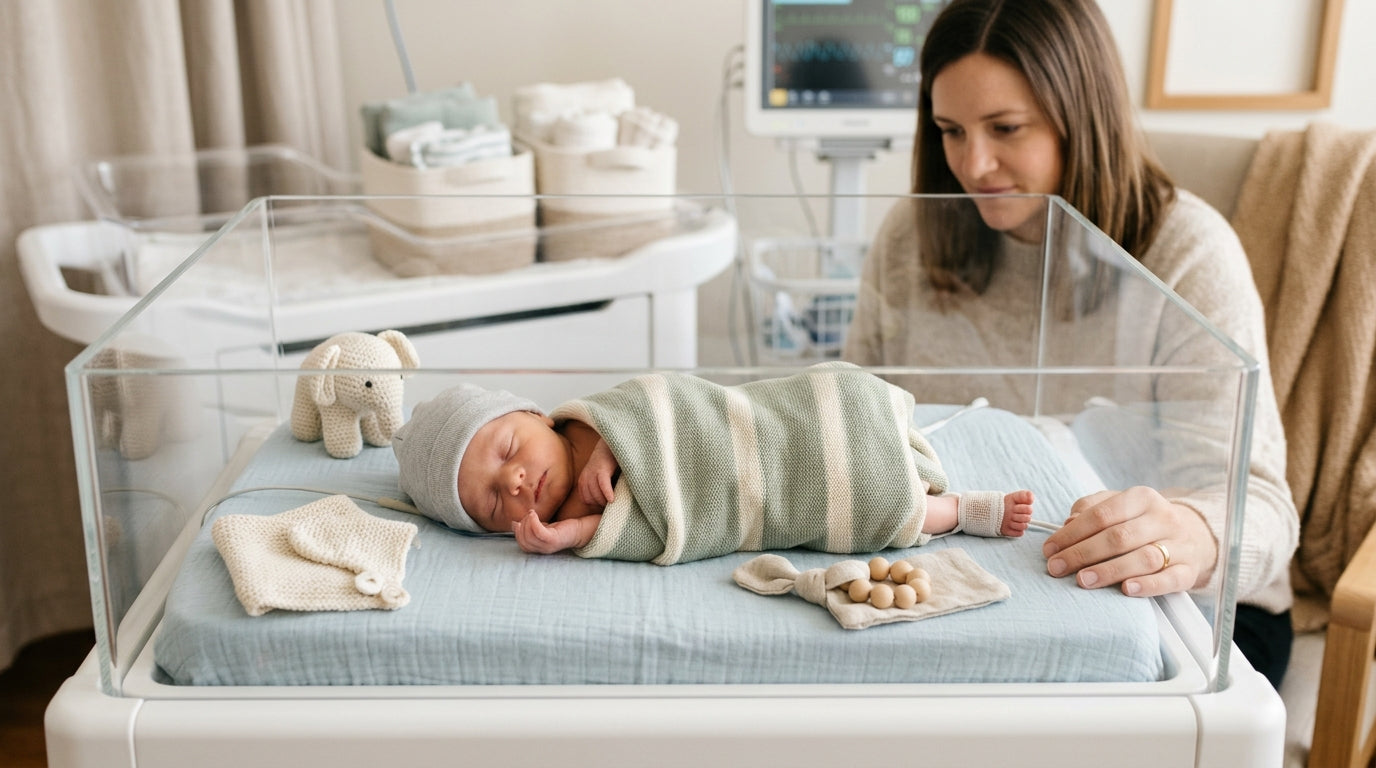
Maya was in this little plastic box. She had a CPAP machine on her tiny nose and IVs in her impossibly small hands. Her skin was so fragile that regular hospital blankets were leaving red, angry marks on her cheeks.
Dave went home to grab some things, and I explicitly told him to bring the Bamboo Baby Blanket in the Blue Floral pattern that my sister had gifted me. Let me tell you, this blanket was a revelation. It's made of this organic bamboo blend, and it's stupidly soft. Like, buttery, melty soft. When the nurses finally let me do skin-to-skin (kangaroo care, they call it), we would drape this specific blanket over both of us. It didn't trap the heat, so neither of us got horribly sweaty, and it didn't scratch her paper-thin preemie skin at all. I genuinely refused to let them use the hospital blankets on her after that. We just cycled this one out and washed it in the sink.
I also had Dave bring the Handmade Wood & Silicone Teether, which was an absolutely unhinged request on my part because she was a four-pound premature infant with a feeding tube, not a teething toddler. I guess I just wanted something normal and pretty to look at? It's a nice teether, honestly. The wood is smooth and the silicone beads are cute. It's a bit heavy for a younger baby, but Maya eventually used it when she was like, nine months old. In the NICU, it just sat on the plastic cart looking aggressively rustic.
Oh, and if you've an older kid who's completely freaked out by the whole hospital situation, we got Leo the Colorful Hedgehog Bamboo Baby Blanket to be his "big brother" blanket while we were gone. He was obsessed with the little hedgehogs, and it was soft enough that he carried it around like a security blanket for the entire three weeks we were living out of the hospital cafeteria.
What Happens Later
I spent so many nights awake next to the incubator, worrying about her future. The doctors throw all these statistics at you about long-term risks—like how babies with growth restriction might have higher risks for high blood pressure or metabolic stuff when they're adults. Honestly? I just blocked that out. I can't worry about my daughter's cardiovascular health at age forty when I'm currently celebrating her drinking 15 milliliters of milk.

The good news is the catch-up growth. Holy crap, they really do catch up. Maya was on a high-calorie preemie formula mixed with breastmilk, and by the time she was six months old, she had thighs like a Michelin man. You would never know she started out the size of a pineapple.
The Messy Advice Portion
If you're reading this because you're high risk, or you're already in the thick of it, please don't just sit there quietly letting things happen to you. Take the low-dose aspirin if your doctor prescribes it, go to every single boring prenatal appointment, and for the love of god, do your kick counts. If you feel like your baby is moving less, don't wait until morning. Go to triage. Demand the steroid shots if they even mention early delivery, because Maya's lungs doing as well as they did is 100% thanks to those awful, painful hip injections.
Preeclampsia hijacked my pregnancy and ruined my birth plan, but modern medicine is absolute magic. Maya is four now. She's currently throwing a tantrum because I won't let her eat a crayon. She is perfect.
Before we get to the frantic questions you're probably Googling right now, make sure you've got your nursery ready for whatever comes your way. Head over and shop the full baby blanket collection so you've something unbelievably soft ready, just in case.
The Frantic Google Search FAQ
Is it my fault my baby stopped growing?
No. Literally, no. I asked my doctor this through hysterical tears, and she looked me dead in the eye and said the placenta is an organ that builds itself. Sometimes it just builds itself poorly. You didn't cause this by working too hard, or stressing too much, or eating the wrong kind of cheese. It's a biological glitch.
Will my premature baby catch up in size?
Usually, yes! It's wild to watch. Maya stayed tiny for the first couple of months, but once she hit her stride around four months, her growth curve shot straight up. Pediatricians track them on a special "adjusted age" curve anyway, but most IUGR babies catch up physically by the time they're two.
Do the steroid shots actually work for the baby's lungs?
Oh god, yes. They're a literal lifesaver. The shots are given to you, not the baby, and they rapidly speed up the production of surfactant in the baby's lungs. My NICU nurses told me they can always tell which babies got the full course of steroids before birth because their breathing is so much more stable.
Will my next pregnancy have preeclampsia too?
This was my biggest fear. The short answer is maybe, but not necessarily. You're at a higher risk if you've had it before, but my doctor put me on baby aspirin the second I got pregnant with Leo (he was my second, Maya was my first—yes, I did this out of order in the story, mom brain is real). I was monitored like crazy with him, and I never developed it. Every pregnancy is a totally different roll of the dice.




Share:
Let's Talk About How Do Babies Get Thrush (And How To Fix It)
How Long Does Baby Acne Last? (And Why You Shouldn't Panic)