

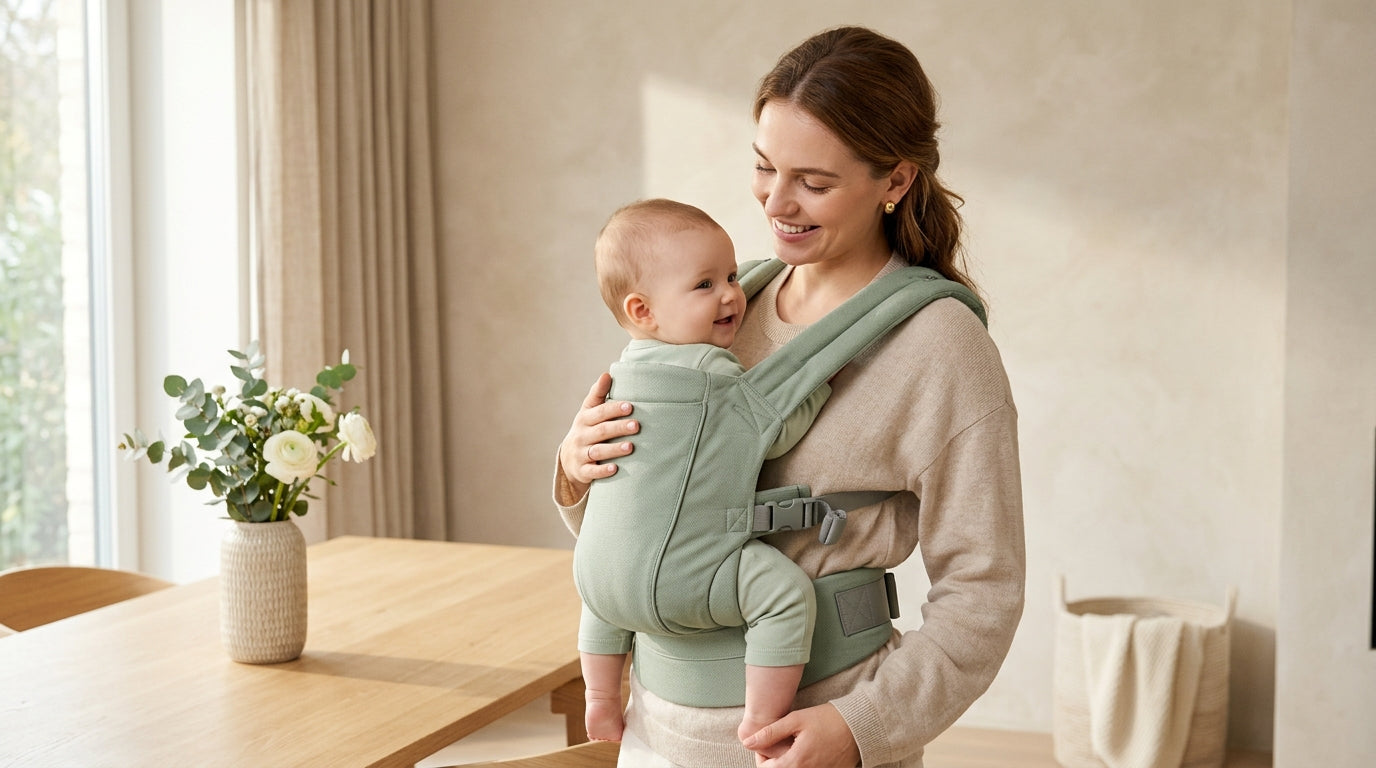
The wind coming off Lake Michigan was zero degrees, and I was standing in the Target parking lot on Clybourn trying to figure out a plastic buckle. My three-month-old was screaming in the backseat. I had just pulled him from the warmth of the baby car seat, and now I was attempting to strap him to my chest using a structured carrier from Momcozy that looked completely intuitive online. In the freezing cold, with sleep-deprived fingers, it felt like trying to defuse a bomb.
I'm a pediatric nurse. I've placed IVs in the hands of premature infants who weigh less than a bag of flour. I understand anatomy. But standing there with twisted nylon straps digging into my parka, I realized that babywearing is entirely different from nursing. It's orthopedic math disguised as a bonding experience.
I ended up just throwing our organic cotton polar bear blanket over his head to block the wind and awkwardly carried him inside like a football. That blanket is actually a lifesaver for winter transfers. It's thick enough to block the Chicago chill but breathable enough that I don't panic about him suffocating under it. I still use it in the stroller.
That day broke my ego. I went home and actually read the medical literature I used to skim past in the clinic. Because if you want to wear your child, you need to understand that their bones are basically cartilage jello for the first six months.
The spine geometry problem
Listen, the hardest part of the fourth trimester is the sheer physical weight of another human being needing to touch you constantly. A baby carrier seems like the obvious solution. You strap them on, your hands are free, you can finally drink your chai. But gravity is relentless.
My pediatrician, Dr. Gupta, told me during our two-month visit that half the parents she sees are wearing their babies too low. I thought I was doing it right until she pointed out that my son was basically resting on my bladder. She told me I needed to pull him up higher, close enough to kiss the top of his head without straining my neck.
This is where the engineering of a Momcozy wrap or structured carrier comes in. The brand gets a lot of hype online, and I bought into it because their designs are acknowledged by the International Hip Dysplasia Institute. That sounds fancy, but from a clinical perspective, it just means the fabric supports the thighs properly. When a baby is in a carrier, their knees must be higher than their bottom. It forms an M-shape. If their legs are just dangling straight down, you're essentially hanging them by their crotch, which places terrible stress on hip joints that haven't fully formed their sockets yet.
I've seen hip dysplasia braces in the hospital. You don't want to deal with a hip brace, yaar. It's a miserable piece of plastic. Getting the fabric knee-to-knee in the carrier prevents that stress.
Sweat and the delusion of breathable fabrics
Nobody tells you how hot babywearing gets. You're pressing a ninety-eight degree heat source directly against your core. Even in the dead of a Chicago winter, I'd unbuckle the carrier and find us both drenched in sweat.
I started dressing him in less layers when I knew I'd be wearing him. Snowsuits inside a carrier are a massive mistake anyway, because all that puffiness ruins the M-position of the legs and makes the straps fit weirdly. I usually just put him in the sleeveless organic cotton bodysuit from Kianao as a base layer. It's fine. It stretches enough over his head and the organic cotton is supposed to be breathable, but honestly, when two humans are strapped together under a coat, everything just becomes a swamp regardless of what you wear.
The wrap-style carriers, like the Momcozy snap one, are worse for this. They require so many layers of fabric crossing over your chest. It feels like wearing a heavy compression bandage. They're incredible for newborns because they mimic the womb, but by the time my son hit fifteen pounds, the wrap was stretching out and my shoulders were burning after twenty minutes.
If you need soft layers that actually hold up to constant washing, you can browse some decent organic baby clothes that won't pill after one contact nap.
Sensory traps in the dairy aisle
Around six months, babies get nosy. They develop neck control and suddenly facing your chest is an insult to their independence. Every mom blog will tell you this is the magical time to turn them around so they can face outward.

I despise outward-facing carrying.
First of all, it ruins your center of gravity. Instead of the baby's weight pulling against your chest, it pulls forward and down, straining your lower back in ways that physical therapy can barely fix. Secondly, it's a sensory nightmare for the baby. When they face you, they can tuck their head and tune out the world when they get overwhelmed. When they face outward in a Target, they're assaulted by fluorescent lights, loud noises, and strangers trying to touch their feet. They have no way to retreat.
Every time I tried the outward-facing position in the Momcozy, my son would be entertained for exactly twelve minutes before completely melting down. His arms would flail, his legs would kick, and he would start scream-crying in the dairy aisle. By the time I managed to unbuckle him, spin him around, and calm him down, I was ready to abandon my groceries and flee.
You can just toss them on your back when they're older and have complete core control, it's much easier anyway.
The chewing phase and saliva management
When they do face inward, the carrier straps become their personal chew toys. Right around four months, teething starts, and the thick canvas straps of the carrier happen to sit directly at mouth level.
My son would soak the shoulder straps in saliva within ten minutes. I was washing the entire carrier twice a week, which wears down the structural integrity of the fabric. I finally got smart and clipped the Panda Teether directly to the shoulder strap with a pacifier clip. This thing honestly saved my sanity.
It's made of silicone, so it's firm enough to dig into his swollen gums but soft enough that he doesn't hurt himself when he inevitably smacks his own face with it. When we were walking, he would just grab the panda, gnaw on the textured bamboo part, and leave my carrier straps alone. I bought three of them so I could always have one in the dishwasher.
Pelvic bone bruises and heavy toddlers
Eventually, front carrying becomes physically unsustainable. My son hit twenty pounds, and my lumbar spine officially retired.

This is where the Momcozy hip seat models come into play. It's a completely different mechanism. Instead of hanging the weight off your shoulders, it provides a firm foam shelf that sits on your hip bone. You basically just rest the toddler on the shelf and keep one arm around them. It's brilliant for the phase where they want to walk, then be held, then walk, then be held, every thirty seconds.
But the fit has to be brutal to work. You have to secure the waistband so tightly around your high waist that it feels vaguely like a corset. If you wear it low on your actual hips, the shelf sags under the child's weight and the edge of the belt digs directly into your pelvic bone. I learned this the hard way after a day at the zoo. I came home with an actual bruise on my hip.
The rule is the two-finger test. The waistband should be tight enough that you can only slide two fingers underneath it, resting high above your hip bones. If you can fit your whole hand under there, beta, you're going to suffer.
The reality of time limits
There's this unspoken pressure to wear your baby all day. Social media makes it look like you should be baking sourdough and vacuuming with an infant permanently attached to your torso. It's a lie.
My physical therapist friend told me that keeping a baby in any carrier for hours on end is a terrible idea. Their spines get stiff, their blood flow gets restricted in their legs, and the parent's back muscles spasm. I think the cartilage needs frequent movement to set properly, but honestly, even if it doesn't, you both need a break.
I started enforcing a strict ninety-minute limit. After an hour and a half, no matter how peacefully he was sleeping, I'd take him out, lay him flat on a mat, and let him stretch his legs. I'd do some shoulder rolls and drink water. You have to balance the convenience of hands-free parenting with the physical reality of blood circulation.
Babywearing is a tool, not a lifestyle. Use the carrier to get through the grocery store, survive a fussy evening, or walk the dog. But don't feel guilty when you unbuckle that massive piece of engineering and just lay them on the floor.
If you're trying to figure out what else you really need versus what the internet tells you to buy, check out our organic baby essentials before you fill your cart with plastic junk.
Messy truths and carrier questions
How do I know if the carrier is tight enough
If you lean forward slightly and the baby pulls away from your chest, it's too loose. They should feel like a heavy, warm tumor attached to your body. You want them secure enough that they don't slump into a C-shape at the bottom of the fabric, but loose enough that you can slide your hand between their back and the carrier. It takes a few weeks to find that exact millimeter of tension.
Are those newborn inserts really necessary
Yes. A newborn is basically a fragile water balloon. They have zero neck control and their legs are too short to straddle the wide base of a standard carrier. If you don't use the insert, they'll sink down, their chin will hit their chest, and they can literally stop breathing. I refused to buy the insert and just used a wrap for the first three months because structured carriers are terrifying for tiny babies.
Can I sit down while wearing the carrier
You can, but it's deeply uncomfortable. The rigid waistband of a structured carrier will immediately dig into your stomach and push the baby up toward your chin. The wrap carriers are much better for sitting. If I had to sit at a restaurant or on a bench, I'd usually just take the whole thing off. It's not worth the indigestion.
How do you clean the Momcozy hip seat
You have to unzip the pocket and pull out the hard foam block before you wash it. I forgot to do this once and the washing machine sounded like it was trying to digest a brick. Once the foam is out, wash the fabric shell on cold and let it air dry over a chair. Don't put it in the dryer unless you want the plastic buckles to warp and melt.
Is the outward facing position bad for their hips
It can be, which is why you only do it for fifteen minutes at a time. It's much harder for the carrier to support the thighs from knee to knee when the baby is facing away from you. Their legs tend to dangle straight down. Between the hip stress and the sensory overload, I think outward facing is mostly a gimmick to keep them quiet for a few minutes while you finish an errand.




Share:
Millie Bobby Brown's Adopted Baby Broke My Millennial Dad Brain
Why Treating My Infant Like A Little Primate Saved My Sanity