

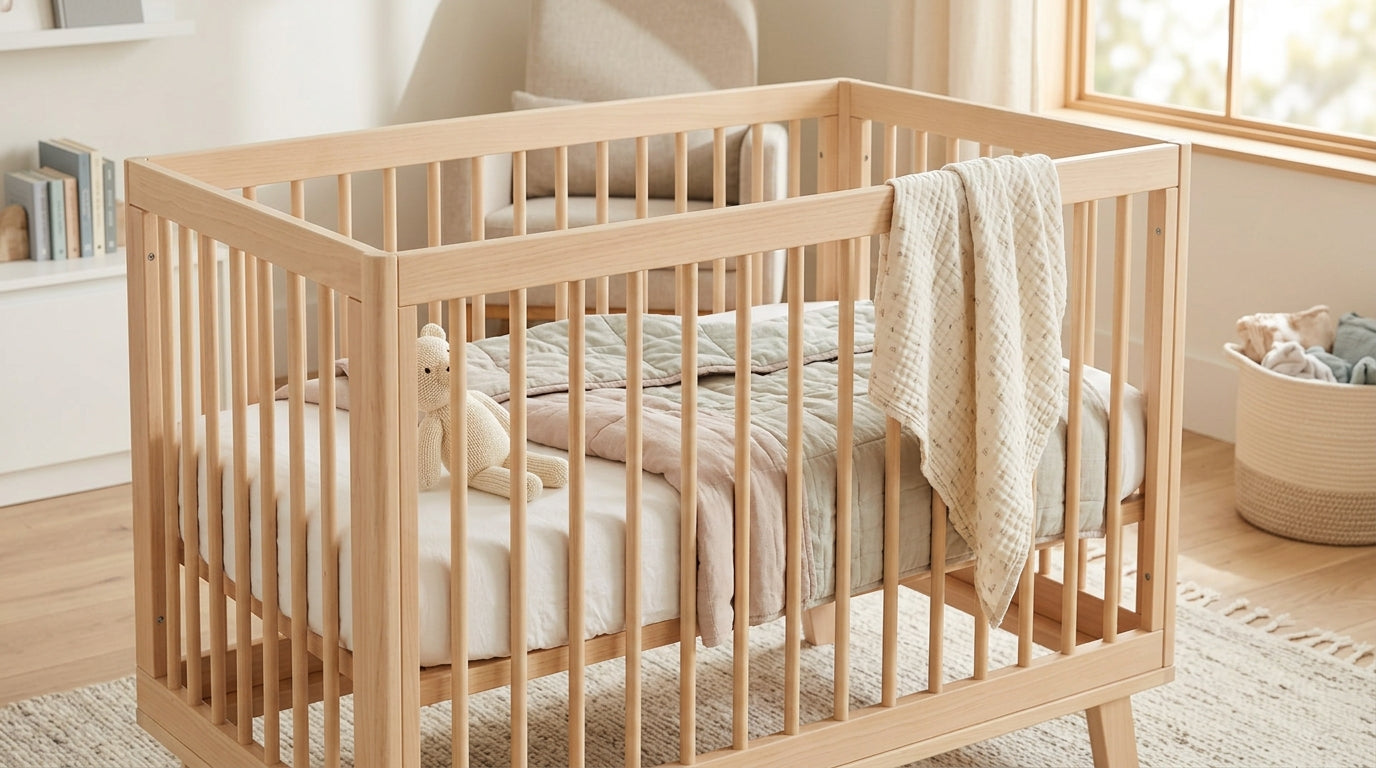
I was sitting on the floor of what used to be my home office, dripping sweat onto a set of Scandinavian assembly instructions, clutching a tiny Allen key like a weapon. It was 2am. My wife was heavily pregnant with twins, sleeping in the next room, and I was staring at three leftover wooden dowels that were absolutely supposed to be inside the structural frame of the infant holding pen I had just spent four hours building. Before this moment, I thought buying furniture for babies was about aesthetics—matching the Farrow & Ball paint, achieving that minimalist nursery look you see on Instagram, perhaps finding something vintage with character.
The reality is much darker. When you're buying a bed for a newborn, you're essentially purchasing a highly regulated, federally scrutinized containment unit designed to keep a tiny, incredibly vulnerable human alive while you attempt to sleep for forty-three consecutive minutes. You aren't an interior designer anymore; you're a prison warden trying to balance breathable airflow with structural integrity.
If you've ever typed frantic, sleep-deprived searches like "safest cot for babie" or just angrily smashed "babi bed" into Google while your phone slips out of your hand, you know the absolute terror of the baby sleep industry. Every decision feels like life or death (mostly because the literature heavily implies that it's), and suddenly you're standing in a retail park in Croydon arguing with your partner about mattress densities.
The vintage death trap my mother tried to give us
My mother, who raised three children in the eighties and views modern health and safety as a personal insult, was absolutely thrilled to drag my old childhood cot out of her loft. It was a beautiful, dark mahogany thing. It had a drop-side mechanism that clattered loudly, slats you could fit a small dog through, and was likely painted with a chemical cocktail that hasn't been legal since the Berlin Wall fell.
Our health visitor took one look at it and laughed out loud. She explained, with a distinctly terrifying cheerfulness, that drop-side beds were banned in the US around 2011 because the hardware tends to break, creating a gap that babies can slip into and suffocate. I had to politely tell my mother that her beloved family heirloom was a certified hazard. She hit me with the classic "well, you survived," which is a terrible statistical argument, but I was too tired to explain survivorship bias to a woman holding a Victoria sponge.
Instead, I learned about slat spacing. Apparently, the distance between the wooden bars must be no more than two and three-eighths inches. If you can fit a standard soda can between the slats, the bed is a death trap. I actually took a can of Diet Coke into a baby shop on the high street and started shoving it between the bars of floor models until a teenager in a branded polo shirt asked me to leave.
Mattresses that feel like the pavement
Before we had the girls, I assumed they would sleep on little marshmallow clouds. You want them to be cozy, right? You want them located in plush, soft fabrics.

Our GP quickly disabused us of this notion, essentially telling us that the sleep environment needs to resemble a sterile monastic cell—a mattress harder than a landlord's heart, covered by a single tight sheet, with absolutely no pillows, massive duvets, bumper pads, or giant stuffed bears that look cute but secretly want to smother your child. It sounds incredibly bleak to put your beautiful new infant on something that has the structural give of a kitchen worktop, but the whole point is that if they roll over, their face won't sink into a soft surface and restrict their breathing. You basically have to push your hand into the center of the mattress, and if it doesn't spring back instantly to mock your weakness, it's too soft.
Then there's the two-finger rule, which haunted me for weeks. The mattress has to fit so tightly against the wooden frame that you can't wedge more than two fingers between them. If there's a gap, a tiny leg or arm can get wedged down the side. I spent an unreasonable amount of time in the middle of the night jabbing my index and middle fingers into the corners of the beds, convinced the mattress had somehow shrunk in the cold.
Why they chew the wood like tiny beavers
Around the eight-month mark, something horrifying happens: your beautiful, angelic children transform into teething rodents. I walked into the nursery one morning to find Twin A aggressively gnawing on the top rail of her wooden bed, making direct eye contact with me while leaving deep, wet teeth marks in the expensive New Zealand pine.
This is when you suddenly realize why everyone online screams about GREENGUARD Gold certification and non-toxic finishes. If they're going to literally eat the furniture, you probably don't want them ingesting whatever volatile organic compounds (VOCs) are used to make cheap engineered wood smell like a new car. I'm fairly sure the certification just means some scientists in a lab checked it for thousands of chemicals so your kid's indoor air isn't quietly poisoning them, but filtering the science through my own sleep deprivation, it just meant I didn't have to call poison control when my daughter digested a fleck of white paint.
You can buy these little plastic rail covers to stop the chewing, but they just figure out how to peel them off and throw them at you when you enter the room anyway.
What to actually put over the bars
Because the bed itself has to be entirely devoid of comfort items to satisfy safe sleep guidelines, you start looking for other ways to keep them warm that don't involve loose, heavy bedding. Blankets become a massive point of contention in our house.

You need something breathable, because babies are terrible at regulating their own body heat and will wake up sweating like they've just run a marathon if you put them in polyester. My absolute favourite weapon in the war against night-sweats is the Bamboo Baby Blanket with the Universe Pattern. It's aggressively soft—like, suspiciously soft—and because it's a bamboo-cotton mix, it breathes incredibly well. Twin A completely ignores the yellow and orange planets printed on it, but I find the space theme very soothing when I'm staring at it at 4am. I actually use the massive 120x120cm one to lay over her legs when she's older, but mostly it is a fantastic barrier when she has a cold; it soaks up the moisture and is incredibly easy to wash.
We also have the Blue Floral Bamboo Blanket for Twin B. It's perfectly fine. The fabric is exactly the same high quality, and the hypoallergenic thing seems to genuinely help with the mild eczema patches she gets on her knees. However, it's very pale, and because she insists on dragging it out of her bed and across the kitchen floor while I make her porridge, it currently has a suspicious brown stain on one of the cornflowers that absolutely refuses to lift, no matter how much biological powder I throw at it.
If you're desperately searching for something soft to introduce into the wooden prison without causing a safety hazard, you might want to look at Kianao's baby blanket collection, though I make no promises they won't just immediately throw whatever you buy over the side onto the floor.
The great convertible lie
When you're pregnant, the baby industrial complex will try to sell you a bed that converts into a toddler bed, then a daybed, then a full-sized adult bed, implying that your child will take this single piece of furniture with them to university.
This is a delusion. By the time they hit two, the wood is chipped, the rails are covered in dried Calpol and inexplicable sticky substances, and you're so sick of looking at the thing that you'd gladly set it on fire. We bought convertible beds, but I completely forgot to buy the toddler conversion rail at the same time, and when I went back to the website eighteen months later, that specific shade of wood had been discontinued.
Bassinets are just expensive, elevated laundry baskets you use for twelve weeks before the baby outgrows them, so don't bother unless you've massive amounts of disposable income and zero storage space.
The only feature that genuinely matters is an adjustable mattress height. When they're newborns, you want the mattress on the highest setting so you don't rupture a disc in your lower back bending over to pick them up seventy times a night. But the absolute second they figure out how to sit up or pull themselves to a standing position, you've to drop that mattress to the floor instantly. I waited one day too long with Twin A, and I walked in to find her chest-high over the railing, preparing to launch herself into the void like an Olympic diver.
Before we get to the questions I usually end up answering for panicked mates at the pub who have just seen a positive pregnancy test, maybe take a deep breath and look through Kianao's organic baby essentials—you're going to need something nice to distract you from the looming cost of nappies and childcare.
Questions from parents who are too tired to google
Are those mini versions seriously worth the money?
Only if you live in a tiny flat in Zone 2 where a full-sized bed means you can no longer open your wardrobe doors. Otherwise, they just grow out of them in six months, and then you've to buy a massive one anyway, meaning you've just spent twice the money to delay the inevitable footprint of baby furniture taking over your house.
When do I lower the mattress?
Basically, the moment you think, "Huh, she looks like she might try to sit up soon." Don't wait for proof. If they can pull themselves up on the bars, the mattress needs to be on the lowest possible setting. Yes, it'll destroy your back trying to lift a sleeping twenty-pound child out of a hole in the ground, but it's better than picking them up off the carpet after they've vaulted the side.
What do I do if I bought an antique bed at a flea market?
Turn it into a really pretentious planter for your garden. Don't put your infant in it. It probably has lead paint, slats wide enough to swallow a toddler, and no structural integrity. It looks great on Pinterest, but the NHS will be distinctly unimpressed.
Can I use a secondhand mattress?
Absolutely not. Even if we ignore the gross-out factor of someone else's baby's bodily fluids—and there are so many fluids—mattresses degrade and lose their firmness over time. A soft, sagging mattress is a massive suffocation risk. Buy the bed frame secondhand if it's a newer model, but always buy a brand new, rock-hard mattress.
How do I stop them from chewing the wood?
You can't. You can try the silicone rail covers, but eventually, they'll find a spot you missed. Just make sure the paint is non-toxic and accept that your beautifully curated nursery furniture is going to look like a family of beavers moved in for the winter.




Share:
The Truth About The Cringe Ass Nae Nae Baby Meme & Sharenting
Why The Crack Baby Mitski Search Term Ruined My Tuesday Night