

It was 3:14 AM, and I was wearing a gray Target nursing tank that smelled strongly of sour milk and desperation. My husband Dave was snoring—not like a cute, rhythmic rumble, but this full-blown, windows-rattling snore that made me want to smother him with a burp cloth. I was sitting on a half-deflated purple yoga ball, bouncing so hard my spine was compressing, holding four-week-old Maya. She was finally, blissfully asleep. Her little chest was rising and falling perfectly.
So, like an idiot, I stopped bouncing.
I held my breath, stood up, and initiated the dreaded Crib Transfer. I tilted my body at a forty-five-degree angle, hovered over her painfully expensive bassinet, and let her back graze the mattress.
Instantly, her eyes shot open. Her arms flew out to the sides. And she started screaming like she was plummeting out of a tenth-story window. Oh god, I had ruined it. Again. I scooped her back up, and the second her cheek hit my chest, she was quiet. I sat back down on the yoga ball, picked up my phone with my free hand, and started furiously Googling things like "why does my baby hate her bed" and "is it legal to drink coffee at 3 AM." I was halfway through typing "cute baby m" into the search bar, hoping a baby macaque video would keep me awake, when I stumbled down a late-night internet rabbit hole about primate biology.
And honestly? It broke my brain in the best way possible.
The crib is basically an evolutionary lie
We're constantly told that a "good" baby is one who sleeps independently in a flat, still, silent box. But if you look at human history—and I mean like, deep, evolutionary, living-in-caves history—putting a baby down is a death sentence.
My pediatrician, Dr. Weiss, who's honestly a saint who deserves a Nobel prize for dealing with my postpartum anxiety, was the one who finally connected the dots for me at Maya's two-month checkup. I was sobbing about how she wouldn't let me put her down to even pee, and Dr. Weiss just kind of patted my knee and said I was fighting millions of years of primate biology.
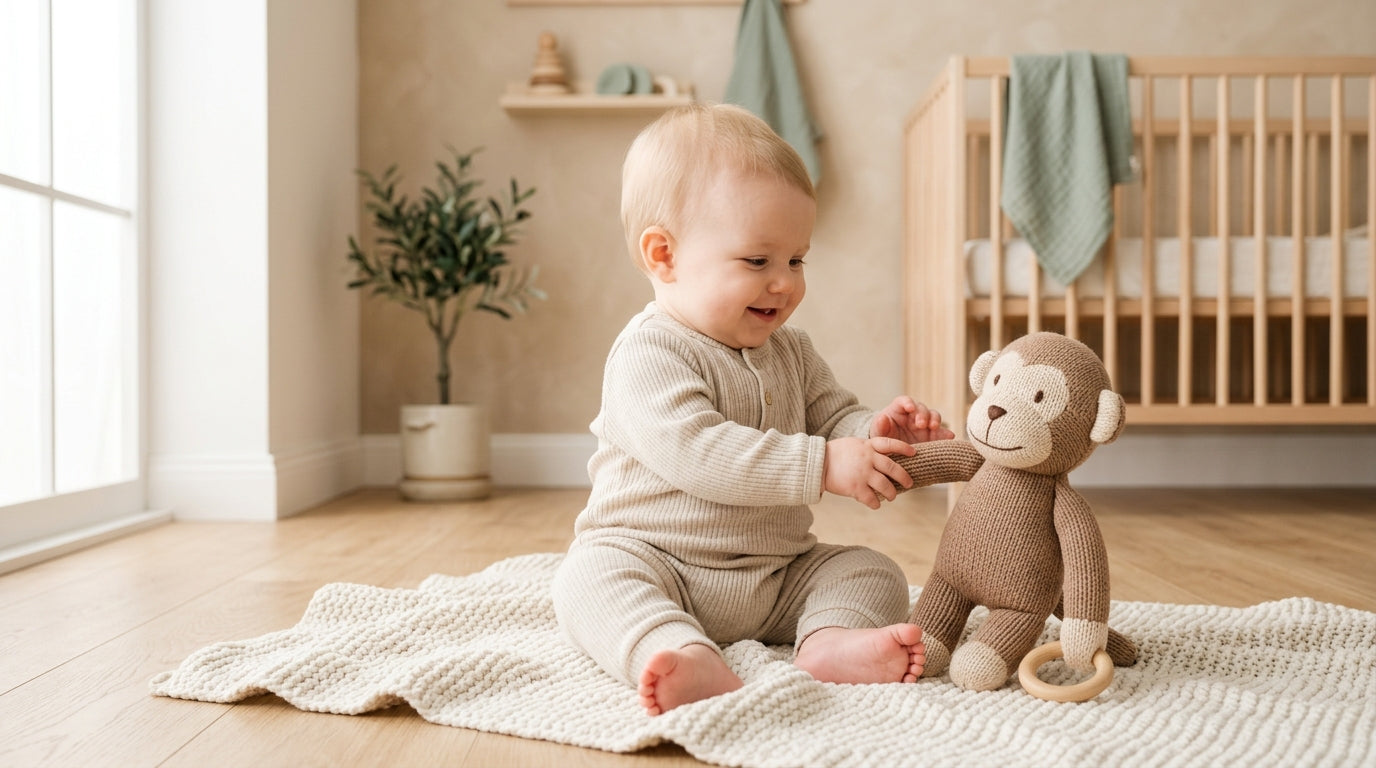
Think about a baby monkey for a second. The literal second a baby monkey is born, it grabs onto its mother's fur and just... holds on. For months. They ride around on their mom's back or stomach while she swings through trees and forages for food. Human babies share like 98% or whatever of our DNA with chimpanzees, but somewhere along the evolutionary line, we lost our fur, and our babies got born with these massive, heavy heads and totally useless, floppy limbs.
A human infant literally can't hold on to us. But their brains don't know that. Their primitive, lizard-brain instincts are screaming at them that if they aren't physically pressed against a warm body, they've been left behind in the jungle for a saber-toothed tiger to eat. So they do the only thing they can do to make sure we don't drop them: they scream.
Anyway, the point is, your baby isn't manipulating you when they wake up the second you lay them down. They're just trying not to get eaten by an imaginary jaguar.
Softness is literal survival
There was this whole psychological experiment done in like, the 1950s? By a guy named Harry Harlow, I think. I'm probably butchering the exact science, but basically, they took these poor little orphaned monkeys and gave them a choice between two fake "mothers." One was made of wire but had a bottle of milk attached to it. The other one didn't have any food, but it was wrapped in soft, cuddly terry cloth.
The baby monkeys overwhelmingly chose the soft cloth mother. They would literally starve themselves just to cling to something soft and comforting, because to a primate infant, physical comfort is actually just as critical for survival as food. It controls their heart rate and their nervous system and their temperature.
When I read that, I completely overhauled how I dressed my kids. I stopped buying those stiff, scratchy "fashion" outfits for infants—you know the ones, the tiny denim jeans that look cute on Instagram but feel like cardboard. I realized that if my kids needed softness to literally feel safe in the world, I was going to wrap them in the absolute best stuff I could find.
If you're looking for that kind of ultimate, Harlow-level softness, check out our organic baby clothes collection. I'm specifically obsessed with the Organic Cotton Baby Bodysuit. It's basically the only thing Leo wore for his first six months. It has this tiny bit of stretch but is mostly just unadulterated, buttery organic cotton. No weird chemical dyes that make them break out in rashes, no scratchy tags, just pure softness that makes them feel like they're still safely tucked against your skin.
The biting phase (or, living with a wild macaque)
If the clinging wasn't enough proof that we're raising tiny apes, let's talk about the chewing. Oh my god, the chewing.

When Leo hit about five months old, he went feral. The sweet, sleepy newborn phase evaporated and was replaced by this drooling, thrashing little creature who desperately wanted to sink his non-existent teeth into everything. My chin. The dog's ear. My collarbone, which actually left a tiny, gross little hickey bruise that I had to explain to my mother-in-law at Thanksgiving.
Like baby monkeys discovering the world through their mouths, human babies have this intense, biological drive to gnaw on things. It's not just about soothing sore gums, though that's a huge part of it, it's also how their brains map out shapes and textures. Dave kept buying him these complicated electronic plastic things that lit up and sang, and Leo would just sort of stare at them and then go back to trying to bite the TV remote.
I ended up buying a bunch of different toys to try and save my collarbone. Some were completely useless. Like, I got this Gentle Baby Building Block Set because some influencer convinced me we needed to be doing "early mathematical spatial reasoning" or whatever. And like, they're fine. They're actually really great for the bath because they float, and now that Leo is four he genuinely builds with them, but for a teething six-month-old? He couldn't get a good grip on the square shapes, so he'd just throw them under the couch in frustration.
But the absolute holy grail, the thing that honestly saved my sanity, was the Panda Teether. I honestly don't know what kind of black magic is in this thing, but the flat shape was so easy for his uncoordinated little primate hands to grab. It has these multi-textured bumps that he would just grind his gums against for like, forty-five minutes straight while I stared at a wall and drank microwaved day-old coffee. It's 100% food-grade silicone so I could just chuck it in the dishwasher when it inevitably got dropped on the floor of Target, and you can throw it in the fridge so it gets nice and cold for their inflamed little mouths. If your baby is currently in their wild animal biting phase, just buy three of these and scatter them around your house. You're welcome.
Why the silent nursery is a trap
Here's another thing we do in modern parenting that goes entirely against nature: we try to make the house dead silent.
We tiptoe around. We shush the dog. We put signs on the front door that say "SHHH BABY SLEEPING PLEASE DON'T RING THE BELL" like we're guarding a bomb. But if you think about how we evolved, silence genuinely means danger. In the wild, the only time the jungle goes completely dead silent is when a predator is nearby. A quiet environment literally triggers an infant's anxiety.
What they expect is noise. Constant, rhythmic, rustling, rumbling noise. They want the sound of a heartbeat, the whoosh of blood vessels, the crunching of leaves, the chatter of a troop. This is why your baby will instantly fall asleep while you're vacuuming right next to their head, but the second you lay them in a pin-drop quiet room, they snap awake.
It's also why motion is so critical. Think about it—if a monkey puts her baby down, the baby stops moving. If the baby is moving, it means an adult is carrying them, which means they're safe. You aren't "spoiling" your baby by rocking them or driving them around the block at 2 AM to get them to sleep. You're basically just tricking their primitive survival instinct into turning off for a few hours.
Please don't buy an actual primate
I feel like I need to take a quick detour here because there's a really weird trend on TikTok right now of people keeping actual monkeys as pets.

Look, I get the appeal. They wear little diapers! They drink from bottles! But seriously, this is a horrific industry. Wild animals belong in the wild, not in a high-chair in your suburban kitchen. When breeders take a baby monkey away from its mother to sell it into the pet trade, it causes massive, permanent psychological trauma. They end up rocking themselves in corners and pulling their own hair out because they're literally dying inside without their biological mother's 24/7 contact. We can learn from primate biology and use it to better understand our own human babies without contributing to the exotic pet trade. Don't be that person. End of rant.
Embracing the cling
The first few months of parenthood are a total mind trip. You're completely stripped of your autonomy, your sleep, and your personal space. It's suffocating, and it's okay to admit that it sucks sometimes. I remember hiding in the pantry eating stale Goldfish crackers while Dave held Maya just so I could have three minutes without someone touching me.
But honestly? Once I stopped trying to force Maya into being this perfectly independent little robot who slept quietly in a box, everything got easier. I bought a soft wrap carrier and just strapped her to my chest all day. I let her sleep on me while I binge-watched terrible Netflix shows. I surrendered to the biology of it all.
Our babies are only little, helpless primates for such a short window of time. Eventually, they learn to walk, and talk, and they stop trying to chew on your collarbone. They let go.
So if you're reading this at 3 AM while bouncing on a yoga ball, wondering what you're doing wrong—you aren't doing anything wrong. Your baby is just doing exactly what millions of years of evolution designed them to do. Drink your cold coffee, pull them close, and just hold on.
Ready to ditch the scratchy fabrics and lean into the softness your baby's biology is craving? Shop our impossibly soft organic cotton collection here.
My Messy, Real-Life FAQ on the Primate Baby Phase
Why does my baby absolutely hate the crib?
Because the crib is flat, cold, and doesn't have a heartbeat. To an infant whose brain is basically still living in the Paleolithic era, being put down in a silent box means they've been abandoned to the wolves. They aren't trying to manipulate you; they're literally experiencing a survival panic. You kind of just have to survive this phase by using motion, white noise, and super tight swaddles to mimic the feeling of being held until they outgrow the instinct.
Is it possible to spoil them by holding them too much?
No. Literally no. My mother-in-law used to tell me I was "creating bad habits" by wearing Leo in a wrap carrier all day, and I wanted to scream. You can't spoil a newborn. Their brains don't work that way yet. They don't have the cognitive ability to manipulate you; they only have needs. Responding to their need for physical contact really builds secure attachment, which makes them *more* independent later on.
Why do they startle so violently when sleeping?
That's the Moro reflex! It's wild, right? It goes back to that monkey instinct. If a baby primate feels themselves falling or losing their grip on their mother, they throw their arms out wide to try and grab onto a branch or some fur to save themselves. Human babies do the exact same thing when you lay them down too fast or if there's a loud noise. It's essentially a built-in "oh crap I'm falling" alarm system.
When does the chewing on literally everything stop?
Oh god, it lasts a while, I'm so sorry. Active teething usually starts around 4-6 months and just kind of comes and goes in miserable waves until they're like two. The front teeth are bad, but the molars are a special kind of hell. Just keep rotating different textures—silicone teethers, wet washcloths in the freezer, whatever you can safely let them gnaw on to save your own skin.
Is white noise honestly natural for a baby?
Yes! We think of white noise machines as this modern technological crutch, but the inside of the womb is insanely loud. It's like 90 decibels in there with your blood whooshing and your heart thumping—roughly the volume of a lawnmower. And historically, human babies were born into noisy communal environments and loud outdoor settings. A silent room is the weird, unnatural thing. Crank the noise machine, they love it.




Share:
The Hilarious Truth About Planning a Baby Moon in the Real World
The Brutal Reality of Baby Modeling: What I Wish I Knew Beforehand