

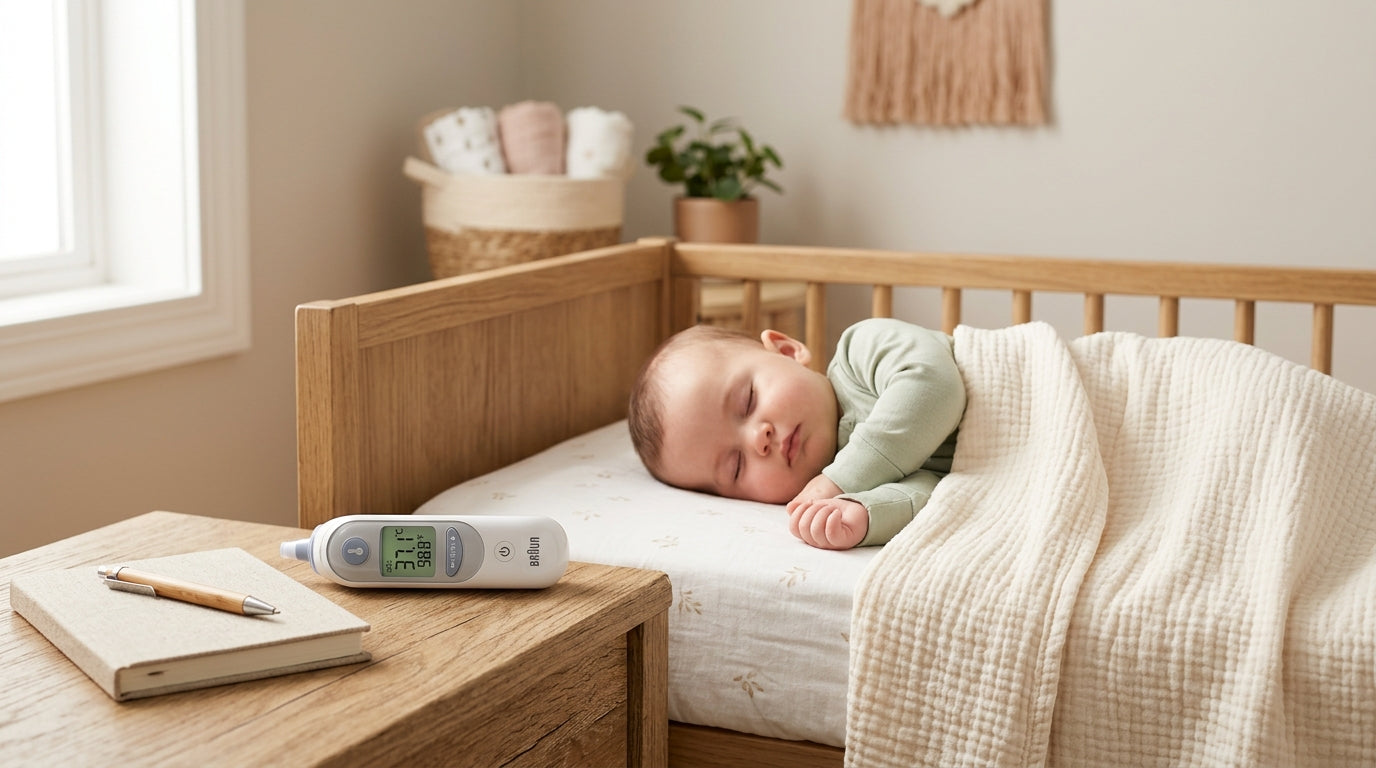
It’s 3:14 AM on a dreary Tuesday in November. Maya is radiating heat like a poorly insulated boiler, and I'm standing over her cot, frantically swiping a sixty-quid piece of infrared plastic across her forehead like I’m scanning a tin of beans at Tesco. She squirms, a red light flashes ominously, and the little backlit screen tells me her temperature is 34°C. According to this highly advanced, aggressively marketed piece of medical technology, my daughter is either a cold-blooded reptile or experiencing deep hypothermia (spoilers: she was just mildly sweaty and very annoyed at me).
This was my brutal introduction to the absolute farce of checking a child's vitals in the middle of the night. Before the twins arrived, I operated under the naive assumption that you just bought a medical gadget, pointed it at the offending child, and it presented you with an undeniable biological fact. As it turns out, capturing an accurate infant temperature is less like science and more like trying to perform a complex magic trick in the dark while sleep-deprived and terrified.
My brief and terrifying career in amateur triage
The panic of that first fever is a universal parenting milestone, but having twins adds a special flavour of chaos to it. When I finally gave up on the infrared scanner and rang NHS 111, the remarkably patient nurse on the other end of the line asked me what Maya's baseline was. I confidently told her I hadn't the foggiest idea. Our GP, the very lovely Dr. Patel, later casually mentioned that a normal core state for a baby sits somewhere loosely between 36.5°C and 37.2°C, and that establishing what normal looks like on a healthy day is quite helpful (a pearl of wisdom that would have been magnificent to possess before I was actively hyperventilating in my slippers).
Dr. Patel also gently informed me that the reliability of the reading completely depends on the specific piece of hardware you're using. This offhand comment sent me into a frantic Amazon spiral the very next day. I essentially bought every model on the market, convinced that somewhere out there was a magical wand that would give me back a shred of control over my children's biology.
A highly opinionated review of the hardware
Let’s talk about the rectal method first. Every medical professional will look you dead in the eye and tell you it’s the absolute gold standard for accuracy in babies under two. I'm sure they're right about the science, but they heavily gloss over the sheer, undignified horror of the application. I've spent twenty gruelling minutes trying to soothe a thrashing, miserable toddler while wielding a flexible-tipped probe equipped with a so-called "parent-proof stopper" (which sounds reassuring on the box but still feels like you're defusing a biological bomb). It's medically superior and I absolutely loathe it.

Then we've the armpit method. This is what the NHS heavily pushes for the under-fives. It's wonderfully non-invasive, provided you've a child who's willing to sit completely still with a cold plastic rod clamped under their arm for sixty to ninety seconds. Maya is not that child. Lily is also not that child. Trying to get an armpit reading in our house usually devolves into a wrestling match, which makes them cry, which makes them hotter, which entirely defeats the point.
Eventually, we graduated to the clinical ear scanners when they hit six months (apparently their tiny ear canals are too narrow before that, another fun fact I learned by reading a manual at 4 AM). The ear gadget is actually brilliant and fast, provided they don't happen to have an ear infection—in which case gently pulling their ear back to align the sensor results in a shriek that will wake the dead, the neighbours, and definitely the sleeping twin.
If you're as overwhelmed by the sheer volume of baby gear out there as I was, you might find some sanity browsing our organic baby clothes, where things are mercifully simpler than medical equipment.
The great infrared deception and swaddle sweat
The reason that fancy forehead scanner lied to me on that fateful Tuesday morning comes down to what I now affectionately call "swaddle sweat." If your kid has been mashed face-down into a mattress, wearing a thick hat, or wrapped up tightly in polyester, the ambient heat gets trapped against their skin and the scanner panics. The forehead devices are incredibly convenient because you don't have to wake the child, but they're highly susceptible to whatever environment the baby was just marinating in.
We realised pretty quickly we needed to ditch the synthetic sleepwear if we were ever going to get a clean read during fever season. I stripped Maya down and swapped her into the Organic Cotton Sleeveless Baby Bodysuit for nights when she was running warm. It’s brilliant because it actually breathes and doesn't trap a layer of volcanic heat against her skin. The organic cotton means I don't have to worry about weird dyes irritating her when she's already miserable and flushed. It’s genuinely saved us from a few false-alarm A&E trips just by letting her skin ventilate properly, allowing the scanner to pick up her actual temperature rather than the temperature of a trapped pocket of hot air.
The two device paranoia method
After a particularly harrowing incident last winter involving Calpol, a thin baby tee, and me almost driving to the hospital with my shirt inside out, I stumbled onto a compromise that mostly keeps me sane. I call it the two-device paranoia method.

I keep the temperamental infrared scanner on the bedside table for a quick, low-stress sweep while they sleep. If it flashes green, I go back to bed. If it flashes red and tells me we've a fever, I don't panic immediately; I just sigh, turn on the dimmest possible lamp, and verify the bad news with the dreaded, basic digital stick as a backup before I actually ring the doctor.
During the chills phase of a fever, when they're shivering but still baking to the touch, finding the right covering is a nightmare. You don't want to overheat them, but leaving them exposed feels cruel. I usually throw the Polar Bear Organic Cotton Blanket over whoever is suffering. It's my absolute favourite thing we own. It’s light enough that it doesn't cause their temperature to spike again, but the double-layered cotton gives them that secure, weighted feeling they desperately need to honestly settle. Plus, the little bears on it are objectively excellent, and I spend a lot of time staring at them while waiting for the Calpol to kick in.
We also have the Bamboo Swan Pattern Blanket, which my mum bought us. I'll admit the bamboo fabric is incredibly cooling and soft when the girls are running hot, but the bright pink swans are a bit much for my sleep-deprived eyes in the middle of the night. Maya, however, is deeply obsessed with it and demands "the birds" when she feels poorly, so it remains heavily in the rotation whether I like the aesthetic or not.
Things that will entirely ruin your reading
Nobody explicitly warns you that these high-tech gadgets are incredibly temperamental divas. If you want a reading that isn't complete fiction, you've to mentally calculate if the device has been sitting in a freezing bathroom before bringing it into a warm nursery, miraculously strip off their excess layers without causing a riot, and avoid taking their temperature directly after you've desperately tried to cool them down in a lukewarm bath.
Parenting a sick toddler is an exercise in managing your own anxiety while pretending to be a pillar of medical competence. You will get false readings. You will panic. You will inevitably end up covered in someone else's drool at a truly ungodly hour. But eventually, you figure out the quirks of your chosen hardware, you establish that elusive baseline, and you survive to panic another day.
If you're looking to upgrade your nursery arsenal with things that genuinely soothe a hot, fussy child, explore our collection of breathable baby blankets designed to keep them comfortable when it counts.
A tired dad's guide to fever questions
Do I really have to wake them up to check their temp?
According to every piece of medical literature, accuracy is paramount. According to me, a father who has spent three hours getting a sick child to sleep, waking them up is a crime against humanity. I usually do a stealth forehead swipe first. If it seems dangerously high, yes, I ruin my own life and wake them up for a proper armpit or ear reading. If it's borderline, I let them (and me) sleep.
Why is the forehead scanner giving me different numbers every time?
Because they're capricious little liars. Seriously though, if your kid just had their head buried in a pillow, or if you just brought the scanner in from a cold hallway, it messes with the infrared sensor. You're supposed to let the device sit in the same room as the child for twenty minutes before using it, which is hilariously impractical when you need to know *now*.
Is the ear check safe for newborns?
Our GP told us strictly no for the under-six-months crowd. Their ear canals are just too narrow, and you'll end up getting a reading of the ear canal wall instead of the eardrum, which is totally useless and will probably just make you panic unnecessarily.
How do I stop them squirming during an armpit reading?
I've yet to find a dignified way to do this. I usually resort to bribery, turning on the television to something highly overstimulating, or wrapping them in a bear hug while quietly whispering apologies into their hair. It's not my finest parenting moment, but it gets the job done.




Share:
Best Baby Strollers 2025: A Letter to My Exhausted Past Self
The Only Sane Guide to Finding the Best Baby Walker Right Now