

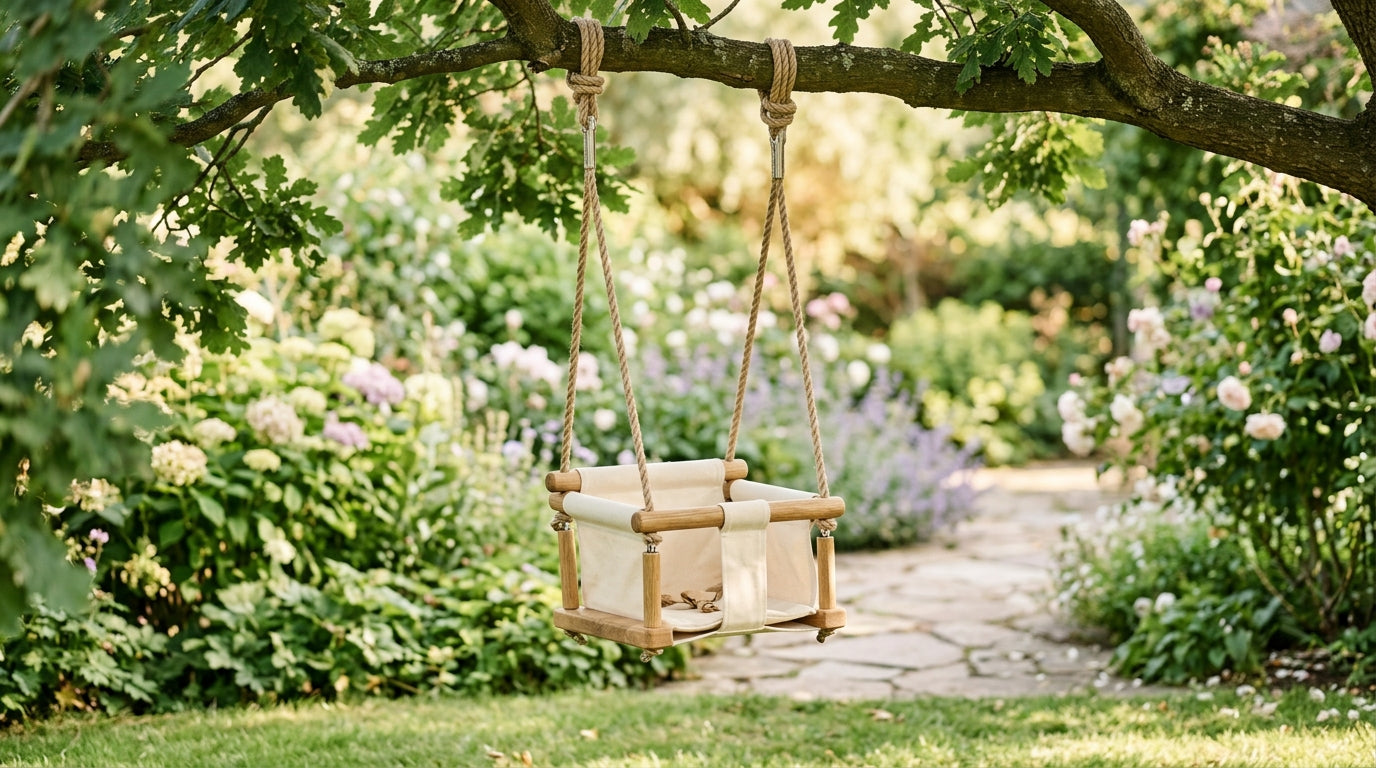
I'm standing in our damp, aggressively overgrown London garden, holding twenty feet of braided nylon rope and staring at a branch on our neighbor's encroaching oak tree, while Florence—who's supposed to be sitting quietly on a blanket—attempts to eat a live woodlouse. This is the exact moment I realized that transitioning from those gentle, motorized indoor rocking devices to an actual physical garden swing requires a degree in structural engineering that I simply don't possess.
You see, for the first six months of their lives, the twins lived entirely in a horizontal plane. They were either flat on their backs, strapped to my chest, or dozing in a vibrating electronic contraption that clicked rhythmically while playing a synthesizer version of 'Für Elise'. But then they hit seven months, and suddenly they looked like giant, disgruntled teenagers spilling out of their tiny infant loungers.
The great indoor eviction
Our GP, Dr. Evans, who delivers medical advice with the weary sigh of a woman who has seen too many panicked fathers, casually mentioned during a check-up that we needed to stop relying on "containers." I took this as a personal attack on the single piece of plastic machinery that allowed me to drink hot coffee at 6am. She vaguely muttered something about flat head syndrome and motor development, which triggered an immediate spiral of guilt on my part.
She told me it was time to move to active play, perhaps involving a proper backyard infant swing, but only if they had "complete head control." Now, I don't know if you've ever tried to objectively evaluate the structural integrity of a baby's neck, but it's not a precise science. It's not like the NHS hands you a spirit level when you leave the maternity ward. I spent the next three weeks randomly tapping their foreheads while they sat on the rug, waiting to see if they'd bobble over like dashboard ornaments.
Florence developed a neck like a tiny rugby prop very early on. She was solid. Matilda, however, was what you might call a late bloomer in the cervical spine department. She sort of swayed in the breeze. So the grand garden installation was delayed while we waited for human biology to catch up with my desire to get them out of the house.
Hardware stores and hostile architecture
Eventually, I felt reasonably certain neither of them would suffer severe whiplash from a light breeze, so I ordered one of those high-backed plastic bucket seats. I naively assumed it would just clip onto something. It didn't. It arrived with chains, S-hooks, and instructions that looked like the blueprints for a medieval trebuchet.
This necessitated a trip to the local hardware store, where I spent forty-five minutes having a deeply unsettling conversation with a man named Dave about load-bearing carabiners. Dave doesn't have children, but he has very intense opinions about shear strength and metal fatigue. By the time I left, I was entirely convinced that my DIY suspension system was going to launch my daughters into the adjacent postal code.
I ended up buying commercial-grade eye bolts that could probably anchor a cruise ship. If you ever find yourself in this situation, just buy the thickest metal objects you can find and tighten them until your knuckles bleed, then wildly hope for the best.
Padding the plastic torture device
Here's a universal truth about municipal-style bucket swings: they're designed to accommodate a hypothetically massive child, which means a standard eight-month-old looks like a single garden pea rolling around inside a snare drum. When I first dropped Matilda into the seat, she completely disappeared below the plastic rim.

I needed a way to pad the interior so she wouldn't rattle around and bash her teeth against the chains. I ended up sprinting inside and grabbing our Infinite Rainbow Bamboo Baby Blanket. I just forcefully jammed it down the sides and behind her back to act as a makeshift shock absorber. Honestly, it's a wildly luxurious item—it's made of bamboo and is softer than most of the clothes I own—so using it as industrial packing material felt like a slight betrayal of its aesthetic purpose. But it worked perfectly. The material is thick enough to wedge her upright, and because it breathes, she didn't immediately overheat while trapped in her plastic confinement.
As for their outfits, I had wrestled them both into the Organic Cotton Baby T-Shirt earlier that morning. It's a perfectly fine shirt. It does exactly what a shirt should do. The main benefit in this specific scenario was that it has a ridiculous amount of stretch, which is absolutely mandatory when you're trying to fold a squirming, rigid-limbed toddler in half to shove them through the tiny leg holes of a swing. By the end of the day, the shirts were covered in a toxic mixture of drool, crushed biscuit, and wet soil, but they survived the wash, so I can't complain.
The damp earth beneath us
Dr. Evans had mentioned something in passing about the dangers of placing play equipment over hard dirt or concrete, warning me about falls. Given that my lawn is mostly comprised of moss, despair, and compacted London clay, I realized I needed a landing pad.
This is where the Large Baby Play Mat Waterproof & Vegan Leather Playmat completely saved my life. Instead of spending thousands of pounds on shock-absorbing rubber mulch like a suburban millionaire, I just dragged this massive leather mat outside and threw it directly over the mud pit beneath the oak tree.
It was, without a doubt, the smartest parenting decision I made that month. Not because anyone fell out of the swing—thankfully, my paranoid carabiner strategy held firm—but because babies drop things constantly. Soothers, half-eaten rice cakes, and beloved stuffed animals were repeatedly jettisoned from the swing. Instead of landing in the wet muck, they bounced off the vegan leather. When we were done, I literally just wiped the muddy footprints off it with a wet towel and dragged it back into the living room. It looks incredibly stylish indoors, but its ability to survive my wet garden is its true superpower.
Need to add some soft padding to your own chaotic garden adventures? Browse our collection of organic bamboo blankets.
The 15-minute timer of anxiety
Once they were finally suspended in the air, padded with expensive bamboo, and hovering over a leather mat, I gave them the first push.

The reactions were completely asymmetrical. Florence threw her head back and shrieked with the manic joy of a skydiver in freefall. She wanted to go higher, faster, completely disregarding the laws of physics. Matilda, meanwhile, gripped the chains with white-knuckled terror, staring at me with a look of deep, abiding betrayal. She looked like a tiny, angry auditor who had just uncovered massive tax fraud.
I also had my phone timer set. I vaguely recalled a terrifying pamphlet from the pediatrician's waiting room warning about hip dysplasia if infants are left dangling in upright harnesses for hours on end. I think the rule was no more than twenty minutes of "container time," though my sleep-deprived brain might be making that up. Regardless, I nervously watched the clock, terrified that if I pushed them for twenty-one minutes, their femurs would permanently detach.
Then, the ultimate nightmare occurred: Matilda’s chin slowly dropped to her chest, and her eyes fluttered shut.
I had read one horrific article at 3am about positional asphyxiation—how a sleeping infant's airway can close if their heavy head slumps forward in a swing. I didn't even think. I lunged forward, grabbed the moving plastic bucket, and aggressively extracted a very confused, newly-awake Matilda, practically sprinting toward the back door. We don't sleep in the garden apparatus. Ever.
Sunburns and extraction mechanics
Someone on an internet forum told me to obsessively check the plastic seat for thermal burns from the sun, which is frankly hilarious given that we live in the UK and haven't seen direct UV light since late August.
The real danger isn't the sun; it's the extraction process. Getting a baby into a bucket swing is difficult. Getting them out when they've decided to splay their legs outward in a rigid V-shape is a feat of herculean strength. Their rubber boots get wedged against the plastic rim. They begin to scream. You have to somehow lift twenty pounds of dead weight straight up while simultaneously squeezing their chunky thighs together. It usually ends with me falling backward onto the grass with a crying toddler on my chest, which is exactly why I put the leather mat down in the first place.
We do it every day now. The rope hasn't snapped. The carabiners haven't sheared. And both twins have developed neck muscles that could rival a heavyweight boxer. It's messy, loud, and constantly panic-inducing, but seeing Florence laugh at the sky makes the terrifying hardware store trips entirely worth it.
Ready to upgrade your outdoor playtime without ruining your aesthetic? Explore Kianao's full range of waterproof playmats and accessories before you tackle the garden.
Frequently Asked Questions I Am Barely Qualified to Answer
When did you actually put them in a garden swing?
Sometime around the eight-month mark. I ignored all the age guidelines on the boxes because Florence was ready at six months and Matilda absolutely wasn't. I waited until I could lightly push on Matilda's forehead while she was sitting on the floor and her neck didn't immediately snap backward like a Pez dispenser. If they're wobbly, keep them on the floor.
How do you stop them wobbling in the plastic bucket?
You stuff the empty space with whatever is nearby. The plastic buckets are massive. I used a thick bamboo blanket folded over three times and shoved it behind their backs and down the sides. It keeps them upright so they don't slump sideways and look like they've had too many pints at the pub. You want them sitting totally vertical.
What happens if they fall asleep in the swing?
You take them out immediately. Full stop. No hesitation. I don't mess around with this at all. If their chin drops to their chest while they're strapped into an upright bucket, they can stop breathing. If Matilda even starts doing the slow-blink, the swinging stops and we go inside to a flat cot.
What ground cover do you actually need?
The safety manuals will tell you to install six inches of rubber playground mulch. I live in a terraced house in London; I don't have the square footage or the budget for a municipal landscaping project. I just throw a heavy, waterproof vegan leather playmat over the grass. It covers the hard mud, stops my knees getting soaked when I'm extracting them, and catches the endless stream of dropped snacks.
Are those 2-in-1 convertible swings any good?
We skipped them. They're the ones with the little T-bar in the front that you can remove later. I found that getting a squirming toddler's legs precisely locked behind a plastic T-bar requires more coordination than I've on a Tuesday morning. I prefer the deep, high-backed buckets where you just drop them in from above like a coin into a slot machine.




Share:
The Urgent Care Algorithm: Surviving Your Baby's First Stitches
Spiders, toddlers, and the absolute chaos of eight-legged pets