

It was 2:14 in the morning, and the glowing plastic octopus under my bare heel was loudly singing the Spanish alphabet. I was holding a screaming newborn, trying not to wake my husband, while this neon monstrosity cheerfully flashed strobe lights into the dark hallway. That was the exact moment I realized my entire philosophy on childhood play was completely, fundamentally broken.
When I had my oldest son, Hunter, I was fresh out of teaching first grade and terrified of messing him up. I fell hook, line, and sinker for every single piece of plastic marketing that promised to turn my six-month-old into a tiny astrophysicist. If the box had "STEM" slapped on it or claimed it developed "advanced cognitive pathways," I threw my debit card at the cashier. I bought light-up tablets, musical walking tables, and robotic dogs that barked prime numbers. I thought I was doing the right thing.
I'm just gonna be real with you: Hunter is now almost five, and he's my cautionary tale. Bless his heart, but because I surrounded him with toys that did all the entertaining for him, he spent his toddler years completely unable to play by himself. If a toy didn't flash, sing, or perform a magic trick when he pushed a button, he'd toss it over his shoulder and stare at me like, "Okay lady, what's next on the itinerary?"
My first kid was a guinea pig (and my third is benefiting)
By the time baby number three rolled around, my rural Texas house looked like a plastic landfill, and I was running a small Etsy shop from my dining table while trying to keep three kids under five alive. I didn't have the time or the energy to be the cruise director anymore. I also didn't have the budget to keep buying D-cell batteries in bulk at Tractor Supply.
I had to completely detox my house. I shoved the singing octopus and the blinking math dog into a donation bin and started over. It turns out, when you take away the constant sensory overload, kids actually remember how to use their imaginations. My grandmother always used to tell me, "If the toy does all the work, the child ain't learning a thing." I used to roll my eyes at her because she also let me play with lawn darts and ride in the back of a pickup truck, but she was entirely right about this.
Real educational value doesn't come from a microchip. It comes from open-ended stuff that just sits there until a kid decides what to do with it. Flashcards for infants are a scam, end of story.
What the doctor mumbled about baby brains
At one of our well-child checkups, I was complaining about how the kids were always fighting, and my doctor started talking about how play physically wires a child's brain. She referenced some developmental psychologist—Dr. Alison Gopnik, I think?—who says kids are basically little scientists running experiments all day. They drop a spoon from the highchair to test gravity. They chew on a block to test texture.

When you give a baby a toy that only has one function—like a button that makes a cow sound—they learn that one cause-and-effect loop in about three minutes, and then they're bored. But when you give them something simple, they've to invent the experiment.
This whole shift really changed how I looked at the baby stage. In the first year, they're literally just trying to figure out how their own hands work and how not to choke on things. You don't need a curriculum; you just need safe stuff they can safely gnaw on.
When my youngest was going through that horrific teething phase where they drool through three bibs an hour, I was desperate. He was chewing on my keys, the dog's tail, and the edge of the coffee table. I ended up getting the Malaysian Tapir Teether, and it was a massive lifesaves. The shape is weirdly perfect because it has this little heart cutout that his chubby little fingers could actually grip without dropping it every five seconds. It's made of food-grade silicone, completely BPA-free, and it has these different textures on the ears and tail that seemed to hit exactly where his swollen gums were hurting. Plus, it looks like an endangered tapir, which is way cuter than those creepy liquid-filled plastic rings from my childhood. I could just toss it in the dishwasher when it got gross. It's probably the most genuinely useful "educational" thing a baby can have, just because it teaches them how to self-soothe and coordinate their hands.
The battery aisle is a trap
Let's talk about the physical environment for a second. If you're a time-strapped parent, the last thing you want is a living room that looks like a daycare exploded. I finally figured out that the best learning toys are the ones that blend into your actual life without screaming at you.
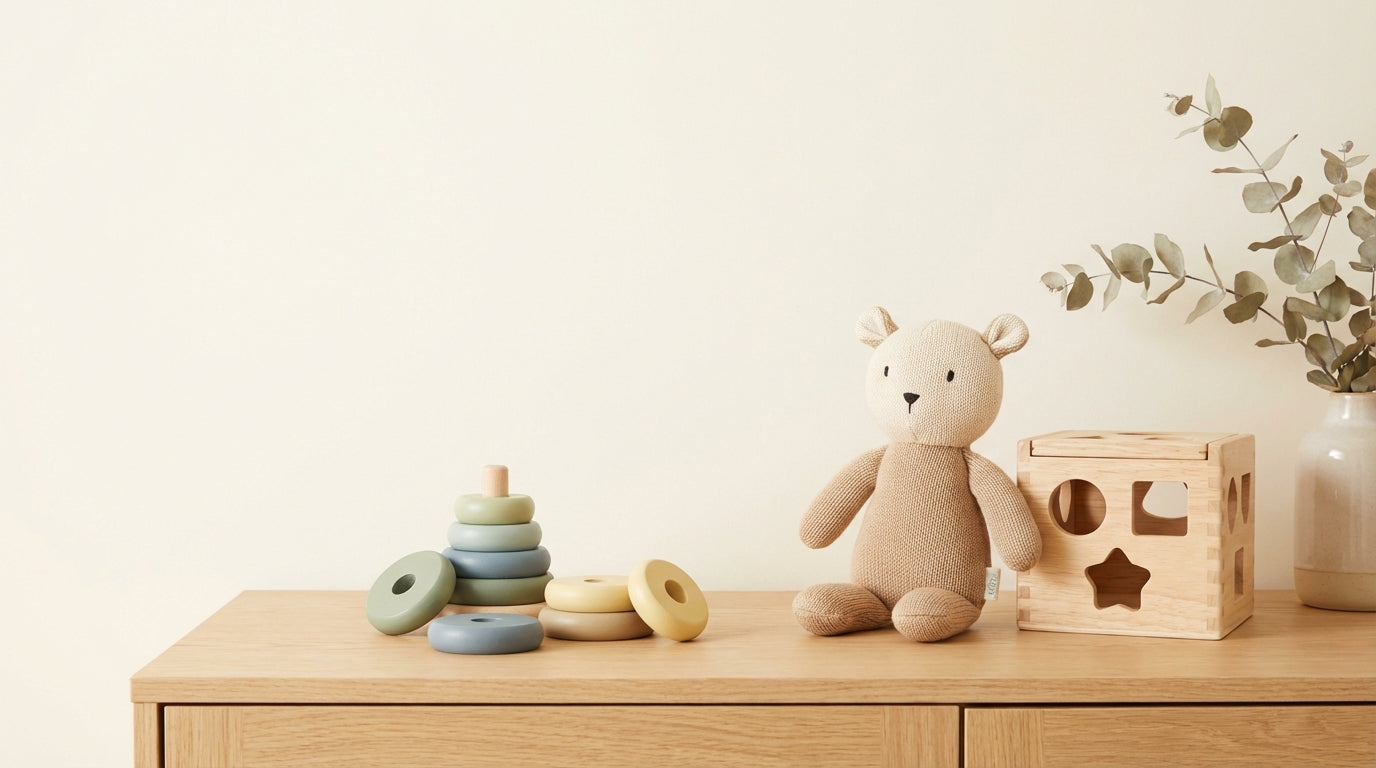
For the floor stage, when they're just starting to roll and reach, I completely ditched the neon padded mats that played carnival music. I swapped it for the Wooden Rainbow Play Gym. Best decision I ever made for my own sanity. It's just a simple, beautiful wooden A-frame with a few tactile hanging toys—a little elephant, some wooden rings, and soft fabrics. No batteries, no flashing lights.
What I loved watching was how my baby actually had to work for it. He'd lie under there and concentrate so hard on batting that wooden ring. Because it wasn't assaulting his senses with lights, he could focus on the physical challenge of hand-eye coordination. And when I had to pack Etsy orders across the room, it didn't give me a migraine to look at it. It's made from responsibly sourced wood and non-toxic finishes, which gave me major peace of mind when he inevitably figured out how to pull himself up and try to eat the frame.
If you're over the plastic landfill taking over your living room, you might want to look at Kianao's wooden play gym collection for something that won't give you a headache.
Toddlers and the whole emotional learning thing
Once they start walking, the game changes completely. Suddenly my doctor is talking about "Social-Emotional Learning" (SEL) like it's the most critical thing in the universe. Apparently, after all the global disruptions over the last few years, kids are way behind on empathy and reading social cues.

I read some watered-down version of a brain scan study that claimed when kids do pretend play, they're actively practicing "mind-reading"—meaning they're trying to figure out what someone else is thinking or feeling. I'm not a neuroscientist, and half the time I don't even know what my toddler is thinking when he decides to paint the dog with diaper cream, but I can tell you that role-playing genuinely works to calm them down.
When my middle child started hitting, we didn't do timeouts; we just started aggressively playing with blocks and pretending the blocks were people having big feelings. Speaking of blocks, we've the Gentle Baby Building Block Set. I'll be honest, they're just okay. They aren't going to win any avant-garde design awards, and they're pretty basic. But they're soft rubber, completely formaldehyde-free, and they float in the bathtub. My kids use them to build towers, squish them, and argue over the macaron colors. They do the job, even if they aren't my absolute favorite aesthetic piece in the house.
Rules I finally learned the hard way
If you're trying to figure out what seriously deserves a spot in your toy bin, let me save you five years of trial and error. Here's my highly unscientific, heavily exhausted mom criteria for bringing a new toy into this house:
- Open-ended is everything. If the toy only does one specific thing, it's going to hold their attention for exactly four minutes. Blocks, magnetic tiles, and art supplies let the kid dictate the play.
- Boredom isn't a medical emergency. You don't need to entertain them every second. Leaving a few simple, wooden objects on the floor and walking away is genuinely good for their brain development.
- Safety means looking at the materials. Kids put everything in their mouths until they're like, three. I don't trust cheap plastic anymore. I look for FSC-certified solid wood, water-based coatings, and food-grade silicone. Period.
- You don't need a degree to play. Sometimes just sitting on the floor and stacking cups while your kid knocks them down is the most educational thing you can do that day.
The truth is, your presence, your conversation, and a safe environment matter way more than any "genius" product on the market. You just need to toss the flashing junk, grab some simple wooden toys, and let them figure it out on their own time while you drink your lukewarm coffee.
Before you buy another piece of plastic that sings off-key and requires a screwdriver to change the batteries, check out Kianao's full line of sustainable play essentials to find something that seriously grows with your kid.
My messy, real-life FAQ
Do babies genuinely need learning toys right away?
Honestly? No. A newborn's brain is working in overdrive just trying to process the ceiling fan and the shadow on the wall. They don't need flashcards or math games. They just need safe things to grab, mouth, and look at. A good teether and a high-contrast blanket are basically a Harvard education for a three-month-old.
How do I get my toddler to play by themselves?
You have to endure the whining first. If they're used to toys that entertain them, they'll complain when you hand them plain blocks. You just have to set the blocks out, sit near them without directing the play, and let them be bored for a minute. Eventually, their little brains will kick in and they'll start building. It takes practice, kind of like sleep training, but way less traumatic.
Are wooden toys really better or is it just an Instagram trend?
I used to think it was just a beige-mom aesthetic thing, but I'm a convert. Wood is naturally heavier, which gives babies better physical feedback when they hold it. It doesn't break into sharp plastic shards when my five-year-old inevitably steps on it. Plus, wood naturally limits the toy from having batteries and speakers, which forces the kid to make their own sound effects. So yeah, they genuinely are better.
What if my kid only wants the loud plastic stuff?
Hide it. I'm serious. I started doing a "toy rotation" where I just boxed up 80% of the loud stuff and shoved it in the garage closet. I left out the wooden blocks, the animal figures, and the play gym. They asked about the plastic singing dog for about two days, and then they completely forgot it existed and started building forts instead.
Is a teether really considered a toy?
When you're six months old and your entire worldview revolves around your gums hurting, absolutely. Chewing is how babies explore the world. A teether with different textures teaches them tactile differences and helps with fine motor skills when they pass it from hand to hand. It's the most functional toy they own in that first year.




Share:
Decoding the Holiday Dress Code: Surviving Baby's First Christmas
Zähne Baby: The Brutal Truth About Surviving the Teething Apocalypse