

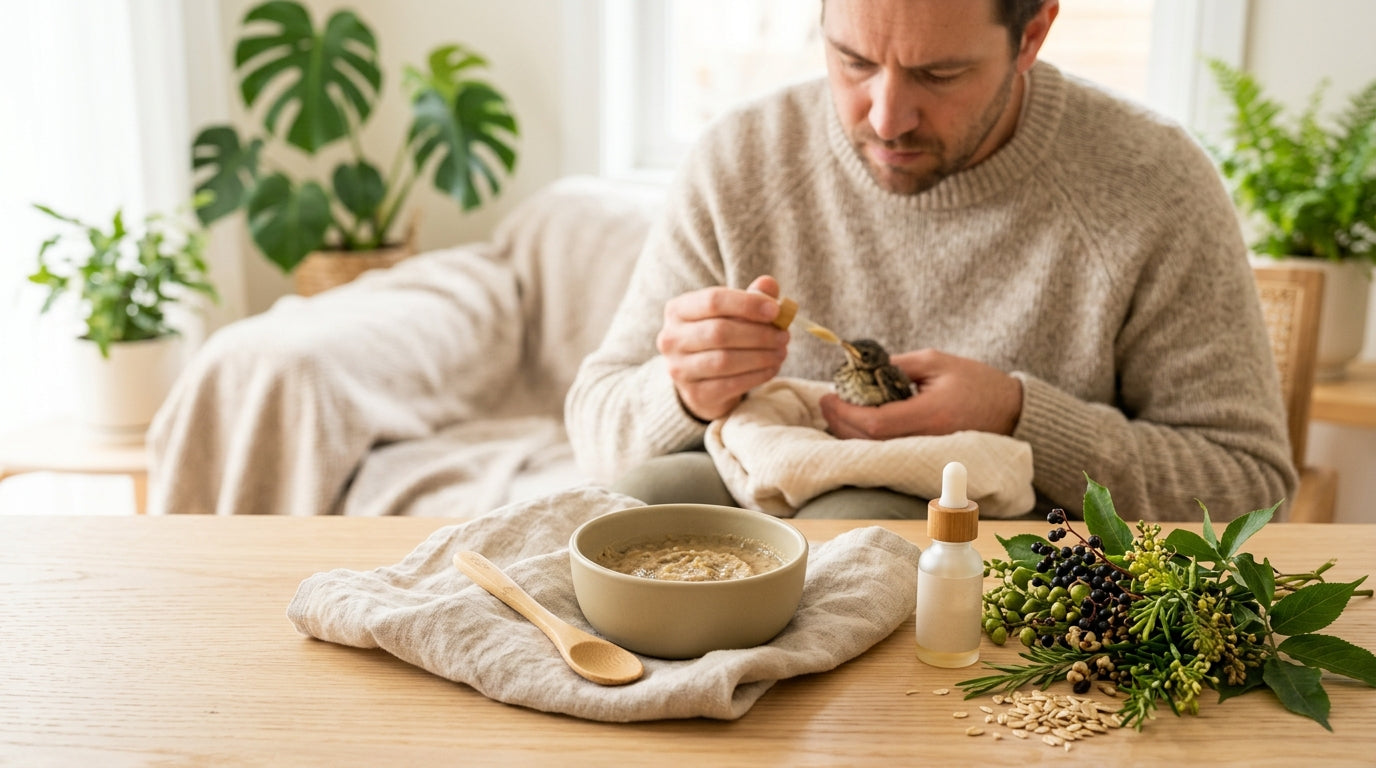
Dear Marcus from last May. You're currently standing in your damp NE Portland yard by the rhododendron bush. Your eleven-month-old son is strapped to your chest, actively chewing on the zipper of your jacket, and you're staring down at a pink, squirming, slightly translucent blob on the mulch. Your pulse is spiking. You have precisely zero training for this scenario. Your immediate instinct as a problem-solver is going to be running into the kitchen to soak some artisanal wheat bread in oat milk to drop into its mouth. Please, for the love of everything, put the bread down.
You approach fatherhood the same way you approach software engineering. If a system throws an error, you check the logs, input a patch, and monitor the output. You track exactly how many ounces your son drinks and you own an infrared thermometer just to check his bathwater. But avian biology is a completely different operating system, and human logic simply doesn't compile here. Everything you think you know about how to nourish a tiny hatchling is probably going to cause a catastrophic system failure.
The pink squirming system crash
Before you start digging through the pantry trying to formulate a nutritional plan for a wild animal, you need to run a basic diagnostic on the hardware sitting in your mulch. Apparently, not all tiny birds are actually lost, and intervening when you shouldn't is basically kidnapping.
- The Fledgling: This unit has feathers, looks like a grumpy old man who just woke up, and is hopping around aimlessly. My doctor—who I definitely texted about this before realizing she only deals with human infants—kindly informed me that these guys are supposed to be on the ground. They're just running their initial flight protocols and their parents are watching from the trees. You leave these ones alone.
- The Nestling: This is what you're looking at right now. It's bald, covered in sparse weird fluff, and its eyes might still be sealed shut. It looks like raw chicken. This is an actual bug in the matrix that needs your intervention.
The great scent myth debugging
Your brain is going to play a very specific piece of legacy code right now. You're going to remember your grandfather telling you that if you touch a wild animal, your human stench will permanently brand it, and the mother will instantly reject her offspring to the harsh elements of nature.
I spent a solid twenty minutes refusing to touch the tiny pink thing with my bare hands, trying to awkwardly scoop it up with two overlapping trowels while my wife Sarah watched from the porch window, shaking her head. I was convinced that the oils on my skin would somehow overwrite the bird's biological signature. It felt like carrying a live grenade wrapped in a fragile, chirping casing.
From what I later gathered reading frantically through Cornell's ornithology forums, birds actually have a terrible sense of smell. They're not bloodhounds. The mother bird doesn't care that you smell like cedarwood beard oil and stale coffee. They're strictly visual creatures, meaning the entire scent-rejection theory is just a massive folklore patch that got applied to human consciousness somewhere in the 1950s and never got deleted.
If you can see the nest up in the tree, you just gently pick the little guy up and put him right back in it.
Boot sequence requires thermal stability
Assuming the nest blew away in the wind and you're stuck with this creature, your next error is going to be focusing on calories. You're going to assume it's starving. But according to the wildlife rehabilitator I finally got on the phone three hours later, feeding a cold bird is a highly efficient way to kill it.

I guess their digestive tracts completely shut down when their core temperature drops, meaning any food you put in their stomach will just sit there and rot instead of digesting. I had to build a makeshift incubator out of an Amazon shipping box, line it with plain paper towels, and balance it exactly halfway on a heating pad set to the lowest possible output. I checked the ambient temperature inside the box with my digital meat thermometer every ten minutes because I'm deeply neurotic, trying to keep it hovering around 85 degrees.
There's also the hydration issue. I was genuinely about to use one of the tools from our Silicone Baby Spoon and Fork Set to drip tap water into its beak. Honestly, that spoon set is just okay—it works fine for shoving mashed sweet potatoes into my kid's face because the grip is decent, but it's nothing revolutionary. However, if I had used it to force water down that bird's throat, I'd have drowned it instantly. Birds apparently breathe through a tiny hole right at the base of their tongue called a glottis, and liquid goes straight into their lungs. They get all their hydration from the moisture in their meals.
Compiling an emergency menu
If you've stabilized the temperature and the wildlife center tells you it'll be four hours before someone can take the intake, you might have to temporarily bridge the caloric gap. This is where the actual dietary logic gets really weird.
My local vet told me on a panicked phone call that wild songbirds need an absurd amount of protein, and the closest thing we humans have in our houses is high-quality cat or puppy kibble. I had to take our neighbor's expensive kitten kibble, soak it in hot water until it turned into a spongy, unappealing mush, and wait for it to cool down to room temperature.
Another option I was told about was mashing a hard-boiled egg with some plain oatmeal and water until it looked like a dense yogurt. What you absolutely can't use is milk, because birds are heavily lactose intolerant and dairy will cause a fatal system crash in their intestines. You also can't use bread, which apparently offers zero nutritional value and causes some terrifying developmental deformity called angel wing where their bones grow entirely wrong.
The nature interface
Standing in the kitchen mashing cat food for a creature the size of a golf ball really made me realize how entirely disconnected I'm from the natural world. My daily environment consists of monitors, mechanical keyboards, and plastic infant toys that aggressively flash primary colors at me.

Sarah actually ordered the Nature Play Gym Set with Botanical Elements when our baby was three months old, and it's weirdly relevant here. I usually track our nursery spending with a color-coded spreadsheet, and I initially raised an eyebrow at buying an aesthetic wooden structure. But it quickly became my absolute favorite thing we own. It has these beautiful wooden leaf pendants and a soft fabric moon. My son would just lie under it for forty-five-minute stretches, totally mesmerized by the subtle wood grains and the gentle clacking sounds of the beads.
It doesn't blink, it doesn't play low-bitrate electronic songs, it just sits there being made of actual organic materials. Dealing with this fragile wild animal in my kitchen made me appreciate that play gym even more. It feels like one of the few authentic, unplugged interfaces my kid has with the physical world right now.
If you want to curate your kid's exposure to the wild without the massive blood-pressure spike of an inter-species medical intervention, I highly suggest you just browse some natural play gear instead of waiting for a bird to fall out of the sky.
Navigating the hardware interface
When it finally came time to deploy the mashed kibble, the mechanical execution was terrifying. I used a pair of blunt tweezers from my wife's cosmetic bag, which I sanitized with boiling water first.
You have to wait for the bird to do something called gaping, which is when they aggressively open their mouths and scream silently at you. I had to gently tap the side of the cardboard box to simulate the vibration of a mother bird landing on a branch, which triggered the programming. Then you've to aim the tweezers specifically toward the right side of their beak—your left, their right—to bypass that breathing hole I mentioned earlier.
I guess they've this weird external pouch at the base of their neck called a crop. You literally watch it fill up with the mush you're feeding them through their translucent skin. Once that pouch looks full, you stop immediately. It was the most stressful mechanical operation I've ever performed, and I once migrated a legacy database with zero backups.
Handoff to the senior developers
You're only doing this to keep the hardware running until the professionals arrive. You're not a Disney princess, and you're not going to raise a wild crow in your home office. Your absolute only goal is to buy enough time to transfer this ticket to someone with a license.
Put the box in a dark, quiet bathroom away from the baby, away from the dog, and away from your own anxious hovering. Let the thermal pad do its job, and wait for the experts to take over.
For parents looking to support their own baby's development with thoughtful, sustainable materials, explore our complete collection of organic nursery items that don't require an emergency hotline to figure out.
The post-incident review FAQ
Can I just give it some cow's milk from the fridge?
No, you absolutely can't. I almost made this exact mistake because mammals drink milk, so my brain assumed everything drinks milk. Birds don't process lactose at all. Pumping dairy into a wild hatchling is going to cause massive digestive failure and probably kill it before the rehabber even calls you back.
How do I know if the bird is honestly hungry?
From what the wildlife lady explained to me, if you gently tap the box and the bird stretches its neck up and opens its mouth as wide as physically possible, it's asking for a data packet. But you also have to look at that weird neck pouch thing. If the crop still looks bulging from the last meal, you back away. They need to fully process the previous batch before you introduce more.
What if I can't find a rehab center open right now?
This happened to me because I found the bird at 6:43 PM on a Sunday. You basically just maintain the holding pattern. Keep the dark box half-on the heating pad on the lowest setting. The vet told me nestlings don't genuinely eat overnight in the wild because their parents are sleeping, so you don't need to stay up until 3 AM shoving soaked cat food into its face. Just keep it warm and try calling again at dawn.
Should I try to build it a new nest out of grass and twigs?
I tried this, and it was a massive waste of time. Woven grass just falls apart and twigs have sharp edges. The professionals told me that a plastic butter tub or a small bowl lined with multiple layers of plain paper towels is infinitely safer and more structurally sound than my pathetic attempt at human-engineered yard architecture.




Share:
What is the baby boo challenge? (And why I nearly called 999)
What's a Nepo Baby? Raising Hard Workers in a Privileged World