

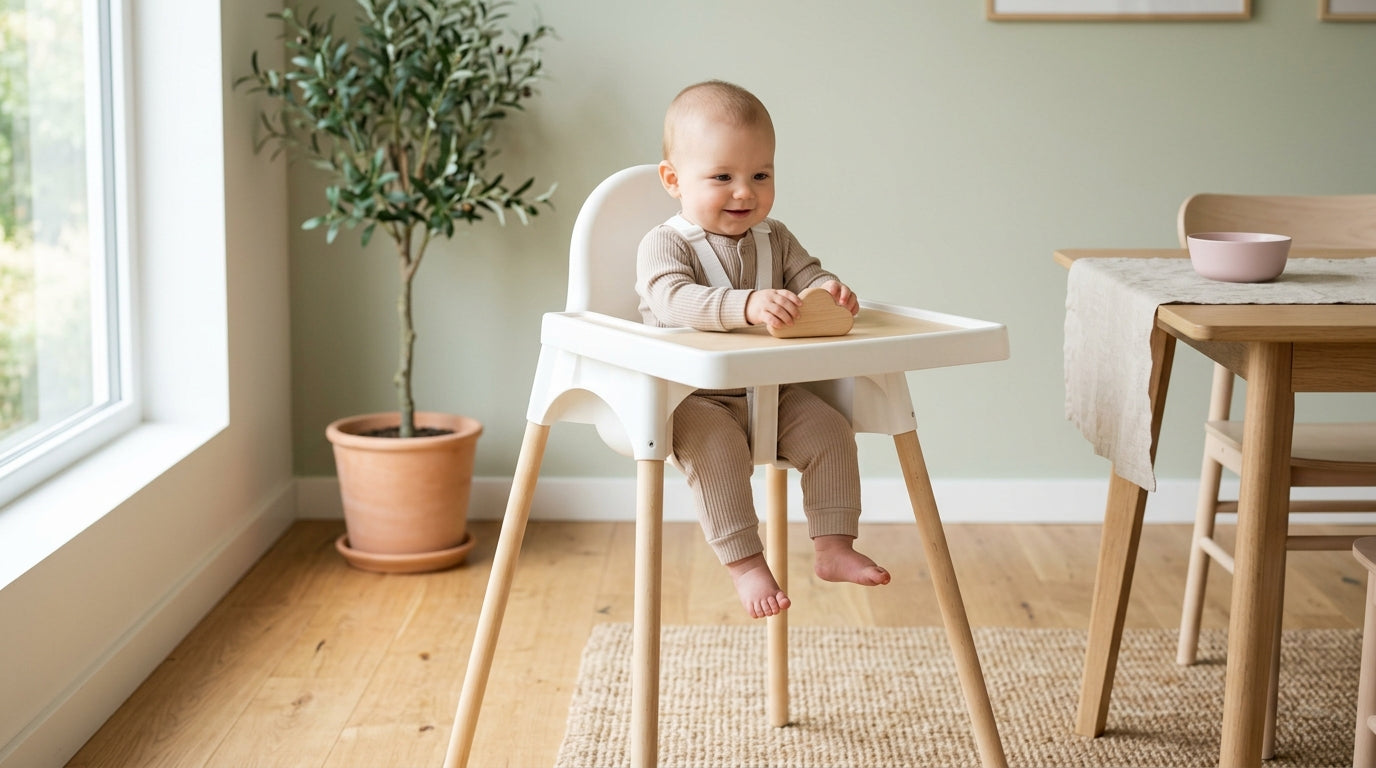
My mother-in-law wanted me to register for a leather-bound high chair that cost more than my first car. My occupational therapist friend cornered me at a brunch to explain that any baby chair without a perfectly adjustable, solid oak footplate would guarantee my child a lifetime of jaw instability. Then my neighbor just gestured toward her patio where a graying plastic bucket sat in the rain and told me to buy the twenty-dollar Swedish thing.
I bought the twenty-dollar Swedish thing. Because I'm practical and frankly a little cheap. Finding an ikea baby chair in a millennial house is like finding a pulse in a living person. It's just expected.
Listen, nobody prepares you for the sheer volume of food that a baby will simply rub into their own thighs while making unblinking eye contact with you.
Figuring out where to trap them while they do this shouldn't require a master's degree, but there's a wide gap between what's convenient for wiping up sweet potato puree and what's actually safe for their developing anatomy.
The great footrest debate of our generation
Here's where the medical reality hits the wall of cheap plastic. The Antilop is basically a bucket with four metal poles jammed into the bottom. It doesn't have a footrest.
My pediatrician vaguely hinted that without feet planted firmly on a solid surface, a baby has a harder time stabilizing their core. She mumbled something about how core stability directly impacts jaw stability, which in turn reduces the likelihood of choking on a rogue piece of broccoli.
Wrap that in a layer of my own hazy nursing school memories about airway management, and it sort of makes sense. We never fed a slumping, unstable patient in the hospital. If you can't brace your trunk, swallowing becomes a chaotic gamble.
So sticking a six-month-old infant in a molded ninety-degree plastic shell where their legs just dangle freely in the abyss is probably not the greatest idea. They look like they're strapped into a theme park ride they didn't meet the height requirement for.
I ended up buying an inflatable cushion insert to prop my son up so he wouldn't slouch sideways like a drunk guy at a bar. Then I went on the internet and bought an aftermarket wooden footrest that clamps onto the metal legs.
You could probably just stretch a heavy physical therapy resistance band across the two front legs if you're entirely out of energy, giving them something semi-solid to push their tiny feet against when they swallow.
The tripwire legs and the harness illusion
The harness is only three points instead of a five-point shoulder system, which basically means you can't ever turn your back unless you want to see what your toddler looks like trying to base-jump onto the kitchen tiles.

But the real safety hazard is the legs on this thing.
They splay outward at an angle that actively defies spatial reasoning. I've stubbed my toe on the back left leg of this chair so many times I'm genuinely surprised my foot hasn't fallen off.
It's like the designers knew the seat itself was too small to tip over, so they compensated by creating a tripwire system for exhausted parents carrying laundry baskets. You'll trip over it, your partner will trip over it, and your desi mom will curse at it every time she comes over to visit.
Why the tray sounds like a bone snapping
The main reason every single one of us buys this specific chair is the cleanup.
Fabric high chairs are an expensive scam. I once watched my sister spend forty-five minutes trying to scrape dried oatmeal out of the quilted seams of a high-end luxury chair. It was a tragic waste of a Saturday.
This cheap plastic shell has zero hidden crevices. You just wipe it down with a wet rag. Or if things get really out of hand with a plate of spaghetti, you push the little metal buttons, pop the legs off, and drag the entire seat into your shower.
It's a beautiful, brutalist approach to dining hygiene.
But taking the tray off is an exercise in violent physics. The first time I tried to remove it to wash it in the sink, I pulled so hard I thought I dislocated my shoulder. When it finally gives way, it makes this deafening plastic snap that echoes through the house and makes you think you just broke the thing in half.
Don't attempt to remove the tray while a baby is actually sitting in the chair because it scares them and it's completely unnecessary.
Just leave the tray attached permanently and drop your kid into the seat from above like you're loading a very squirmy cannonball.
Things to stick to the slick plastic
Because you're stuck with a massive expanse of slick plastic for a tray, you desperately need plates that anchor down. Otherwise, you're just handing your kid a frisbee loaded with hummus.

I exclusively use the Baby Silicone Plate with the bear shape for meals that actually matter.
I'll admit I originally bought it because the muted colors didn't make my kitchen look like a preschool exploded, but the real magic is the suction base.
If you wipe the plastic tray down so it's slightly damp, and press this plate right in the center, it fuses to the surface like it's welded. My son spent a solid ten minutes trying to pry it off by the bear's ears before giving up and genuinely eating his pasta. It's made of heavy, food-grade silicone that feels indestructible, and I toss it in the dishwasher every night without it absorbing that weird soap taste.
I also bought the Silicone Bear Suction Bowl thinking we needed a deeper vessel for oatmeal.
It's fine. The suction works just as well.
But honestly, the depth is a bit weird for a beginner using a spoon, and my son gets frustrated trying to scoop around the curved edges. Half the time he just leans over and tries to drink the oatmeal straight from the bowl like a stray cat. It holds dry snacks perfectly fine, but for messy meals, I vastly prefer the divided plate.
When the bear plate is in the wash, we rotate in the Silicone Cat Plate.
It's the exact same bulletproof silicone, but the whisker design gives the plate slightly different compartment shapes. The smaller ear sections are genuinely brilliant for holding a tiny dollop of peanut butter without it bleeding into the dry crackers in the main section. Because let me tell you, if the wet food touches the dry food, my toddler acts like I just served him poison.
If you're tired of watching your lovingly prepared organic meals hit the linoleum, check out our feeding collection for silicone plates that genuinely stay where you put them.
Surviving the toddler thigh trap
Eventually, the honeymoon period ends.
The manual says the chair is rated for thirty-three pounds, but the reality is you stop using it the day your kid's thighs get stuck in the leg holes. Pulling a screaming toddler out of a plastic bucket while the entire chair lifts off the ground with them is a parenting rite of passage I don't care to repeat.
You can't just graduate them to your regular dining chairs right away though.
They're too short, so they end up kneeling on the upholstery, leaning precariously over the table, and spilling milk directly into their own laps. Ikea makes these wooden junior chairs that bridge the gap nicely by boosting the kid up to elbow-height at the table while giving them a solid footrest.
Fixing the posture deficit while praying you don't snap your wrist on the tray is just the baseline for keeping those suction plates from becoming airborne.
Before you serve another meal that ends up entirely on your floor, grab a few suction plates to secure your perimeter.
Messy questions I get about this chair
Can I just put my baby in the chair at four months if they've good neck control?
Listen, my mom was pressuring me to stick my son in a seat the second he held his head up. But even with good neck control, if they can't sit up completely unaided on the floor, they're going to slump in this slick plastic bucket. Wait until they're solid sitters unless you want them slumped over looking miserable while they try to swallow puree.
Is the inflatable cushion really necessary?
I tried to skip it to save ten bucks, but my kid kept sliding sideways like he was doing an accidental core workout. The cushion just fills that empty void behind their back. Once they get chunky enough to wedge themselves in securely, you can deflate it and throw it in a closet forever.
How do you get the tray off without waking the whole house?
You don't. I'm completely serious. The snapping sound is unavoidable because of how the thick plastic grips the metal rail. I stopped taking it off entirely after week two. I just wipe it with a wet soapy sponge right there in the dining room and call it clean enough.
What's the best way to get suction plates to genuinely stick to the tray?
The tray has a very slight texture to it that sometimes ruins the suction seal if the plastic is completely bone dry. I always take a damp cloth, wipe the tray down, and slam the silicone plate down while the surface is still a tiny bit wet. It creates a vacuum that even my aggressively strong toddler can't break.
Why did you buy a third-party footrest instead of just letting their legs dangle?
Have you ever sat on a really tall barstool with no foot ring for an hour? Your legs fall asleep and your lower back starts screaming. Babies feel the same way. Plus, when they're gagging on a piece of banana, they need something to push their feet against to help cough it up, which was terrifying enough for me to immediately buy a wooden foot plate online.




Share:
I Want You To Be Mine Again Baby: Fetty Wap & Postpartum Love
Why explicit industry baby lyrics are ruining my mornings now