

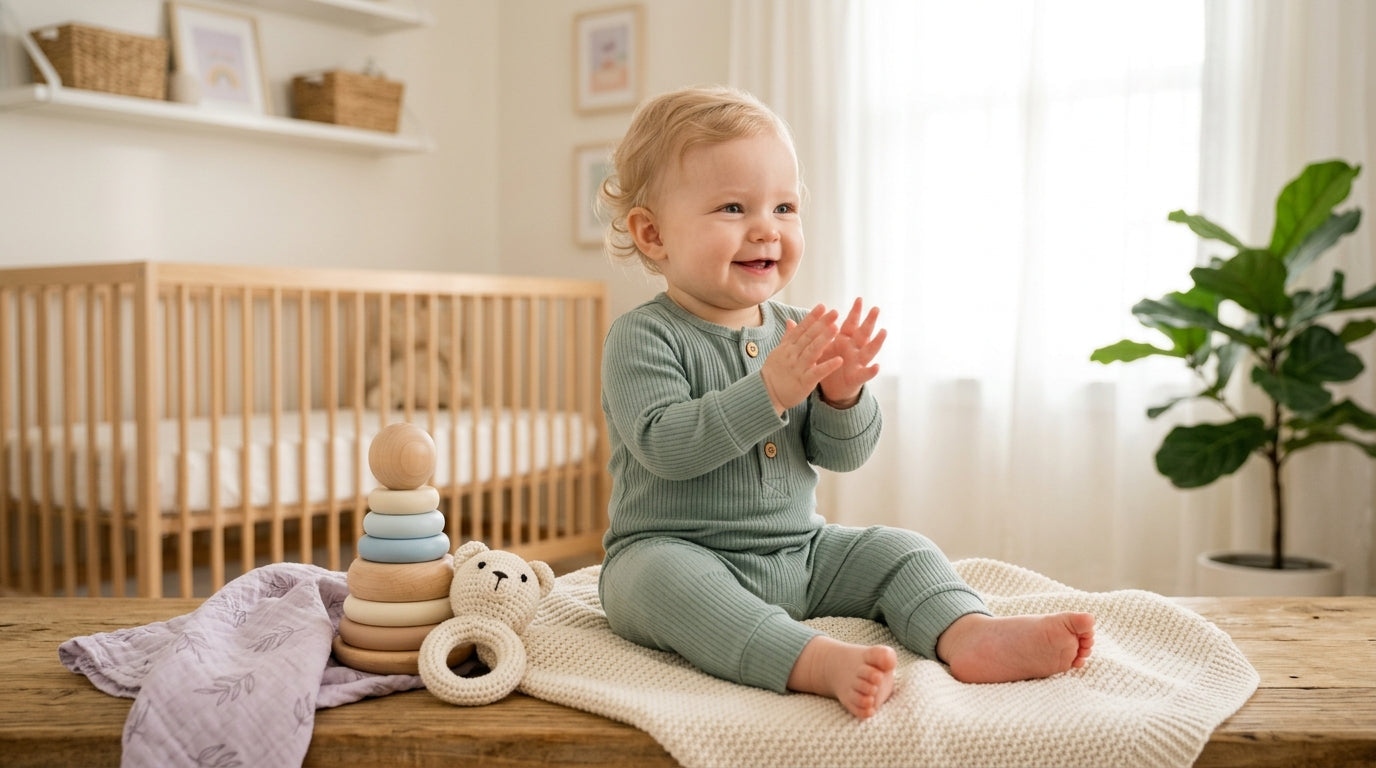
Dear Priya from six months ago.
You're currently sitting on the jute rug in the living room. Your knees hurt. You have sung some variation of pat-a-cake forty-seven times today. Your coffee is cold and your eight-month-old is staring at you like you're a localized weather event.
You're clapping your hands together like a trained seal, leaning in way too close to her face, projecting a manic energy that's frankly alarming. You're doing this because yesterday at the library storytime, Maya's kid started aggressively applauding the librarian, and your kid just sat there eating a board book.
You went down a dark internet rabbit hole at 3 a.m. last night. You were typing so fast with one thumb in the dark that you searched "babi won't clap" and then ended up on some archived forum from 2011 where someone named Susan said her "babie" clapped at four months old. Susan is a liar, yaar. But you believed her, and now you're sweating through your shirt trying to force a neurological milestone.
I'm writing this from the future to tell you to stop. Put your hands down. Drink the cold coffee. It's going to be fine.
The neurological gymnastics of applause
As a pediatric nurse, I used to chart developmental milestones all day long. In the hospital, we triage based on breathing and bleeding. It's highly objective. You're either oxygenating or you're not. But in the wild, out here in the suburbs, parents triage based on who has mastered the pincer grasp and who can applaud on command. It's a sickness.
I forgot all my clinical training the second they handed me my own kid. I started treating the milestone charts like a syllabus I was failing.
When I finally broke down and brought a literal flowsheet of missing gestures to my daughter's nine-month well-visit, Dr. Gupta just sighed. My pediatrician told me that the clapping timeline is a massive, blurry spectrum. They say it's about the cerebellum connecting with the motor cortex, or maybe the frontal lobe, I honestly blanked during that part of neuro. But basically, a baby has to develop the core strength to sit up without tipping over, the shoulder stability to lift both arms, and the spatial awareness to bring two meat paddles together in the exact midline of their body.
That's a lot of math for a brain that just figured out it has feet.
Dr. Gupta said babies usually start showing the prerequisite coordination around eight or nine months, but the actual, purposeful clapping mostly happens between ten and twelve months. Sometimes fifteen. It happens when the neural pathways decide to sync up, not because you sang louder.
That mommy group rant I promised
I need to talk about the competitive clapping for a minute. There's this phenomenon where parents treat their infant's hand sounds as a direct reflection of their own intelligence. You will go to a music class and see mothers aggressively holding their child's wrists, forcing their hands together on the beat like they're operating a tiny, fleshy percussion instrument.

They look around the room to make sure everyone sees that their child is participating. It's wild.
We attach so much meaning to clapping because it's the first time they validate us. For months, you just pour milk and love into this screaming void. Then one day they smack their hands together when you walk in the room, and you finally feel seen. We want the applause. We want to know we're doing a good job.
But forcing it doesn't work. Waving, pointing, high-fives. It's all just imitation until it's communication. Let them figure out their hands on their own time.
Toys that accidentally teach the midline
Listen, instead of grabbing their wrists like a tiny hostage and forcing their hands together while you sing loudly, just scatter some specific objects around their play space and let them discover the acoustics of collision.
Before babies clap their hands, they clap things. They need to figure out that two objects coming together in the center of their body makes a satisfying noise.
I actually tricked my daughter into finding her midline by using the Bunny Teething Rattle with the floral crown. This is probably my favorite thing we own. It's just a beechwood ring with a crochet bunny head on it, but the weight of it's perfect. I'd hand her the bunny in her right hand, and a wooden block in her left. Because the wood ring on the bunny is hard, when she accidentally smashed it into the block, it made this loud, hollow thwack.
She paused. Looked at her hands. And then did it again. That was her first clap. It wasn't skin on skin, it was wood on wood. The crochet part got completely soaked in drool because she was teething horribly at the time, but it washes easily with dish soap. The untreated wood is safe, which is great because she mostly just tried to swallow the ears.
We also have the Koala Teething Rattle, which functions exactly the same way. Sometimes I'd give her the bunny and the koala and let them fight it out in the middle of her chest. It builds the exact same shoulder and core muscles needed for actual clapping. Plus they look cute sitting on the rug.
I'll say, we also got the Llama Teether. It's cute. The rainbow heart design is nice. It's great for actual teething because you can throw the silicone in the fridge and it numbs their gums. But for learning to clap, it's useless. It's so soft that when they bang it against something, it makes zero noise. Without the acoustic feedback, my kid just dropped it and crawled away. Buy it for the molars, not for the milestones.
If you're currently trapped in the teething trenches while simultaneously obsessing over motor skills, you can explore Kianao's organic teething toys collection to find things they can safely smash together.
When the silence actually means something
I wrap all this medical advice in sarcasm because humor is how I cope with the crushing anxiety of motherhood. But I also know why you were up at 3 a.m. Googling.

You aren't worried about the clapping. You're worried about what the lack of clapping means. You're terrified of autism spectrum disorder, or global developmental delays, or some failure in the wiring that you missed because you were too busy looking at your phone.
I've seen a thousand of these anxious charts in the clinic. The truth is, a single missing milestone is rarely a siren. It's a data point. If your baby is twelve months old and not clapping, but they're pointing at the dog, making eye contact, babbling, and waving bye-bye, they're likely just prioritizing different skills. Maybe they're working on walking. The brain can only renovate one room at a time.
However.
My pediatrician rule of thumb is this. If you hit fifteen months and there are no gestures at all. No waving, no pointing, no reaching to be picked up, no clapping. Or, if they used to do these things at ten months and suddenly stopped making eye contact and stopped gesturing entirely. That's when you stop Googling and you start calling. Early intervention is basically magic, but you've to open the door for them. Don't let the fear of a label keep you from getting your kid some occupational therapy.
Just wait it out
So, dear past Priya. When do babies start clapping. Whenever they feel like the show was good enough to warrant it.
Your kid is fine. In a few months, she's going to start clapping when the dog vomits on the rug. She is going to clap when you drop a glass jar of pasta sauce in the kitchen. She will applaud your minor tragedies with the exact same enthusiasm she applauds the Mickey Mouse clubhouse.
You will miss the quiet.
If you need tools to help them practice bringing their hands together while keeping their mouths safe from plastic, check out Kianao's sustainable play gear to build that core strength.
The messy questions everyone asks
What if my baby claps the backs of their hands together?
Mine did this for a solid month. It looked like she was trying to brush dust off the back of her knuckles. It's totally normal. Proprioception is hard. They know the hands are supposed to meet, but they haven't figured out the rotation of the wrists yet. They look a bit broken, but they figure it out eventually. Just let them look weird for a while.
My ten-month-old used to clap and now they stopped. Should I panic?
I panicked over this exact thing. Kids drop skills all the time when they're learning a new one. It's like their RAM gets full. If they're suddenly putting all their energy into pulling up to stand, the clapping might disappear for three weeks. As long as they haven't lost all their social skills and eye contact, they're just distracted by their legs.
Is banging two toys together the same developmental milestone?
Clinically, it's the prequel. Banging blocks together requires the same midline crossing and shoulder stabilization. It's actually sometimes easier for them because the objects give them a bigger target to hit than their own tiny palms. If they're aggressively smashing wooden rings together, the actual skin-on-skin clapping is right around the corner.
Does clapping mean they're genuinely happy?
At first, no. At nine or ten months, it's purely a party trick. They're just imitating a motion they saw you do. They don't know it means "good job." But around twelve to fifteen months, the cognitive shift happens. They realize clapping equals excitement. That's when they start applauding their own snacks.
How long should I practice clapping with them every day?
Zero minutes. Don't make this a drill. Babies learn through play and observation. Just live your life, clap when you're genuinely excited about something, and let them watch you. If you sit them down for a clapping seminar every morning, you're going to make both of you miserable. Put on some music, dance around, and let the motor cortex do its thing.




Share:
When Babies Pull to Stand: The Messy, Exhausted Reality
Panic vs reality: exactly when do babies start to talk anyway