

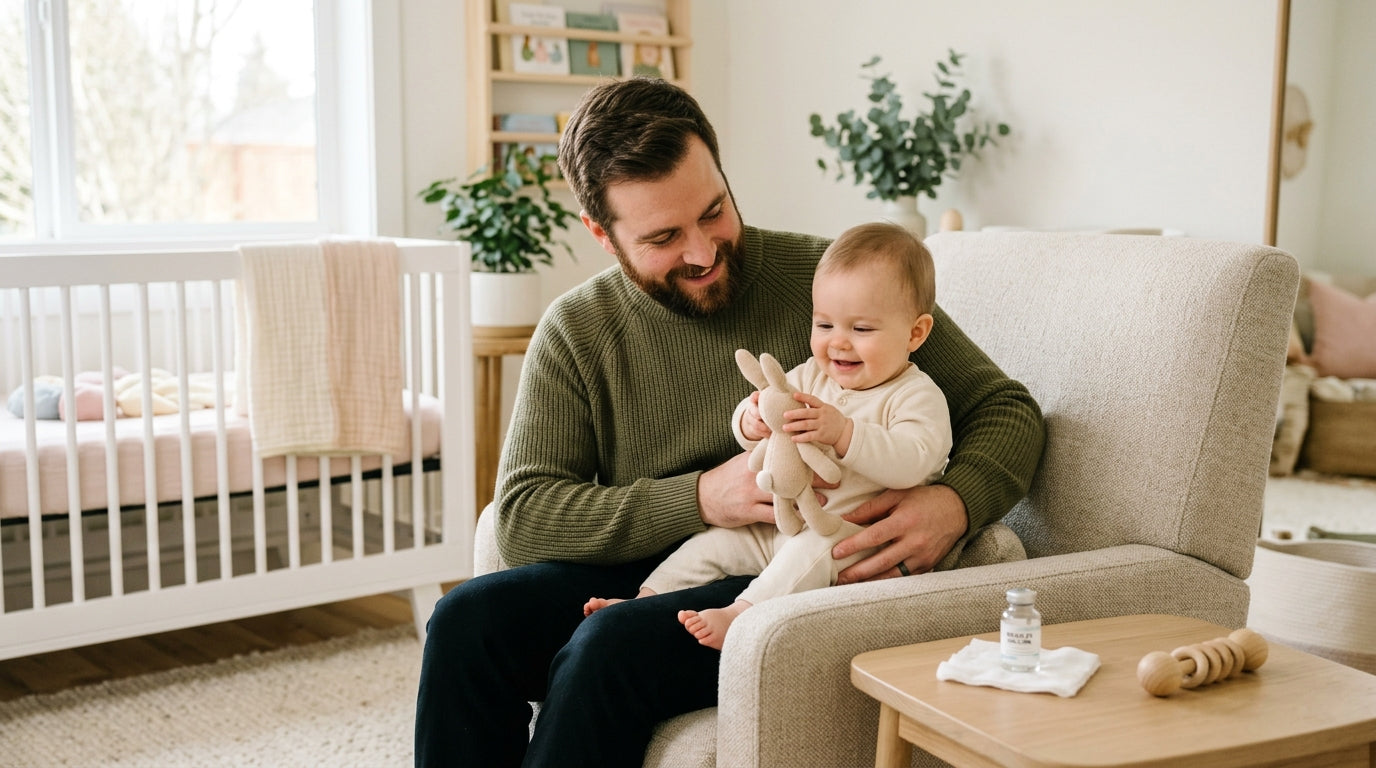
I was sitting in Dr. Lin's examination room with a color-coded spreadsheet printed on actual paper, which should tell you everything about my mental state at the time. My daughter was six months old, we were exactly three weeks out from a fourteen-hour travel day to London for my sister-in-law's wedding, and I had been consuming local health authority data dashboards like they were sports scores. My wife, Sarah, was staring at the ceiling, pretending she didn't know me. I slid the spreadsheet across the paper-covered examination table, pointed to the row labeled "MMR," and asked our pediatrician if we could just force the update early.
Before becoming a dad, I viewed the human immune system like a blank hard drive. You're born, you encounter viruses or vaccines, and your body writes the code to defend against them. Simple. Therefore, if we were taking our infant into an international airport—which is basically a global exchange hub for respiratory droplets—I wanted all the defensive software installed immediately. I had spent three nights scrolling through Reddit threads, typing frantic queries like "can my babie get the shot early" and "babi health travel protocols" into search engines while bouncing on a yoga ball at 3 AM. I was convinced that the standard immunization timeline was just a suggestion that I could optimize.
Dr. Lin looked at my spreadsheet, looked at me, and gently explained that biology doesn't care about my itinerary. The timeline for when infants are allowed to receive this specific immunization is locked behind a fascinating, highly annoying biological mechanism that I had completely misunderstood.
The Legacy Code Problem
Apparently, babies aren't born with blank hard drives. When my daughter was in utero, Sarah's immune system basically transferred a massive bundle of legacy firewall code—maternal antibodies—directly into her bloodstream. This borrowed immunity is incredibly cool, but it acts like highly aggressive security software during the first year of life.
Dr. Lin tried to explain that the measles, mumps, and rubella (MMR) shot is a live vaccine, meaning it contains a safe, severely nerfed version of the virus. If you inject that data into a newborn, those maternal antibodies instantly recognize it, attack it, and delete it from the system before the baby's own immune cells even have a chance to log the event and learn how to fight it. You're basically dropping a software patch into a firewall that immediately shreds it.
Which is why the standard protocol mandates waiting until 12 to 15 months of age. By that point, the legacy antibodies from the mother have naturally degraded and faded out of the baby's system, meaning the baby's hardware can finally process the vaccine on its own and write its own permanent defense code. Hearing this completely shattered my illusion of control, realizing my daughter was currently operating on a temporary, expiring license key of maternal immunity that I couldn't monitor or measure.
Brute-Forcing the Travel Protocol
But there's a weird loophole, which is what we ended up utilizing. If you're traveling internationally, or if you happen to live in a city experiencing an active outbreak, pediatricians will sometimes authorize an early "bonus dose" for infants between 6 and 11 months old. Because we were flying to London, Dr. Lin approved it.
Here's the catch that nobody tells you: this early dose doesn't actually count toward their permanent record. Because those maternal antibodies are still hanging around, the retention rate for this early patch is notoriously unreliable. From what I understand, I read a study from some children's hospital suggesting that a huge percentage of kids who get this early shot lose the protective antibody levels within a few years anyway. So even if you get the early travel shot at 8 months, you still have to go back and get the official 12-month dose, and then another booster when they hit school age.
We got her the early shot. She was cranky for exactly one day, ran a tiny temperature that made me obsessively check the digital thermometer every twenty minutes, and then she was fine. But a vaccine takes a couple of weeks to actually build up any immunity, and in the meantime, I still had to figure out how to transport an infant through an international terminal without her contracting the plague.
This is where physical barriers became my obsession. If I couldn't guarantee her internal firewall was active, I was going to wrap her in external ones. We heavily relied on the Long Sleeve Organic Cotton Baby Bodysuit from Kianao for the flight. I love this thing mostly because it covers her arms entirely, minimizing the amount of bare skin touching those questionable airplane tray tables, but it also saved us during a catastrophic diaper blowout somewhere over Greenland. The lap shoulders meant I could pull the ruined garment down over her legs instead of up over her head, which prevented a biohazard situation in the tiny airplane lavatory. It's soft, it stretches, and it somehow survived me scrubbing it out with hotel bar soap in a sink at two in the morning.
The Physics of Airport Germs
Let me just rant for a second about the sheer impossibility of keeping a baby's hands clean in a public space. Before we left, I had this vision of maintaining a sterile perimeter around her at all times. I packed sanitizing wipes, I planned out our seating arrangements, I calculated the air filtration rate of a Boeing 777.

None of it mattered because an 11-month-old's hands defy the laws of physics. They move with the speed of a striking cobra and possess the grip strength of a rock climber. I'd wipe down the armrest, and in the three seconds it took me to throw the wipe away, she had already touched the bottom of my shoe, grabbed the safety card out of the seatback pocket, and shoved three of her fingers directly into her own mouth. The surface area of an airport is basically infinite, and her desire to lick the most unhygienic quadrant of it's constant. I spent a four-hour layover in Heathrow just playing a desperate, exhausting game of defense against her own limbs.
People on the internet will tell you to just use organic hand sanitizers every five minutes, but honestly, that just gives them wet, sticky hands that they immediately rub into their own eyes, causing a completely different meltdown that you now have to manage in front of hundreds of tired commuters.
Gear That Did And Did Not Help
To keep her hands occupied and out of her mouth, we bought a bunch of teethers for the trip. I've highly mixed feelings about the Violet Bubble Tea Teether we brought along. I'll be brutally honest: trying to scrub airplane lint and crushed crackers out of the tiny silicone boba crevices with a flimsy hotel toothbrush made me deeply question my life choices. When you're jetlagged and exhausted, the last thing you want to do is detail a tiny silicone cup like you're detailing a car engine.
However, I've to admit that it successfully distracted her from licking the tray table for exactly forty-two minutes, which in baby-flight-time is essentially a decade. She loved gnawing on the textured top, and since it's food-grade silicone, I didn't have to worry about what weird chemicals she was ingesting. It's a great product if you've access to a dishwasher, but as a travel toy, it tested my patience.
If you're gearing up for a trip and want to browse things that might actually keep your kid occupied (and clothed in fabrics that can survive a blowout), check out the organic baby essentials collection. Just maybe leave the intricately textured teethers at home if you're staying in a hotel without a kitchen sink.
Outbreaks In Our Own Zip Code
The anxiety doesn't end when you get home from traveling, unfortunately. A few months after our trip, there was a tiny localized outbreak in the Portland area. Only a handful of cases, but when you're the parent of an infant who isn't fully vaccinated yet, any number higher than zero feels like a massive flashing red light on your dashboard.

Since she was under 12 months and her early travel dose was basically expiring data, we went into lockdown mode. We avoided the indoor playgrounds, the crowded coffee shops, and the children's museum where toddlers just run around exchanging fluids like it's a competitive sport. We spent a lot of time on our living room floor.
This is where having decent home gear genuinely saved my sanity. We have the Panda Play Gym Set, which is this minimalist wooden A-frame with a little crocheted panda and a wooden teepee hanging from it. I appreciate this thing on a deeply spiritual level because it doesn't require batteries, it doesn't blink, and it doesn't play a highly compressed, synthesized version of "Old MacDonald" that makes me want to throw it out a window. It just sits there, looking aesthetically pleasing and vaguely Scandinavian, while she bats at the wooden stars. It kept her happily occupied on the rug while I neurotically refreshed the county health department's website to see if the local case count had gone up.
What I Honestly Know Now
Before all of this, I thought parenting was going to be a lot more like software engineering. I thought there would be clear inputs and expected outputs. I thought I could just read the documentation, apply the patches on my own accelerated schedule, and guarantee a bug-free experience for my kid.
The reality is that their little bodies are running on highly complex, messy legacy systems that operate on timelines we can't completely control. You can't hack the immunization schedule. You just have to trust your pediatrician, accept the weird limbo of the first year, and try to keep them reasonably shielded from the sneezes of strangers without losing your mind in the process.
If you're currently in that weird waiting period before the 12-month mark, trying to figure out how to safely leave your house without putting your kid in a plastic bubble, you're not crazy. It's a stressful window of time. If you need some gear to make the isolation or the travel slightly more bearable, take a look at Kianao's wooden play gyms or breathable layers before you finalize your game plan.
My Frantic Dad FAQs
Can my baby just get the MMR vaccine at 6 months to be safe?
From what Dr. Lin drilled into my head, you really only do this if you're flying internationally or living in the middle of a hot zone. If you just give it to them at 6 months for fun, the mother's lingering antibodies will just destroy the vaccine before it works, meaning you put them through a needle poke for absolutely no long-term benefit. Always ask your own doctor, obviously, but they generally won't do it unless there's an active risk profile.
What happens if we get the early travel shot? Do we skip the 12-month one?
Nope. This was the most frustrating part to learn. The early shot is basically a temporary patch with terrible data retention. Because of those maternal antibodies messing with the process, the early vaccine's protection drops off a cliff after a while. You still have to go back and get the official 12-to-15-month dose to write the permanent code into their immune system.
Does breastfeeding seriously help protect them before they can get vaccinated?
Apparently, yes. Sarah was nursing, and our pediatrician mentioned that breastmilk acts like a real-time data transfer of antibodies. If the mother comes into contact with a virus, her body produces antibodies and passes them through the milk to the baby. It's not a bulletproof shield, and it doesn't replace a vaccine, but it's a pretty amazing supplementary defense mechanism while you're stuck in that first-year waiting period.
What if my infant is exposed to an active case before they're old enough for the shot?
I asked this exact question during one of my anxiety spirals. If an infant under 6 months gets exposed, doctors won't give them the vaccine. Instead, they apparently give them a shot of something called immunoglobulin within a few days of the exposure, which is basically an instant injection of immune proteins to help fight off the virus. It's an emergency intervention, not a preventative schedule thing.
What are the actual side effects if we do get the early travel dose?
For us, it was just system lag. She ran a low-grade fever for about 24 hours and was incredibly grumpy. Dr. Lin warned us she might get a tiny, mild rash a week or two later, which is just the body processing the weakened virus, but we never saw one. It was honestly less dramatic than her reaction to teething, though I still checked her temperature roughly eighty times in one afternoon.




Share:
The Unvarnished Truth About Your Infant's Shifting Eye Colour
The Great Eye Colour Waiting Game: A London Dad's Guide to Melanin