

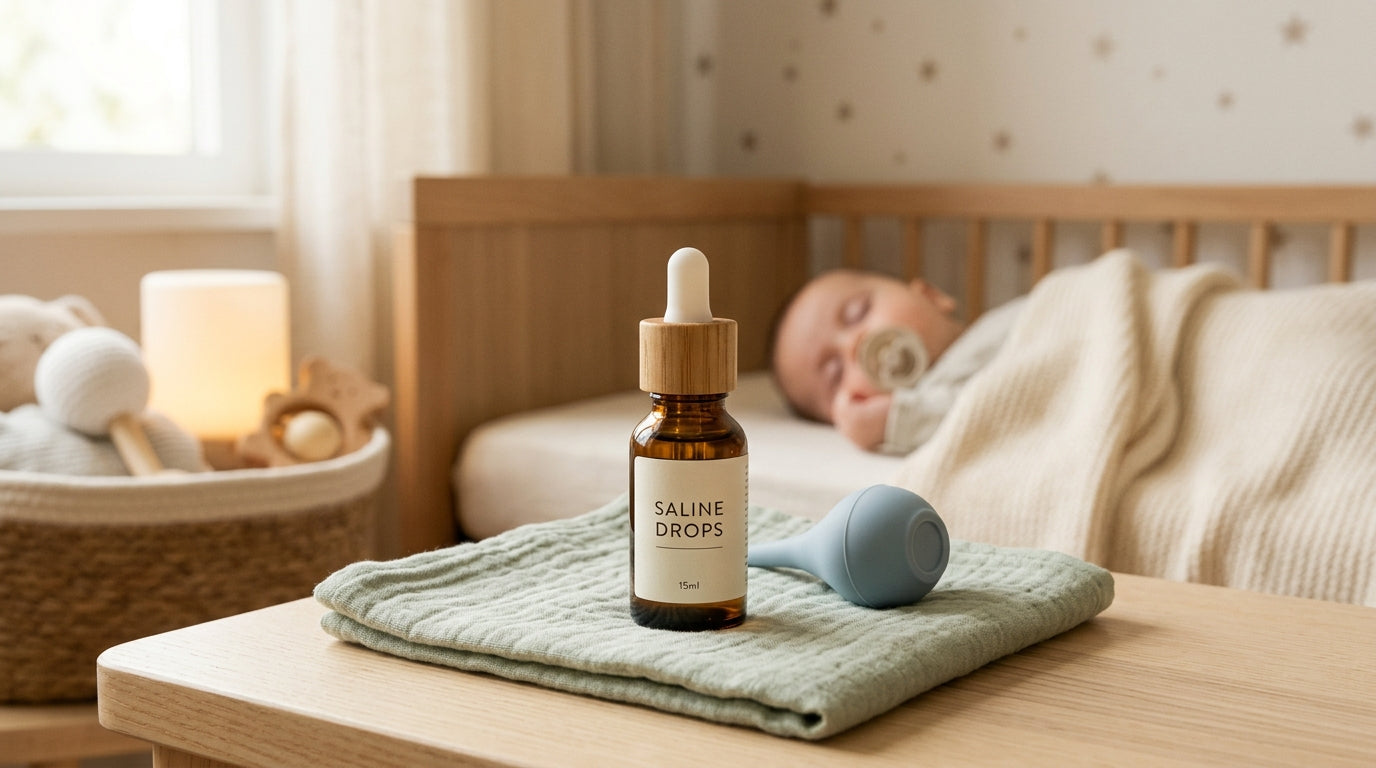
The baby monitor is a liar. It amplifies every rustle of a sleep sack until it sounds like a break-in. But at two in the morning, the sound that actually pulls you from your REM cycle is the death rattle. It's this wet, whistling, ungodly noise coming from the bassinet. You stand over them in the dark, convinced their lungs are collapsing. You shine your phone flashlight into their face, blinding them, only to discover the culprit. It's a single, solitary booger. It's practically microscopic. But because infants are obligate nose breathers, that tiny fleck of dried mucus has turned your child into a wheezing pug.
Before I had a kid, I thought salt water was just a crunchy alternative for parents who were afraid of actual medicine. As a pediatric nurse, I handed out little plastic ampules of the stuff like candy. I thought I knew what I was doing. As a mother, I realize I was wildly under-educating those parents. I should have been giving them combat training.
Listen. Getting liquid up a tiny nostril is a full-contact sport. You're going to need strategy, patience, and a complete disregard for your child's temporary outrage.
The cold medicine myth I completely believed
There was a time I assumed you could just dose a congested infant with a tiny syringe of cherry-flavored decongestant. My doctor laughed at me. She reminded me of what I used to tell patients at the hospital. We don't give cough and cold syrup to the little ones. The AAP strictly prohibits it, mostly because the side effects are terrifying and unpredictable.
But when you've a crying, sputtering child, doing nothing feels like a failure. You want to fix it. You want a chemical solution. I used to browse those trendy online babi boutiques looking for some magical, overpriced eucalyptus rub. It turns out the only safe, doctor-approved intervention is literal salt water.
I guess the 0.9 percent sodium chloride roughly matches the natural saltiness of the human body. The medical theory is that salt water soothes the inflamed sinus tissues better than plain water, which apparently just dries them out more. Honestly, my understanding of the exact cellular mechanism is a bit fuzzy these days. I'm just pretty sure it works by turning the hardened cement in their nasal cavity back into a liquid state so it can eventually exit the building.
Never use adult nasal spray
I've seen a thousand of these cases in the ER. Tired parents, desperate for sleep, grab whatever is in their own medicine cabinet. They find a bottle of oxymetazoline spray and give the baby a quick squirt.
This is a disaster. Adult nasal decongestants cause the blood vessels in the nose to constrict violently. It clears the airway for about an hour, and then the body panics and floods the area with even more blood and swelling. We call it the rebound effect. The congestion comes back twice as bad, and now the nasal tissue is chemically dependent on the spray just to function. It's a miserable cycle to break. Stick to plain, boring, unmedicated saline. It has zero drugs in it. You can use it fifty times a day if you really want to, though your child will probably stop speaking to you.
The hospital bulb syringe is a biological weapon
Let's talk about the suction device. When you give birth, the hospital sends you home with this teal rubber bulb syringe. They tell you to use it to clear the airways. They make it look so easy.
I despise that blue bulb. You can't see inside it. You squeeze it, stick it in the nose, and release. Maybe it pulls out some snot. Maybe it just makes a sad honking noise. Then you rinse it in the sink and throw it in a drawer. Six months later, you cut it open on a whim and discover a thriving ecosystem of black mold growing in the dark, damp belly of the bulb. You have been shooting mold spores directly into your baby's skull. It's horrifying.
Throw the bulb away. Buy one of those silicone tube aspirators where you use your own lung power to suck the snot out. Yes, it sounds disgusting. Yes, there's a filter to stop the mucus from entering your mouth. You will get over the gross factor the first time you see how effectively it clears the blockage. Just don't use your actual mouth directly on the baby. That's a great way to give yourself whatever rhinovirus is currently tearing through your daycare.
If you want to make your own saline water at home, you've to boil the tap water for ten minutes and use non-iodized salt, but honestly, who has the energy for amateur chemistry when you can just buy a sterile bottle for three dollars.
The midnight triage protocol
Applying nasal drops requires the kind of physical restraint usually reserved for wild animals. You can't reason with an eight-month-old. They don't care that you're trying to help them breathe.
The standard advice is a series of polite suggestions. Lay the child down. Support the neck. Use the drops. Wait calmly. Suction gently.
Here's what actually happens. You pin their flailing arms under a swaddle blanket, wedge their head gently but firmly between your forearms, squeeze three or four drops into the left nostril while they scream bloody murder, and then you just have to wait.
The waiting is the most critical part of the entire operation.
You can't squirt the saline in and immediately start suctioning. The salt water needs at least sixty seconds to break down the proteins in the thick mucus. If you go in too early with the aspirator, you're just going to irritate the nasal lining and pull out clear liquid, leaving the actual blockage perfectly intact. So you sit there for a minute or two, holding a furious, wet-faced toddler. I usually hum a song or softly tell him it's okay, *beta*, even though he clearly thinks I'm trying to waterboard him.
After a minute, you apply the suction. The amount of material that comes out of such a small face will shock you. It's deeply satisfying in a very weird, primitive way.
The gear that keeps us sane
When you're dealing with a sick infant, you need distractions. You need things to occupy their hands so they're not clawing at your face while you try to use medical care.
I used to think wooden teething toys were just aesthetic props for Instagram moms. Then my kid got his first upper respiratory infection. I handed him the Crochet Bunny Rattle Teething Toy from Kianao right before I brought out the saline bottle. It's actually my favorite thing we own. He gets completely fixated on the wooden ring and the little crochet ears. I shake it, he grabs it and shoves the ears in his mouth, and while he's distracted chewing on organic cotton, I ambush his nose with the drops. It buys me exactly four seconds of compliance, which is all I need. Plus, it survives getting dropped on the hardwood floor about ten times a day.
Our collection of baby gear has slowly evolved from things I thought looked cute to things that genuinely serve a tactical purpose in the trenches.
The vomit factor no one warns you about
Here's a piece of clinical knowledge I learned the hard way in my own living room. Timing is everything.

Don't use nasal drops right after a feeding. Don't do it. Just trust me on this.
When you loosen all that congestion, a lot of it drains down the back of the throat. If your baby has a stomach full of warm milk, that sudden influx of salty post-nasal drip is going to trigger their gag reflex. You will clear their nose perfectly, and then they'll immediately exorcist-vomit all over your clean sheets, the rug, and your only clean pair of sweatpants. I've spent too many 3 AM shifts doing laundry because I forgot this rule.
Always do the saline routine about thirty minutes before you feed them. It clears the airway so they can honestly latch and swallow without suffocating, and their stomach is empty enough to handle the drainage.
Hydration and the mouth-breathing babie
When their nose is totally blocked, babies have to breathe through their mouths. This dries out their throat, making them cough more, which makes them cry, which creates more snot. It's a terrible feedback loop. Keeping them hydrated is half the battle.
If you've an older infant or toddler, getting them to drink water when they feel miserable is tough. We use the Silicone Mug Set. It's slightly weighted at the bottom so he can't instantly knock it over, and the soft edges don't hurt his teeth when he clumsily jams it against his face. I just keep it filled with room temperature water nearby. He takes tiny sips throughout the day, which helps thin out the mucus naturally from the inside.
with actual meals during a cold, expectations need to be on the floor. A sick toddler is not going to eat a beautifully curated plate of steamed vegetables. They're going to want beige carbohydrates. I serve buttered toast on our Baby Silicone Plate. Honestly, the plate is just okay. The suction base is aggressively strong, which prevents him from throwing it across the room when he's frustrated by his own congestion. But the little bear ear compartments are too small to hold anything useful. I usually just put two blueberries in there to appease him. The main section holds the toast. It works well enough, and when he's sick, I'm not fighting him on presentation.
Knowing when to fold and call the doctor
Most of the time, a stuffy nose is just a stuffy nose. You use the drops. You suction. You run a cool mist humidifier in the corner of the room. You survive.
But sometimes, the saline is not enough. As a nurse, I've to give you the disclaimer. If you look at your baby's chest and see the skin sucking in hard under their ribs or at the base of their neck, that's called retractions. It means they're working way too hard to pull air in. If they're flaring their nostrils wildly with every breath, or if they're grunting at the end of an exhale. That's when you stop messing around with salt water and drive to the doctor or the ER.
But for the standard, run-of-the-mill daycare crud? The saline is your best friend. It's messy, it's loud, and nobody enjoys the process. But when you finally clear that blockage and hear the silent, steady rhythm of your baby breathing easily through their nose again, it feels like winning a gold medal. You wipe the tears off their cheeks, rub a little balm under their chafed nose, and lay them back down.
It's just snot, yaar. We can handle snot.
If you're stocking your nursery for cold season, make sure you've the basics covered. Explore our teething and feeding essentials to keep them distracted and hydrated when the inevitable sniffles hit.
Frequently Asked Questions
Can I use breastmilk instead of saline drops in my baby's nose?
I see this floating around the internet all the time. Listen, breastmilk is great for a lot of things, but I'm highly skeptical of shooting it up a nasal cavity. My doctor told me to stick to sterile saline. Breastmilk has sugars in it, and leaving stagnant sugar sitting in a warm, dark sinus cavity just sounds like an invitation for a bacterial infection. I stick to salt water. It's cheap and it doesn't harbor bacteria.
How many times a day can I use the nasal drops?
Technically, since there's no medication in them, you can't really overdose a baby on pure saline. I use them whenever my son sounds like a percolating coffee pot. Usually, this means right before naps, right before bedtime, and maybe before a big meal. But I try not to suction more than three or four times a day. The suctioning itself can irritate the fragile lining of the nose if you do it constantly. Sometimes you just have to let the nose run and wipe it gently.
My baby screams when I try to put the drops in. Am I hurting them?
You're not hurting them, they're just deeply offended. Nobody likes having liquid squirted up their nose. It feels weird and invasive. The crying seriously helps a little bit because it opens up the airway and forces the mucus forward. Just make sure you're using a soft-tipped applicator and not jamming the plastic tip far up into the nostril. Keep it right at the entrance. The outrage will pass the minute they realize they can breathe again.
Do I've to use a suction device after the drops?
Not always. If it's just dry winter air making their nose crusty, sometimes I just drop the saline in to moisturize the tissue and leave it alone. The baby will usually sneeze a few minutes later and blow the softened booger out onto their shirt. But if they're heavily congested and can't clear it themselves, the suction is necessary to honestly remove the blockage. The drops just prep the site.
Can saline drops cause ear infections?
The drops themselves don't cause ear infections. Ear infections happen because the eustachian tubes in babies are very short and horizontal, making it easy for fluid and bacteria from a cold to back up into the ear drum. If anything, keeping the nasal passages clear with saline helps reduce the pressure and drainage, which might really help prevent the ear infection. But if your baby is tugging at their ear and running a fever, the saline is not going to fix it. Call the doctor.




Share:
Dear past Priya, please stop trying to scrub baby skin raw
The Truth About The Saja Boys Baby: A Midnight Panic Explained