

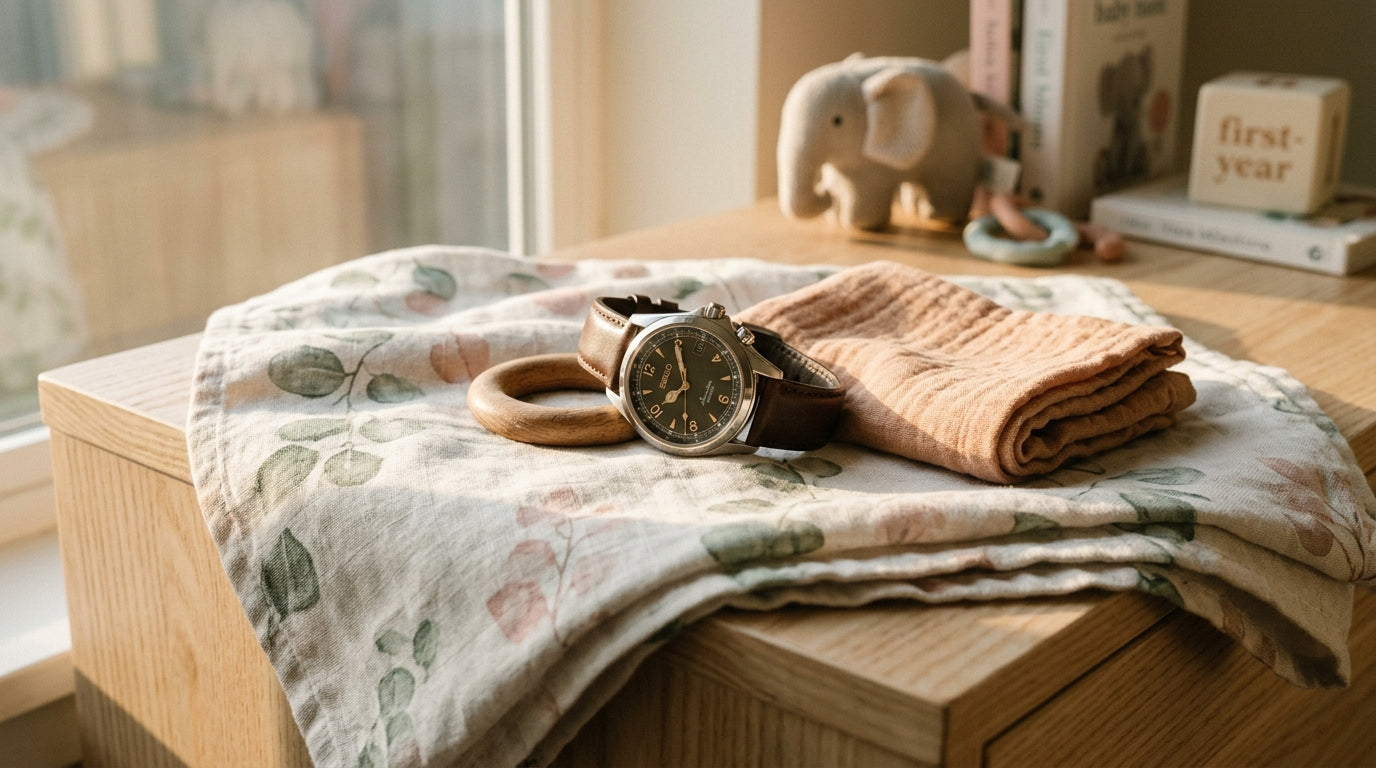
My left wrist vibrated with a Slack notification from my engineering manager right at the exact moment my son sneezed a mouthful of mashed sweet potato across my chest. It was a Tuesday, roughly 6:14 AM. I was wearing my smartwatch, an organic cotton t-shirt that used to be white, and a look of big, hollow exhaustion. As I tried to wipe the orange sludge off my digital screen, I accidentally swiped right, calling my boss on speakerphone while the baby began screaming because the dog had stolen his sock. The sensory feedback loop was absolute hell.
I realized right then that I needed to downgrade my personal hardware. Parenthood is overstimulating enough without a computer strapped to your arm telling you your heart rate is elevated. Of course my heart rate is elevated—I'm trying to keep a tiny, suicidal human alive in a house full of sharp corners. I needed a watch that just told the time. Something analog. Something that could survive being submerged in bathwater, covered in oatmeal, and violently yanked by a creature who currently possesses the grip strength of a mountain gorilla.
That's how, standing in the Portland drizzle outside a coffee shop while the baby slept in his carrier, I fell down a Reddit rabbit hole and discovered the Seiko SPB155, affectionately known by watch nerds as the "Baby Alpinist."
A terrible name for a piece of adult hardware
Let me clear something up immediately because my wife definitely had questions when she saw the browser tabs on my laptop. The Seiko Baby Alpinist is not a product for babies. You don't strap a $700 mechanical timepiece to an 11-month-old. Apparently, horology enthusiasts just slap the word "baby" onto any watch that's slightly smaller than its predecessor.
When the package arrived, I had to explain to my wife that the "baby" part just meant it lacked the internal compass bezel of the original 1959 Seiko Alpinist and was shrunk down to a very reasonable 38mm case diameter. She looked at me, looked at the watch, and then gently reminded me that if one of the tiny metal spring bars popped off, it would become an immediate choking hazard. I actually brought this up at our next wellness visit. My pediatrician gave me this deeply tired smile and said something along the lines of keeping all jewelry components out of the crib, so I mostly just try to make sure he doesn't use it as a pacifier. Everything is a potential threat when your kid is in the phase of testing the world's physical properties via his mouth.
But the 38mm size is actually a massive tactical advantage for a dad. When you're constantly reaching under a squirming infant to snap up their clothes, a giant, chunky dive watch is a liability. You end up scraping their legs. The Baby Alpinist slides right under the cuff of a jacket and stays completely out of the way when I'm wrestling him into his Organic Cotton Baby Bodysuit. Honestly, that bodysuit is one of the only garments we own that handles his sudden, unpredictable thrashing without ripping, mostly because of that 5% elastane stretch, but also because I don't get a massive watch crown caught on the envelope shoulders every time I dress him.
The bathtub splash zone data
Parenthood requires gear with ridiculous tolerances. You think you live a calm, indoor life until you're tasked with bathing a child who has suddenly decided he's an Olympic swimmer trying to break the world record for water displacement.

The Baby Alpinist features 200 meters of water resistance and a screw-down crown. I've no intention of scuba diving to 600 feet, but I absolutely need military-grade waterproofing for 7:00 PM in my own bathroom. I track the bathwater temperature religiously—aiming for exactly 37.5 degrees Celsius—and once he's in the tub, my arms are submerged up to the elbows. I used to take off my old dress watch and leave it on the sink, which meant I never knew how long he'd been in the water. Now, I just plunge my arm right in. The Seiko doesn't care. It survives the soapy water, the sudden splashes, and the frantic towel-drying process without fogging up.
It also has a domed sapphire crystal. Apparently, sapphire is grown in a lab and is second only to diamonds in hardness, which is critical because my son's favorite new game is smashing his toys directly into my left arm. We have this Gentle Baby Building Block Set that we bought a while ago. They're just okay. They float in the tub, which is nice, but as an engineer, it deeply annoys me that the math symbols printed on them don't actually form logical equations. You can't add a fruit icon to a number three and equal a zebra. But whatever, he likes chewing on them and banging them against the watch face, and so far, the sapphire hasn't scratched once.
Resolving the stainless steel teething crisis
Right around month eight, my son initiated a massive firmware update. His first bottom teeth started coming in, and his entire operating system crashed. He was drooling everywhere, waking up every two hours, and trying to bite literally anything that offered resistance.
For a few dark days, his target of choice was the stainless steel bracelet of my Seiko. He would grab my wrist, pull it to his face, and try to gnaw on the metal clasp. Obviously, dragging tiny, fragile new teeth across brushed steel is a terrible idea for both the kid and the watch. We tried freezing wet washcloths. We tried distracting him with wooden spoons. Nothing worked until we finally got the Panda Teether.
I'm not exaggerating when I say this piece of silicone saved my remaining sanity. The flat, wide shape meant he could genuinely grip it with his clumsy little hands without dropping it every four seconds, which meant I didn't have to bend down to pick it up off the floor 800 times a day. It has all these different textured zones that he would violently grind his gums against while maintaining intense, unblinking eye contact with me. I started keeping it in the fridge next to my IPAs. Whenever he'd make a dive for my watch, I'd quickly swap in the cold panda. It was a flawless redirection tactic. Plus, it's basically indestructible—I just throw it in the top rack of the dishwasher every night while I'm sanitizing the bottle parts.
My ongoing feud with the 6R35 movement
Let me complain for a minute, because if you're going to spend this kind of money on an analog watch, you need to know the cold, hard data. Inside the Seiko Baby Alpinist is the 6R35 automatic movement. It winds itself using the kinetic energy of your arm moving. Theoretically, bouncing a baby for six hours a day gives this thing enough juice to power a small village.

It has a 70-hour power reserve, which is legitimately incredible. If I take the watch off on Friday night and leave it on my dresser, it'll still be ticking when I put it on Monday morning for my first Zoom call. That part is brilliant.
But the accuracy? It drives my analytical brain completely insane.
Seiko claims the 6R35 operates within a tolerance of -15 to +25 seconds per day. In the software world, a variance that large would crash the server. I genuinely tracked it on a spreadsheet for two weeks, measuring it against an atomic clock app on my phone. Some days it ran 10 seconds fast. Other days, it lost 5 seconds. It's wildly inconsistent. It behaves exactly like my 11-month-old's nap schedule. You think you've the algorithm figured out, you plan your afternoon around a two-hour sleep window, and then boom—he wakes up after 34 minutes and the whole system is thrown into chaos.
I constantly have to unscrew the crown and hack the seconds hand to sync it back to reality. It's frustrating, but in a weird way, it forces me to check out of my digital ecosystem and perform a physical maintenance task. (Also, the bracelet taper doesn't go quite narrow enough at the clasp, but honestly, that's barely noticeable once you get used to it).
LumiBrite and the midnight troubleshooting sessions
If you're reading this, you probably already know about the midnight shifts. You wake up in the pitch dark. You don't want to look at your phone because the blue light will destroy whatever melatonin you've left in your brain, but you desperately need to know if it's 2:00 AM or 5:00 AM. If it's 2:00 AM, you're giving a bottle and going back to bed. If it's 5:00 AM, congratulations, your day has started.
The Baby Alpinist has these cathedral-style hands filled with Seiko's proprietary LumiBrite material. Apparently, it absorbs ambient light during the day and emits it in the dark. I don't fully understand the chemistry, but I do know that at 3:17 AM, when I'm standing in the nursery swaying like a zombie, I can look down at my wrist and clearly read the time. It glows a faint, radioactive-looking green. It gives me exactly the data I need without blasting my retinas with notifications about emails I can't answer anyway.
It's weird to think of a luxury watch as a piece of parenting survival gear, but it really is. It detaches you from the stress of the internet while keeping you anchored in the present physical moment, whether that moment involves reading a board book for the twelfth time or wiping squash off the ceiling.
If you need a hardware reset in your own parenting journey, I highly suggest swapping your smartwatch for something mechanical. Put the phone in another room, strap on a watch that can survive the splash zone, and just be offline for a while. You can explore more ways to upgrade your analog parenting setup in Kianao's baby essentials collection.
And seriously, if your kid is trying to eat your stainless steel jewelry, save your watch crystal and get the right gear.
Shop the Panda Silicone Teether here before your baby destroys your favorite accessories.
My disorganized answers to your watch questions
Are mechanical watches safe to wear around a baby?
Mostly yes, but with asterisks. The watch case itself is just a hunk of polished steel, which is fine, but you've to watch out for the tiny spring bars that connect the bracelet to the case. If your kid somehow manages to break the bracelet and swallow a spring bar, you're taking a trip to the ER. My rule is simple: the watch stays on my wrist. If I take it off, it goes on a high shelf out of his reach. Never let them play with it unsupervised.
Why do they call it the Baby Alpinist?
Because watch people are weird and bad at naming things. It's just a smaller (38mm) version of the classic Seiko Alpinist watch without the compass ring. It has absolutely zero features designed for an actual human infant, unless you count the fact that the textured dial looks kind of like the oatmeal my son spits on the floor.
Will baby bath water ruin an automatic watch?
If you're wearing a vintage watch from the 1960s, yes, absolutely don't put it in the tub. But the Baby Alpinist has a screw-down crown and 200 meters of water resistance. It can handle warm soapy water, baby shampoo, and aggressive splashing without breaking a sweat. Just make sure the crown is genuinely screwed down tight before you plunge your arm into the water.
What do I do if my baby keeps trying to bite my metal watch band?
You redirect them immediately because metal will wreck their incoming teeth. Slide the watch up your arm or take it off entirely, and hand them something meant for chewing. I literally carry a silicone teether in my back pocket now specifically to swap out when he tries to make a meal out of my wrist.
Is the 6R35 movement accurate enough for tracking baby schedules?
It's accurate enough to tell you when it's time for a nap, but it's not going to win any precision awards. It gains or loses roughly 10-15 seconds a day depending on how you rest it at night. If you need down-to-the-millisecond accuracy to track exactly how long a feeding took, keep your smartphone nearby. But if you just want to know if you've survived until bedtime, it does the job perfectly.




Share:
Dear past me: Surviving the great scrap baby incident of October
She Told My Baby We Danced Till Three: The 3 AM Sleep Guide