

Don't buy the fifteen-dollar dinosaur onesie multipack from that targeted midnight social media ad. I know it looks like a steal when you're nursing at three in the morning and your impulse control is completely shot. I did exactly this when my son was four months old and going through a sleep regression that felt like a localized hostage situation. Three days after I put him in those stiff, brightly dyed polyester-blend suits, his chest looked like a relief map of the Rocky Mountains. I spent forty dollars on various oat baths trying to fix a skin reaction caused by a cheap zipper and fabric that felt vaguely like a recycled plastic bottle. Listen, nobody tells you that the cheapest clothing usually ends up costing you the most in pediatric copays.
I spent my entire twenties working in a pediatric ward looking at mysterious rashes, and I somehow still fell for the fast fashion trap the second I had my own kid. We get so distracted by cute patterns that we forget babies are essentially highly permeable sponges. Their skin is supposedly five times thinner than adult skin, which means every weird chemical dye or pesticide residue lingering in that cheap cotton goes straight into their tiny, delicate systems. When you buy conventional baby clothes, you're basically wrapping your kid in an agricultural science experiment.
What my pediatrician said about toxic threads
I took my son to our clinic looking like a total failure of a nurse, convinced he had some rare autoimmune response to my breastmilk. Dr. Patel just sighed, pushed her glasses up her nose, and asked me where I bought his pajamas. She gently suggested that dressing a sweaty, irritated infant in a synthetic petroleum byproduct might not be the best idea for his dermal barrier. She told me to look into sustainable fashion, or what the European eco-moms call nachhaltige mode, because apparently the baseline toxicity of American mall brands is a known trigger for contact dermatitis.
She explained that conventional cotton is one of the dirtiest crops on the planet, heavily sprayed with pesticides that don't just vanish when the shirt is sewn. I read somewhere later that it takes something like twenty thousand liters of water just to grow the cotton for a couple of t-shirts, which feels like fake math to me, but the environmental disaster aspect seems very real. When you combine those agricultural chemicals with synthetic dyes that make those onesies neon blue, you create a perfect storm for infant eczema. Dr. Patel basically handed me a tube of hydrocortisone and told me to throw away everything in his closet that had an acrylic blend.
The medical magic of used clothing
If you want the ultimate life hack for newborn skin, you need to understand that the absolute safest thing you can put on your baby is a shirt that has already been worn and washed by three other children. New clothes are actually kind of disgusting when you think about the manufacturing process and the chemical treatments used to keep them from wrinkling in shipping containers.
Every time you run a piece of clothing through the wash, you strip away a tiny bit of the formaldehyde and heavy metals that conventional factories use to set their dyes. By the time a cotton sleeper has survived an older sibling and made it into a hand-me-down bin, it has been medically sanitized by sheer friction and detergent. I used to turn up my nose at stained second-hand clothes, but now I look at them the way I look at a sterile surgical field.
There's this whole movement now about buying brand new organic everything, which is fine if you've the budget, but don't let anyone shame you for accepting garbage bags full of old clothes from your cousin. Those faded, pill-covered pants are basically an armor against chemical absorption. You just wash them on hot, ignore the slightly stretched necklines, and rest easy knowing your kid is not absorbing whatever proprietary chemical blend fast fashion companies are using this week.
People swear by untreated virgin wool for its natural antibacterial properties and how it supposedly cures everything from eczema to bad moods, but I can barely manage my own laundry right now without shrinking my favorite sweaters so I completely ignore that advice.
Deciphering the tags on baby clothes
Trying to figure out which clothes are actually safe is a lot like trying to read an uncooperative patient's chart. Brands love to slap the word natural on a tag just because the garment contains three percent cotton next to a bunch of polyester. You really only need to look for a couple of specific letters if you want to be sure you're not buying garbage.

GOTS is the main one, which stands for Global Organic Textile Standard, though I just call it the good stuff. If a brand has this certification, it means someone actually checked to make sure the cotton was grown without toxic pesticides and that the people sewing it weren't treated terribly. It's the closest thing we've to a verified health history for a piece of fabric. I guess OEKO-TEX is okay too, since it means the final product was tested for harmful substances, even if it's not fully organic.
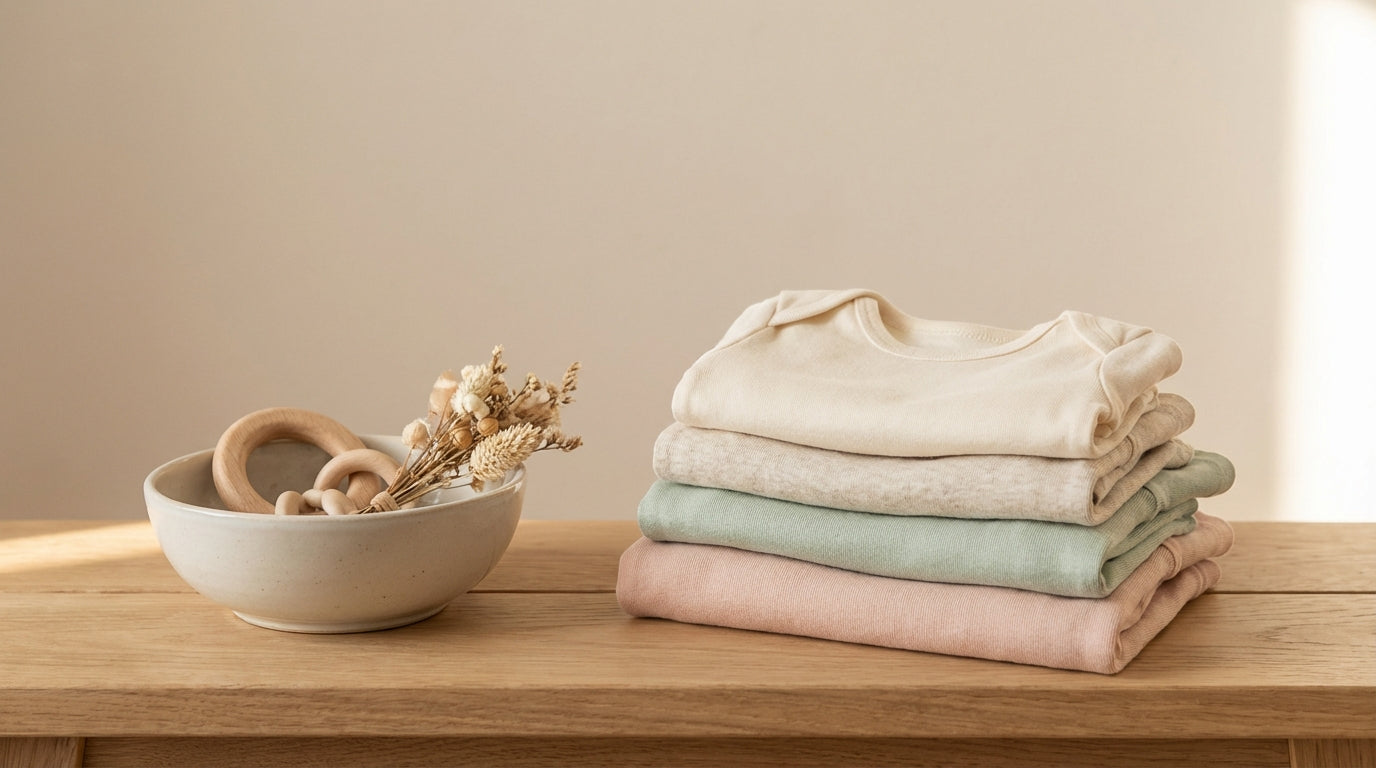
When my son's skin was at its worst, I ended up overhauling his basics with actual certified organic pieces that didn't feel like sandpaper. I picked up the Long Sleeve Organic Cotton Baby Bodysuit from Kianao and it was genuinely like a medical intervention for his torso. It's made from ninety-five percent organic cotton with a tiny bit of stretch, and it comes in these very muted, undyed colors that don't aggravate his skin at all. I've washed it probably sixty times and it somehow gets softer, which is a rare comfort when you're doing triage on a screaming, itchy infant at dusk.
The sizing up strategy saves your sanity
You have to stop buying clothes that fit your baby perfectly right this second while simultaneously throwing out everything that's slightly too big just to achieve some aesthetic perfection that only exists on social media. Babies grow with the speed of an aggressive tumor, and if you buy a newborn size, they'll wear it for exactly nine days before having a blowout that ruins it forever.
My desi mother used to buy my clothes three sizes too big, and I hated her for it when I was ten, but I completely understand it now. Buy the sustainable clothes in gender-neutral earth tones and buy them large. You roll the sleeves up three times. You fold the pants waistbands over. You let them look slightly baggy and disheveled because you're extending the life of a fifty-dollar organic sweater by eight months.
This also helps you avoid the online return cycle, which is a nightmare. I learned recently that about half of all clothing bought online gets returned, and a lot of companies just throw those returns into an incinerator because it's cheaper than restocking them. So you order three sizes of a sustainable outfit to see which fits, return two, and accidentally cause more carbon emissions than if you had just bought a fast fashion shirt at the mall. Just buy the bigger size, measure your kid, and commit to the garment.
If you need to make the nursery look nice for your own mental health, you can incorporate safe textiles without going overboard. I've the Mono Rainbow Bamboo Baby Blanket draped over my rocking chair. It's totally fine, very soft, and the terracotta arches look nice on video calls. It's mostly bamboo and organic cotton, so it keeps stable temperature well when my son falls asleep on me, even if the rainbow design feels a bit millennial for my current exhausted vibe.
Softening the blow of playtime
Once you fix the wardrobe, you start looking at everything else touching your kid's skin. I realized my son was spending four hours a day mashing his face into a brightly colored plastic playmat that smelled faintly of gasoline when it first came out of the box. We obsess over the clothes they wear but let them chew on polyvinyl chloride toys because they light up and play annoying songs.

I eventually packed up the plastic mat and switched to wood and organic fabrics for his floor time. We use the Organic Cotton Baby Blanket with the Whale Pattern as a base on the living room rug. It's GOTS certified, heavy enough to provide a buffer against the floor, and the gray whales are visually calming when I'm on my third cup of coffee and can't handle bright colors. It's large enough that he can honestly roll around on it without immediately ending up on the dog hair-covered carpet.
Listen, you don't have to throw away every single synthetic thing you own and go live in a yurt. Parenting is mostly just risk reduction and picking your battles. If you can swap out the base layers that sit directly against their skin for organic cotton or bamboo, you're already doing better than I did for the first four months. Your baby's skin will calm down, you'll stop buying hydrocortisone in bulk, and you'll eventually sleep again. Probably.
What moms seriously ask me about eco-friendly clothes
Is organic cotton really better or is it a scam?
I thought it was a complete scam designed to extract money from anxious parents until I saw my kid's eczema disappear when we switched. It's not necessarily the organic cotton itself that's magic, but rather the absence of the toxic pesticides and harsh chemical dyes used in the normal stuff. When you remove the irritants, the skin heals. It's basic pathophysiology, yaar.
Do I really need to wash new baby clothes before using them?
Yes, you absolutely have to wash them, and honestly you should wash them twice. Even if they're organic, they've been sitting in warehouses, touched by dozens of hands, and stuffed into cardboard boxes. My nursing preceptors would have a stroke if they saw someone put an unwashed factory garment onto a fresh newborn.
How do I get stains out of organic clothes without harsh chemicals?
You let the sun do the work. I put stained organic onesies out on my back porch and let the UV rays bleach out the sweet potato and blowout stains. It sounds like a hippie myth but it genuinely works, mostly. If it's really bad, I make a messy paste of baking soda and dish soap, scrub it aggressively, and hope for the best. Sometimes you just have to accept that your baby will wear a slightly discolored shirt.
Are bamboo clothes safe for eczema?
Bamboo is tricky because the process to turn hard bamboo wood into soft fabric usually involves a lot of harsh chemicals, turning it into a semi-synthetic rayon. But the final fabric is incredibly smooth, cool to the touch, and very breathable. Most babies with eczema tolerate high-quality bamboo very well because it doesn't trap heat or scratch the skin. I use it, but I try to buy blends that mix it with organic cotton just to be safe.
Why are sustainable clothes so expensive?
Because paying farmers fairly and not dumping toxic waste into rivers costs money. Fast fashion is artificially cheap because someone, somewhere in the supply chain is being exploited, and the environmental damage is not factored into the price tag. I just buy way fewer clothes now. A baby really only needs about seven good outfits anyway, the rest is just us playing dress-up.




Share:
The "Baby Store Near Me" Trap: A Father's Reconnaissance Guide
My very messy, tear-filled attempt at babydecke stricken