

Dear Marcus from exactly six months ago,
It's currently 3:14 AM in your timeline, and I know exactly what you're doing. You're sitting in the glow of your laptop in the nursery, holding a screaming, five-month-old Maya, and you're logging the exact duration of her cries in a color-coded Google Sheet. You're sweating through your t-shirt, your jaw is clenched, and you're terrified that if you give in and rock her to sleep right now, you're going to ruin her. Somebody at the grocery store—or maybe a well-meaning but outdated relative—casually told you that picking up a crying infant every time she whines is going to turn her into a tiny dictator, a little tyrant who manipulates your entire life. So you're sitting there, trying to debug your daughter's sleep cycle with rigid data entry, waiting for her to "self-soothe."
I'm writing from the future—Maya is eleven months old now, pulling herself up on the coffee table and terrorizing the cat—to tell you to close the laptop and just hold the damn baby.
You're spinning out because you think you need to establish dominance over a creature who hasn't even realized her own hands belong to her yet. My wife Sarah tried to gently explain this to me last week, pointing out that Maya wasn't running complex psychological operations against us, she just had a wet diaper and a weird burp trapped in her chest. But I didn't listen until I fell down a late-night internet rabbit hole and discovered where this whole "don't spoil the newborn" firmware actually came from.
The literal fascist origins of crying it out
I did the deep dive so you don't have to, and it turns out the cultural obsession with not letting babies manipulate us has a wildly dark origin story. Back in 1934, a German physician named Johanna Haarer wrote a parenting manual called The German Mother and Her First Child. It sold over a million copies and became the foundational text for state-sponsored child-rearing in the Third Reich. Her explicit goal was to engineer tough, unemotional soldiers who would never question authority.
Haarer's instructions were basically a beta test for generational trauma. She told mothers to isolate their babies for 24 hours immediately after birth. If the baby cried, the mother was only forbidden from picking them up, cradling them, or stroking them. The book claimed that offering comfort would create a little autocrat who would dominate the household. It was the most extreme, state-mandated version of the cry-it-out method in human history.
I sat in the dark reading this and felt my stomach drop. The advice we still hear today—the offhand comments about "spoiling" a three-month-old, the warnings that your baby is trying to control you—literally shares DNA with a historical movement designed to systematically destroy human empathy. It's wild how this stuff just seeped into the groundwater of modern parenting, disguised as "building independence" when it was originally engineered to do the exact opposite.
Also, while we're fixing your timeline, please take all of Maya's miniature denim jeans and throw them directly into the trash, because denim on an infant is a crime against physics and she hates them.
Dr. Lin’s crash course in cortisol and server crashes
At Maya's six-month checkup, our doctor, Dr. Lin, noticed my borderline psychotic spreadsheet printed out on the clipboard. She took a long look at my dark circles and asked how the sleep training was going. I mumbled something about optimizing independent sleep pathways. She sighed, put down her pen, and explained John Bowlby's Attachment Theory to me in a way my tech-addled brain could finally process.
Apparently, human babies are born with a completely unconfigured limbic system. They don't have the internal software to keep stable their own emotions or heart rates yet. When Maya cries, it's not a manipulation tactic; it's her only mechanism for throwing a system error flag. Dr. Lin told me that when we ignore those cries to avoid "spoiling" her, her tiny body gets flooded with cortisol. From what I gather from the medical journals I panic-read later that night, prolonged exposure to that stress hormone can actually alter the physical development of the hippocampus.
So, instead of pacing the hallway outside her door, tracking the minutes on your phone, and agonizing over whether you're creating a dependent monster, just go in and scoop her up, because trying to force independence through isolation is just teaching her nervous system that the server is down and nobody is ever coming to reboot it.
Hardware updates that actually helped us survive
Once I finally let go of the fear of raising an infant authoritarian, I realized that making Maya comfortable wasn't a failure of discipline. It was just basic troubleshooting. And a huge part of that was getting her out of scratchy, stiff clothes that were probably causing half the crying in the first place.

Remember that epic 3 AM blowout last Tuesday? The one that breached all known containment protocols and required a full bath in the dark? That's exactly why you need to order more of the Organic Cotton Baby Bodysuit Sleeveless Infant Onesie. Seriously, buy like ten of them.
I didn't care about organic cotton before I had a kid. I thought it was just marketing fluff for people who buy twelve-dollar smoothies. But Maya's skin is so sensitive that regular synthetic fabrics give her this weird, patchy red rash on her ribs. This Kianao bodysuit is made with 95% organic cotton and a little bit of elastane, which means it honestly stretches when you're trying to wrestle a squirming baby into it. But the real genius is the envelope shoulders. When the inevitable diaper disaster strikes, you don't have to pull the ruined fabric over her head and drag the mess through her hair. You just pull it down over her shoulders. It's a localized tactical retreat that will save your sanity. Plus, the lack of scratchy tags means she isn't writhing around trying to scratch her neck while you're trying to rock her to sleep.
If you want to upgrade the nursery hardware without buying more toxic plastic junk, you should honestly just browse the Kianao organic baby gear collection and replace the stuff that isn't working.
The teething geometry problem
Right around month six, Maya is going to start shoving everything into her mouth. Your keys. The television remote. The cat's tail. You will panic and buy a mountain of chew toys.
I'll be honest with you about the Panda Teether Silicone Baby Bamboo Chew Toy. It's fine. It's objectively a well-engineered piece of food-grade silicone. It's completely BPA-free, the multi-textured surfaces seem to do a decent job of massaging her gums, and I like that I can just throw it in the dishwasher when it gets covered in dog hair. But if I'm being perfectly real, Maya still prefers gnawing on my collarbone over any manufactured product on the market.
That being said, you should still keep one in the diaper bag. There will be moments in the checkout line at Trader Joe's when she starts melting down because her molars are shifting, and handing her a cold silicone panda (yes, you can put it in the fridge, which is a neat trick) will buy you exactly the four minutes of silence you need to pay for your groceries. It’s not a magic wand, but it’s a functional patch for a recurring bug.
Creating a safe environment for deployment
Here's the paradox of this whole attachment thing that finally clicked for me: you create independence by providing total security first.

Dr. Lin mentioned this concept called a "secure base." If Maya knows that you'll absolutely catch her when she falls, and that you'll always respond when she signals for help, she genuinely becomes more confident to explore on her own. You aren't trapping her by holding her; you're giving her the confidence to leave you eventually.
You can see this playing out right now in the living room. We set up the Wooden Baby Gym from Kianao on the rug. It's this minimalist wooden A-frame with these soft, earthy-toned animal toys hanging from it. Right now, at five months, she's probably just staring at the elephant with mild confusion. But by month eight, she's going to be rolling under it, swatting at the wooden rings, and testing her grip strength.
I like it because it doesn't have flashing LED lights or an electronic voice shouting the alphabet at me. It's just quiet, natural wood and soft fabric. It gives her a designated zone to figure out gravity and hand-eye coordination at her own pace, while I sit nearby and drink lukewarm coffee. She plays independently because she knows I'm right there.
Deleting the spreadsheet
So, Marcus. Please listen to me. Stop tracking the cries. Delete the Google Sheet.
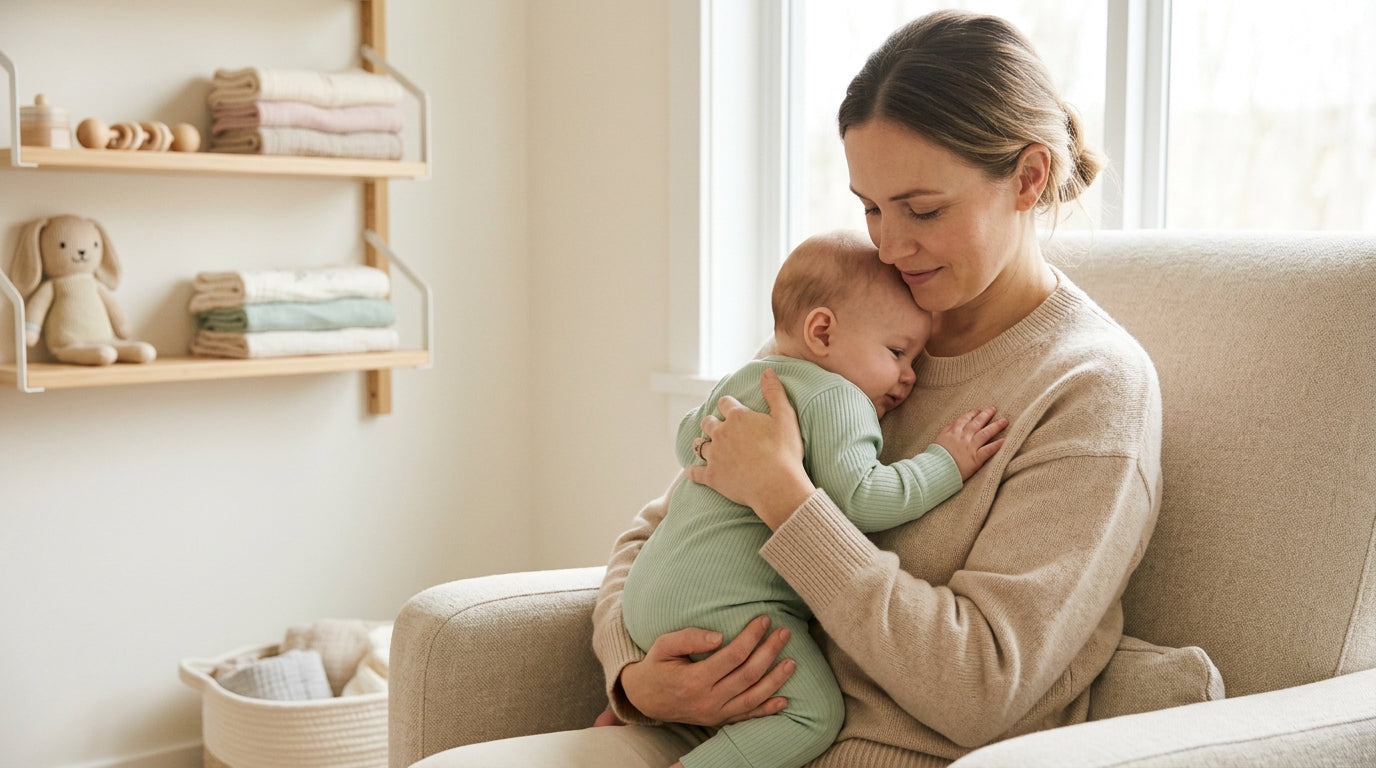
When you hear her whimpering through the baby monitor tonight, don't look at the clock to see if it's been the recommended five minutes of "settling time." Just go to her. Pick her up. Let her feel your heartbeat against her chest, because that physical contact literally keeps stable her nervous system. She is not a hostile entity trying to overthrow the government of your household. She is just new here, and she's terrified of the dark, and she needs her dad.
You aren't raising a tyrant. You're just raising a human. Be gentle with her, and for the love of god, be gentle with yourself.
Take a breath,
Marcus (Month 11)
P.S. If you're still awake and anxiety-scrolling, you can find clothing that genuinely respects her skin at Kianao. Browse their natural fiber collections before you buy another stiff polyester onesie from a big box store.
Dad's late-night FAQ: Attachment and sleep panic
Is it really possible to spoil a newborn baby?
According to my doctor and literally every modern scientific journal I've stress-read at 4 AM, no. It's biologically impossible to spoil an infant. They don't have the cognitive capacity for manipulation. When they cry, it's just raw data indicating a need. Feeding them, holding them, and responding to them just builds trust. So ignore your great-aunt's advice and just pick up the kid.
Why does everyone talk about cortisol like it's poison?
From what I understand, cortisol is just a stress hormone. We all have it. But babies don't know how to turn off the tap once it starts flowing. If you leave a baby crying alone in a room for an hour because a book told you to, their brain gets flooded with it. Over time, apparently, this can rewire how they handle stress for the rest of their lives. It's basically hardware damage via software overload. I prefer to avoid it when I can.
Does holding my baby to sleep mean she'll never sleep alone?
This was my biggest fear. I thought if I rocked Maya to sleep once, I'd be rocking a 14-year-old to sleep before high school. It doesn't work that way. Giving them comfort when they're tiny honestly gives them the secure foundation to sleep alone later. Maya still has rough nights, but she learned that her crib is a safe place because she knows we'll come if she really needs us.
What if I'm just too exhausted to respond immediately?
Look, the science says to be responsive, but it also assumes you're a functioning human. There were nights where I had to put Maya down in her crib, walk out of the room, and take deep breaths for five minutes because I was losing my mind. That's completely different from systematic, enforced isolation. Taking a minute to keep stable your own nervous system so you don't drop the baby is just smart operations.
Why do synthetic baby clothes make sleep worse?
I didn't believe this until I saw it. Babies are terrible at thermoregulation. If you put them in cheap polyester, they sweat, the sweat gets trapped, they get a rash, and then they wake up screaming at 2 AM because they're itchy and hot. Switching to breathable organic cotton was like installing a much better cooling fan in a server. It doesn't solve every crash, but it drastically reduces the overheating errors.




Share:
Why The Baby Highland Cow Trend Completely Took Over My Life
Why my toddler's search for baby hotline lyrics gave me a heart attack