

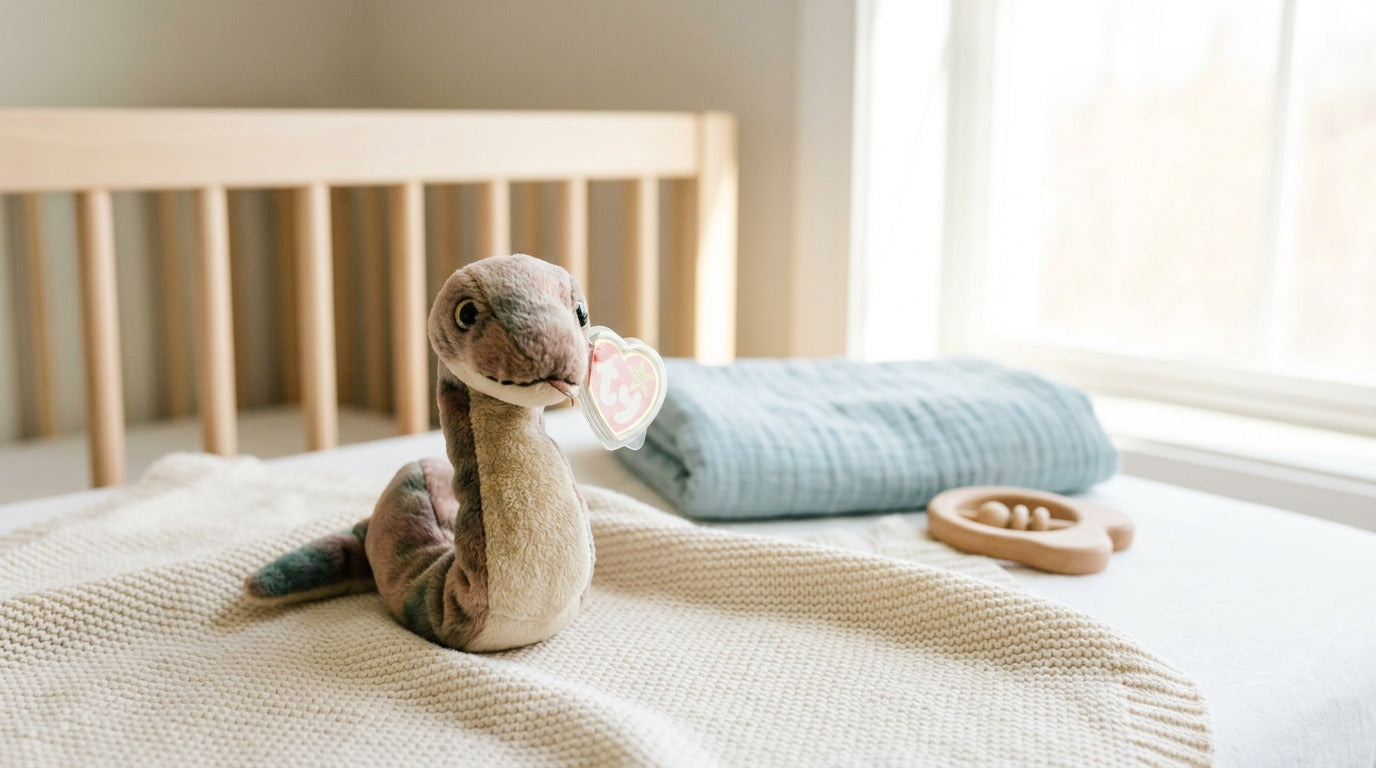
My mom's care package arrived at 2 PM on a Tuesday, smelling faintly of mothballs and unfiltered 1997 optimism. I sliced open the cardboard, pulled out Claude the Crab—complete with the pristine heart-shaped tag encased in a plastic protector—and handed it straight to my 11-month-old son. Three seconds later, I'm executing a desperate finger-sweep maneuver to pry a hard plastic crab eyeball out of his jaw. Nostalgia almost caused a fatal system error right there on our living room rug, and my wife Sarah hasn't let me live it down since.
I guess I just assumed that because I survived the 90s, the hardware from that era was inherently safe. My brain glitched, confusing my fond childhood memories with actual safety protocols. We millennial parents are constantly falling into this trap, trying to force backward compatibility on biological units that just aren't designed to handle legacy tech. Sarah tells me I treat our son like some kind of e baby from an old browser game sometimes—just clicking "feed" and "sleep" and expecting the status bars to stay green without reading the patch notes.
Well, I've read the patch notes now. And if you're thinking about introducing your infant to that tote bag of collectible plushies sitting in your attic, you might want to review my troubleshooting logs first.
Nostalgia is a terrible operating system
Before the Claude the Crab incident, I didn't think twice about stuffed animals. They're soft, they're cute, and they're theoretically designed for tiny humans. But apparently, an authentic vintage beanie baby wasn't actually engineered with a modern infant's user interface in mind. An 11-month-old's UI consists entirely of putting objects into their mouth to run a diagnostic check. They don't care about the poem on the tag. They just want to test the tensile strength of a sewn-on plastic nose using their brand new incisors.
When you really look at these things through the lens of modern parenting anxiety, they're basically brightly colored fragmentation grenades of choking hazards. I spent an hour last night going down a Reddit rabbit hole about the history of safety standards for plush toys, and honestly, the fact that any of us made it to adulthood without inhaling a plastic whisker is a statistical anomaly.
The great plastic pellet vulnerability
Let's talk about the actual filling for a minute, because this is where my analytical brain completely short-circuited. These toys get their signature flop from thousands of tiny plastic pellets. According to my frantic midnight googling, the older ones were filled with PVC pellets, while the newer iterations transitioned to polyethylene. But honestly, the chemical composition doesn't even matter when you consider the structural integrity of 25-year-old polyester thread.
I started tracking my son's destructive output. In a single 45-minute play session, he generated enough pulling force to separate the velcro on my laptop bag, rip a board book completely in half, and partially dislodge a baseboard. If you hand a baby a bean-filled toy with degrading seam integrity, you're just counting down the minutes until those pellets spill out onto the playmat. Dr. Aris, our pediatrician, vaguely explained that ingesting those pellets can cause severe intestinal blockages, which sounds like a catastrophic hardware failure I definitely don't want to deal with.
And no, your first-edition Princess Diana bear isn't going to appreciate in value enough to pay for their college tuition, so stop refreshing eBay and just put it back in the attic.
What the pediatrician actually told me
After the eyeball incident, we had his routine checkup, and I nervously brought up the plush toy situation. I asked Dr. Aris if maybe the pellet-free stuffed animals were okay to leave in his crib at night, just so he had some company. She gave me the most exhausted, patient look I've ever seen on a medical professional's face.

She told me that the sleep surface needs to be completely void of anything soft. No blankets, no bumpers, and absolutely no stuffed animals of any kind until they're at least 12 months old, maybe older. Apparently, anything fluffy in a crib acts like respiratory malware. I had this vision of a perfectly curated, Instagram-worthy crib full of woodland creatures, but the reality is that safe sleep means the crib looks like a minimalist holding cell. We just have to accept that aesthetics take a backseat to oxygen intake.
If you're realizing your nursery might need a security audit, you might want to browse some of Kianao's organic collections to find things that won't give your pediatrician a stress headache.
Patching the system with safer alternatives
Once we completely deprecated the 90s toy box, I had to find a new way to keep him occupied while his teeth pushed through his gums. His fussiness metrics were spiking, and my noise-canceling headphones were only doing so much. We needed a chewable object that wouldn't require a Heimlich maneuver if he got too aggressive.
Sarah ordered the Panda Teether Silicone Baby Bamboo Chew Toy, and it's honestly the most stable piece of baby hardware we own right now. I've actual data on this: his crying episodes drop by roughly 40% when I hand him this panda. It's made of a single piece of food-grade silicone, meaning there's zero chance of a plastic eye popping off. He gnaws on the textured bamboo-shaped parts like a tiny, frustrated puppy. Plus, when he inevitably drops it on the floor of the coffee shop, I can just throw it in the dishwasher when we get home. No moldy fluff, no exploding beans.
We also picked up the Gentle Baby Building Block Set. They're okay. I mean, they're soft rubber, which is a massive upgrade from hard plastic because when I inevitably step on one at 3 AM while fetching a bottle, it doesn't pierce my heel like a rogue Lego block. He mostly just likes it when I build a tower so he can violently dismantle it and yell at the fallen pieces. They serve their purpose, but I still end up picking them up off the rug twelve times a day.
Cloth over collectibles
The other variable I didn't calculate with the old plush toys was the dust factor. My son has skin that reacts to literally everything. I keep a spreadsheet tracking the ambient humidity against his eczema flare-ups, and the data suggests his skin is a highly sensitive, easily corrupted ecosystem. Handing him a dusty, synthetic velvet toy from 1998 resulted in a constellation of red dots across his chin within an hour.

We've pretty much strictly moved to organic materials for anything that touches him for prolonged periods. Sarah bought a stack of the Organic Cotton Baby Bodysuit Sleeveless Infant Onesies, and they're basically the only things he wears indoors now. They're incredibly breathable, and more importantly, they've this stretchy envelope shoulder design. I used to sweat through my shirt trying to pull stiff cotton over his giant, wobbly head, but these stretch just enough to avoid the morning deployment struggles. It's a small optimization, but when you're operating on four hours of sleep, avoiding a wardrobe-induced meltdown is a massive win.
Deprecating the past
Look, I get it. We want to share the things that brought us joy with our kids. But treating your child's toy box like a museum exhibit for your own childhood is a terrible strategy with far too many glitches.
Instead of hoping those vintage seams hold together under the crushing force of baby jaws, just pack the nostalgia away safely and give your kid something designed for their actual developmental phase. Don't leave legacy plushies in the crib or assume old safety standards apply today while trying to recreate your childhood through dangerous collectible toys.
If you're ready to upgrade your baby's interactive gear to something that won't crash your anxiety levels, check out Kianao's modern, safety-tested essentials before you make your next nostalgic impulse buy.
My messy troubleshooting FAQ
Are any of the old 90s stuffed animals safe for a baby?
In my very stressed, very paranoid opinion: no. Unless you want to spend your evening supervising every single movement your baby makes with it. The plastic eyes, the little attached tags, the disintegrating internal threads—it's just a cascade of potential choking hazards. Dr. Aris says save them for when the kid is like, three or four, assuming they still care about a crab named Claude by then.
How do I know if a new plush toy is actually safe?
I literally pull on everything now. I check if the eyes and nose are embroidered directly into the fabric rather than glued or sewn on as separate plastic pieces. If it feels like it has beans or pellets inside, I put it right back on the shelf. I also check to see if it can survive a hot wash cycle, because babies secrete an unbelievable amount of sticky fluids.
When can my baby finally sleep with a stuffed animal?
Everything I've read and been told by our pediatrician points to 12 months as the absolute minimum, but some doctors push it to 18 months just to be safe. Until then, the crib needs to be a barren wasteland. No pillows, no blankets, no cute little bears. Just a mattress, a fitted sheet, and a baby in a sleep sack.
What should I do with the giant box of vintage toys my parents saved?
I put ours in a vacuum-sealed bag and shoved it into the darkest corner of the guest room closet. Maybe when he's older, he'll think they're cool retro artifacts, or maybe he'll just look at them the way I look at my dad's old eight-track tapes. Either way, they're out of the primary testing environment for now.




Share:
The Michelin Star Delusion: Surviving the Home Baby Bistro Era
Dear Past Priya: The Goldie Baby Method For Maternal Burnout