

It was a wet Tuesday afternoon in November when the kitchen ceiling began to ominously bow, creating a distended, watery underbelly right above the toaster. A pipe had burst somewhere in the floorboards above, and as I desperately tried to catch the escalating drips with a pasta pot, I noticed the twins standing perfectly still in the doorway. They weren't crying. They were just watching the plaster crack with this terrifying, wide-eyed silence, absorbing the fact that the absolute safety of their home was suddenly turning to liquid. My mum’s phone suddenly lit up the counter with a text asking if the ‘babie’ (she aggressively refuses to wear her reading glasses and her autocorrect has simply given up) was frightened of the loud banging, while simultaneously, my Instagram feed refreshed to show some terrifyingly calm influencer hashtagging her minimalist emergency #babi kit in a pristine beige hallway.
I just stood there with my useless saucepan, realizing I had absolutely no idea how to guide two human beings through a crisis without completely messing them up.
I used to think disaster preparedness was exclusively for people in Nevada who bury shipping containers full of baked beans in the desert. As a London dad, my version of crisis management has historically been making sure we've enough Calpol in the cupboard and knowing which neighbor has a spare set of house keys. But watching Edward Buckles Jr.’s documentary about the youth who survived the 2005 hurricane completely dismantled my comfortable, ignorant little worldview. It turns out, surviving the actual physical disaster is only about ten percent of the battle.
The absolute lie of "they're too young to understand"
There's this pervasive, deeply annoying myth in the baby advice industry that infants and toddlers are essentially goldfish—that if you just distract them with a shiny object and a forced smile, they won't notice that their entire world has been upended. I can't tell you how much I loathe the phrase "kids are resilient." People toss it around like verbal confetti whenever something terrible happens, using it as a convenient excuse to avoid doing the incredibly difficult emotional labor of guiding a child through trauma.
They aren't resilient; they're just entirely dependent on us and lack the vocabulary to articulate their existential dread. When you watch the interviews with the grown survivors from that catastrophic storm, the most heartbreaking recurring theme is that nobody ever stopped to ask the children how they were feeling. The adults were in hyper-survival mode, completely missing the fact that the little ones were quietly internalizing the chaos, the sudden displacement, and the raw, unfiltered terror of their parents. They don't forget the vibe of a panicked evacuation just because they're young, they just bury it deep in their little nervous systems where it mutates into something incredibly difficult to untangle later in life.
I genuinely get angry thinking about how much pressure is put on kids to just "bounce back" so the adults can feel better about the situation.
As for the internet's obsession with rotating your emergency canned goods every six months and memorizing water purification techniques, honestly, who has the time or the mental bandwidth for that when you’re already surviving off four hours of sleep?
What our health visitor actually said about tiny traumas
From what I can gather through my sleep-deprived, anxious reading of various studies, the fallout from a natural disaster or even a localized emergency (like being forced out of your flat for a week because of Thames Water's sheer incompetence) doesn't manifest in toddlers the way you see PTSD on television. You don't get dramatic flashbacks.

Brenda, our local NHS health visitor—a woman who has seen absolutely everything and suffers no fools—mentioned over a cup of tepid tea that trauma in toddlers is incredibly sneaky. She told me that if a child goes through a frightening displacement, you shouldn't just look for crying. You have to watch out for the weird, silent signs: sudden regressions in potty training, an absolute refusal to sleep in their own bed, or suddenly screaming bloody murder when you turn on the bath taps because their brain has suddenly associated running water with that time the house flooded. You have to somehow swallow your own rising panic during an emergency and look your toddler in the eye to ask how they're feeling, completely abandoning the old parenting strategy of just smiling manically and pretending the rising floodwaters are an exciting new indoor swimming pool.
If you're currently scrolling through your phone at 3am worrying about how to protect your little ones from a world that seems increasingly unpredictable, maybe take a breath and look at some soft, comforting basics that at least give you control over their immediate physical environment.
The toxic trailer problem (and my obsession with safe materials)
One of the most infuriating details about the aftermath of the 2005 crisis was the housing situation. Displaced families, already traumatized and exhausted, were moved into temporary government trailers that were later found to be off-gassing toxic levels of formaldehyde. It's a staggering double betrayal: surviving the storm only to have your safe haven slowly poison your respiratory system.

Ever since I learned that, I've become borderline neurotic about the chemicals surrounding the twins. When our ceiling caved in and we had to spend three days in a damp, aggressively cheap hotel off the North Circular, the girls were sweating through their synthetic pajamas, breaking out in these furious red stress rashes. The last thing a stressed child needs is clothing that fights against their skin.
That's precisely why I'm so relentlessly loyal to the Organic Cotton Baby Bodysuit from Kianao. When everything else is chaotic, you need a baseline of guaranteed safety. This onesie is made from 95% organic cotton, meaning it’s grown without all the horrific pesticides and synthetic fertilizers that usually end up microscopic and embedded in normal high-street baby clothes. It has just enough elastane (5%) that you can aggressively wrestle a thrashing, panicked toddler into it without popping a seam. More importantly, it breathes. When babies are anxious, their body temperature fluctuates wildly, and this un-dyed, chemical-free fabric actually helps keep stable their little microclimates so they don't wake up screaming from a heat rash on top of a nightmare.
Stuffing the panic bag with things that actually work
So now we've a "go-bag" sitting in the hallway cupboard. It doesn't have a tactical knife or a flare gun, but it does have things designed to ground the twins if we ever have to leave in a hurry.
I threw a Bear Teething Rattle Wooden Ring into the front pocket. I’ll be completely honest with you here—I've a love/hate relationship with this thing. The untreated beechwood ring is brilliant and entirely safe for them to gnaw on when stress makes their gums flare up, but the soft crochet bear attached to it gets a bit soggy and weird after heavy use. You have to carefully hand-wash it, which is frankly a ridiculous and highly annoying chore to ask of a parent who's currently managing an evacuation. But, because it has zero toxic finishes and no plastic components that might off-gas in a hot car, it earns its place in the bag.
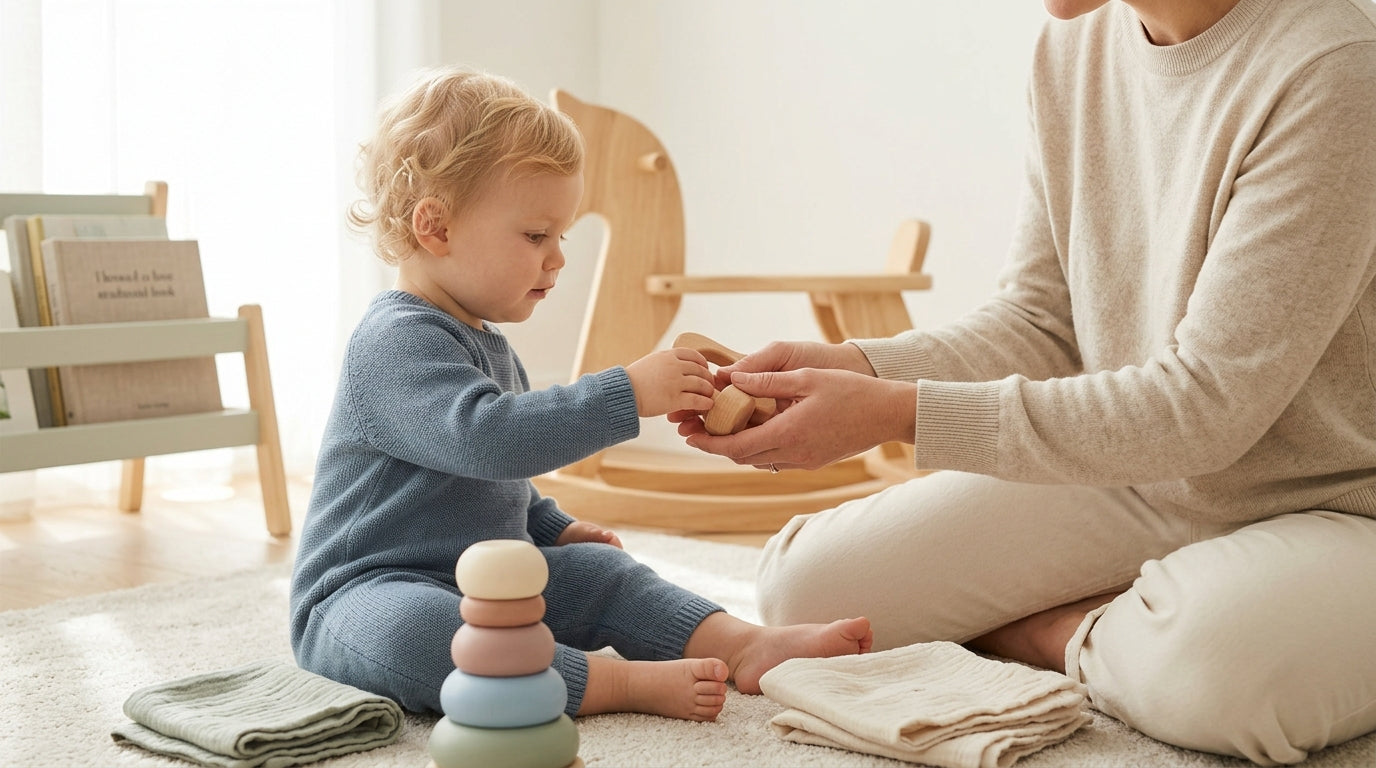
If you've the boot space for it, the one thing that genuinely saved our sanity during our three-day hotel exile was having a familiar micro-environment to set up on the floor. I highly rate the Rainbow Play Gym Set. Yes, it takes up space, but the wooden A-frame and the little hanging elephant gave the girls a designated, safe zone that smelled like home and wasn't the collapsing ceiling of our kitchen. It gave them sensory input that they could control, which Brenda the health visitor says is vital for helping small brains process feelings of powerlessness.
We can't control the weather, the bursting pipes, or the fact that the world occasionally loses its collective mind. But we can stop treating our babies like unfeeling luggage during a crisis. We can give them clean air, safe fabrics, and the dignity of having their fear acknowledged.
Go check out Kianao's full range of strictly non-toxic, sustainable baby gear to build a safe environment you can seriously trust.
My deeply unscientific, painfully real FAQ on crisis parenting
How do I explain a scary weather event to a two-year-old?
With infuriatingly simple honesty. Don't use metaphors about the sky being angry, because then they'll just develop a complex about the sky hating them. I just tell the twins, "The wind is blowing very hard and it sounds loud, but we're inside and the walls are strong." They don't need a meteorological breakdown, they just need your heart rate to be slow when you speak to them.
What should honestly go in a toddler's emergency bag?
Forget the wilderness survival gear. You need three days of their specific brand of snacks (because a crisis is not the time to introduce a new texture), two sets of organic cotton clothes that won't irritate stress-induced eczema, a physical comfort object that smells like their bed, and whatever medication they take, plus Calpol. Don't pack toys with flashing lights or loud sirens; the environment is stimulating enough.
How long does it take for a toddler to "get over" an evacuation?
It’s been six months since our kitchen flooded and Matilda still occasionally points at the new plaster and says "water fall down" with genuine concern in her voice. There's no timeline. You just have to patiently validate it every single time by saying, "Yes, the water fell down, but it's fixed now and you're safe." It takes as long as it takes.
Is it worth paying more for organic cotton if we're just going to ruin it?
Yes, especially if you're living out of a suitcase or a temporary space where you can't control the air quality or the laundry detergent being used. The peace of mind knowing their base layer isn't slowly seeping formaldehyde into their pores while they sleep is worth skipping a few artisanal coffees. Trust me.
Should I hide my own fear from my children?
My therapist literally laughed at me when I asked this. You can't hide it—they can smell the cortisol on you. If you're shaking, they know. Instead of pretending you're fine, just narrate it: "Daddy is feeling a little bit worried right now because of the loud noise, but Daddy is still in charge and is keeping us safe." It gives them permission to feel their own fear without thinking the world is ending.




Share:
Kat Timpf's Birth Story Proves We Can't Control Everything
What the King Harris Baby Drama Taught Me About Surviving Newborns