

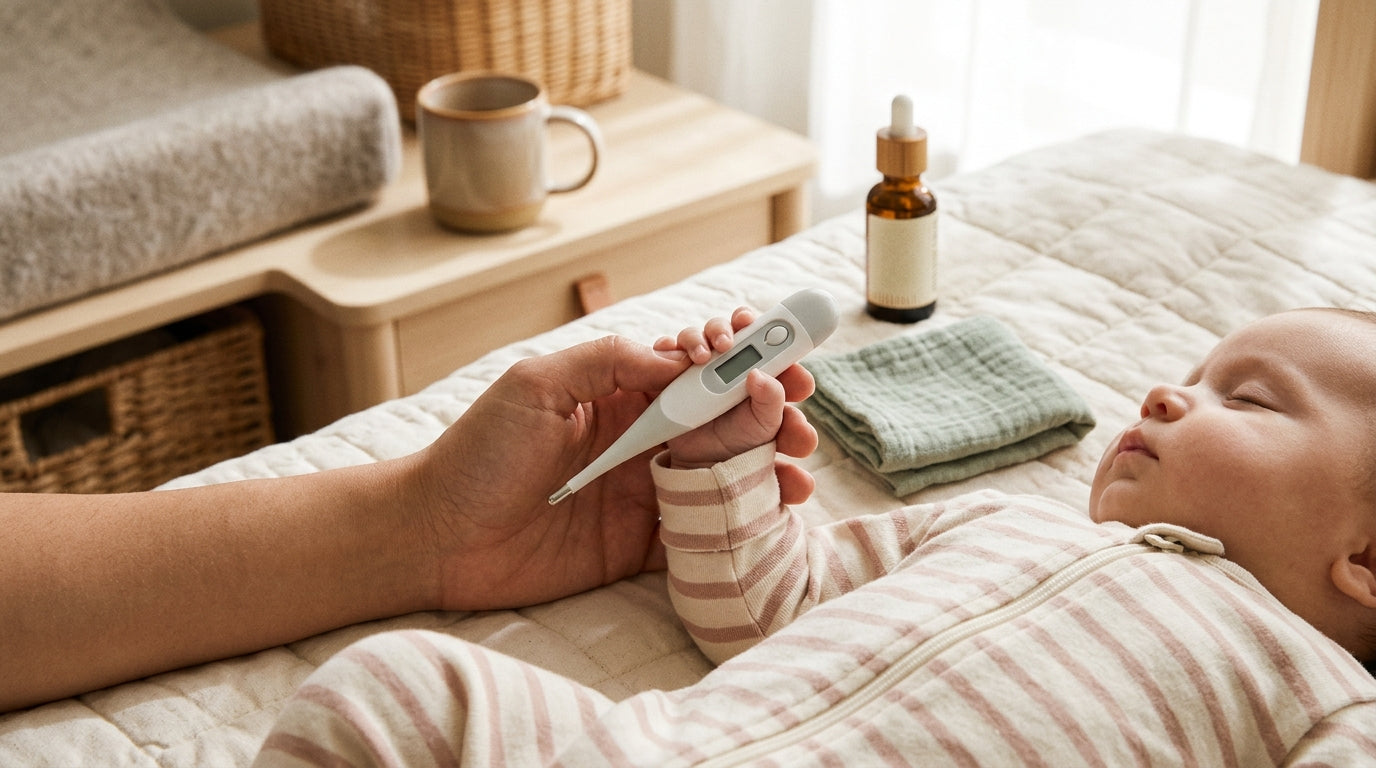
The biggest lie the parenting industry sells us is that the second your kid feels warm to the touch, you need to panic, strip them down, and immediately pump them full of fever reducers. I'm standing here in my laundry room in rural Texas, folding a mountain of tiny, syrup-stained pajamas, to tell you that's complete garbage.
I know this because last night at 2:14 AM, I was sitting on the nursery floor with a flashlight under my chin, squinting at the faded black lines on a sticky purple syringe while my middle child screamed bloody murder. We've all been there. You're exhausted, your brain is functioning at roughly the capacity of a damp sponge, and you're trying to do medical math in the dark so you don't accidentally poison the tiny human you grew from scratch.
With my oldest—who is a walking, talking cautionary tale for basically every mistake a first-time mother can make—I used to freak out if the thermometer hit 99.1 degrees. I'd be speed-dialing the nurse line, crying, convinced my kid was melting from the inside out. My grandmother, bless her heart, would just sip her sweet tea and say, "Let the boy bake a little, Jess. The fever is cooking the bugs."
I used to roll my eyes so hard I'd see my own brain, but honestly? She wasn't entirely wrong. My doctor eventually told me that a fever is just the body doing its job. It's the alarm system and the sprinkler system all in one. Unless they're absolutely miserable, refusing to drink, or in pain, you don't always have to jump straight to the medicine cabinet. Sometimes you just let them be warm and grumpy for a bit.
The math that makes me cry
Let's talk about the actual dosage for the baby, because this is where I usually lose my mind. If you've ever looked up the whole tylenol baby meaning online, you've probably seen a million moms arguing in forums about age versus weight. Here's the unvarnished truth, straight from Dr. Miller down at our local clinic: age means absolutely nothing with medicine.
I can't stress this enough, y'all. Age is a useless metric. My oldest was a string bean who wore 9-month clothes at his first birthday, while my youngest is built like a tiny linebacker and was busting out of 18-month pants at eight months old. If I dosed them based on the month printed on their birth certificates, I'd be drastically under-medicating the chunky one and probably hurting the skinny one.
It's deeply annoying that the medicine boxes still put those little age brackets on the back like they mean something. It's just a rough guess for people who don't own a scale. You have to go by their exact weight. I weigh my kids by stepping on my bathroom scale holding them, then stepping on it alone, and subtracting the difference because there's zero chance I'm getting a sick toddler to stand still on a cold piece of glass.
Here's how the actual rules work in our house, based on my very imperfect understanding of pediatric medicine mixed with sheer survival instinct:
- The under-two mystery: If your kid is under two years old, the box just says "Ask a doctor." They do this so we don't accidentally wreck their tiny livers. You actually have to call the doctor at your well-check and force them to give you a weight-based cheat sheet for your fridge.
- The timing game: You can only give it every 4 to 6 hours, and my doctor said never more than 5 times in a single day. I literally write the time on my arm in Sharpie because I'll 100 percent forget by morning.
- The great concentration swap: Apparently, back in the day, the infant drops were way stronger than the older kid liquid, and people were mixing them up. Now, the baby stuff and the children's stuff are exactly the same strength. You're just paying an extra four dollars for the word "Infant" and a plastic syringe. Save your money, buy the bigger bottle, and just keep your old syringes.
Don't even get me started on the little plastic plug thing that goes in the top of the bottle. You know the one. You're supposed to stick the syringe in it and turn the bottle upside down to draw out the liquid. Half the time, the pressure builds up and the stupid plug shoots out like a champagne cork, blasting sticky grape fluid all over your countertops, your shirt, and the dog. I've spent literal hours of my life scrubbing dried cherry-flavored syrup out of grout lines. Just dip the syringe directly into the bottle like a civilized person and wash it off after.
Anyway, never give them those multi-symptom cold syrups either. They're a waste of money and usually just make kids wired or drowsy with zero middle ground.
The spitting strategy
Okay, so you've got the correct amount in the syringe. Now you've to get it into the belly of a thrashing, furious creature who has the sudden superhuman strength of an adult alligator.
If they spit it out—and they'll spit it out—you've to figure out if you should give more. My nurse friend told me the golden rule is 20 minutes. If they gag and vomit the medicine back up within 20 minutes of you giving it, you can usually try again because it hasn't absorbed yet. If it's been 21 minutes? You're out of luck. You have to wait the full four hours. It's brutal.
To avoid wearing the medicine, I employ a few highly classified tactics that feel mean but are necessary for the greater good.
- Don't shoot it straight down their throat unless you want to get puked on. You have to slide the syringe into the side of their mouth, right into the cheek pouch, and squirt it a little bit at a time.
- If they're chronic spitters, do the cheek squeeze. You gently squish their little cheeks together so their mouth makes a fish face. They can swallow, but they can't spit. It looks ridiculous, they'll be mad at you, but the medicine goes down.
- Follow it immediately with a distraction. The second the syringe is empty, I shove a pacifier or a bottle in there to force them to swallow the rest and wash the taste away.
Teething misery versus actual illness
Sometimes they aren't even sick, they're just getting a tooth, and honestly, teething is worse than a cold because it lasts for months. They drool until their chin is chapped, they chew on the edge of the coffee table, and they run these weird, low-grade temperatures that make them act like tiny drunk people.

When my second kid was cutting his molars, he destroyed two of my favorite throw pillows just gnawing on the corners. I finally bought the Panda Teether Silicone Baby Bamboo Chew Toy from Kianao, and it actually saved my sanity. I'm going to be real with you, I usually think fancy teething toys are a scam because kids just want to chew on your car keys anyway. But this thing is 100% food-grade silicone and it has these little bumpy textures on the bamboo part that my son became obsessed with.
It's completely flat, so he could actually hold it himself instead of me having to hold it to his mouth for him while I tried to pack Etsy orders. The only annoying thing is that because it's silicone, if you drop it on the floor, it immediately attracts every piece of dog hair in a ten-mile radius. But you just throw it in the dishwasher or wash it in the sink, so whatever. I'd stick it in the fridge for ten minutes before I gave it to him, and the cold would numb his gums enough that I wouldn't even need to use medicine half the time.
We also tried the Bubble Tea Teether Silicone Baby Gum Soother because it looked hilarious. It's cute, but honestly, the little boba pearls on the bottom were a bit weird for my kid's tiny mouth, and he definitely preferred the flatter shape of the panda. Don't get me wrong, it works fine and it's totally non-toxic, but if you're on a budget and only buying one, get the panda.
The terrifying newborn phase
I need to take a second and talk about babies under three months old, because this is the one time my "let them bake" grandmother philosophy completely goes out the window.
If your newborn feels hot, you don't mess around with home remedies. You don't try to sweat it out. You definitely don't listen to the old ladies at church who tell you to rub a little whiskey on their gums (seriously, why was that an acceptable thing in the 80s?).
My doctor was incredibly clear about this: if a baby under 12 weeks old hits 100.4 degrees, you don't give them medicine to bring it down. You put them in the car seat and you drive to the emergency room. Giving them a fever reducer at that age just masks the things to watch for of what could be a massive, life-threatening infection. Their immune systems are basically nonexistent. They need doctors, not a sticky purple syringe.
Dressing a hot baby
When they do have a fever and they're over that newborn danger zone, dressing them is an absolute nightmare. You want them comfortable, but you don't want to trap the heat.

My go-to move is stripping them down to just a diaper and a super breathable layer. Synthetic fabrics like polyester are the devil when your kid is sweating out a fever. They trap the moisture against the skin, and then the baby gets the chills, and then they scream, and then nobody sleeps.
I'm highly particular about baby clothes, mostly because we're on a tight budget and I refuse to buy crap that shrinks in one wash. But the Organic Cotton Baby Bodysuit Sleeveless Infant Onesie from Kianao is honestly worth the twenty-ish bucks. It's 95% organic cotton, which means it breathes beautifully and lets the heat escape off their little bodies.
During our last bout with a daycare stomach bug, my youngest practically lived in these. They have an envelope shoulder, which means when the inevitable diaper blowout happens, you can pull the whole thing down over their feet instead of dragging a soiled collar over their head. My only gripe is that the metal snaps at the bottom are aggressively strong—you really have to yank them apart—but at least they don't pop open when the baby is crawling across the floor.
If you're looking for more ways to keep them comfortable and distracted while they feel like garbage, take a look at our wooden play gym collection or the organic baby blankets to create a cozy, safe floor space where they can just lay around and look at nice things.
The truth is, seeing your baby sick or hurting from teeth is just awful. It triggers some primal panic deep in your gut. But you learn to trust your instincts. You learn to read their moods instead of just reading the thermometer. And you learn that almost everything is fixable with time, patience, and maybe a little bit of properly measured liquid acetaminophen.
Before you dive into the frantic Google search spiral, read through these messy, real-life answers to the questions I know you're asking right now, and then go check out Kianao's organic comfort items to help your little one feel better.
Things you're probably googling at 3 AM
Why is infant acetaminophen the exact same stuff as the children's bottle?
Because humans are sleep-deprived and prone to error! Back in the day, the infant drops were super concentrated, so you only had to give a tiny bit. But parents were buying the infant stuff, reading the children's dosage amounts, and accidentally giving massive, dangerous overdoses. The FDA finally stepped in and made all the liquid versions the exact same strength (160mg per 5mL) so you literally can't mess up the concentration, just the volume. You're just paying a premium for the word "infant" on the box.
Can I just squirt the medicine into their bedtime bottle?
I tried this exactly once and it backfired spectacularly. The problem is that if they don't finish the entire bottle, you've absolutely no idea how much medicine they genuinely ingested. Did they get half a dose? A quarter? You can't give them more because you might overdose them, but they didn't get enough to kill the fever. Never mix it in a full bottle. If you must mix it, put it in one tablespoon of milk or applesauce so you know they swallow the whole thing.
What do I do if I lost the syringe that came with the box?
Whatever you do, don't use a spoon from your kitchen drawer. A "teaspoon" of medicine is a specific medical measurement (5mL), but the spoon you eat cereal with could hold anywhere from 2mL to 7mL. If you lost the syringe, march your tired self down to the local pharmacy. The pharmacist will almost always just hand you a plastic medical syringe for free if you ask nicely.
How do I know if they're running a fever from teething or if they're genuinely sick?
My doctor told me that teething can cause a slight temperature elevation, but it almost never causes a true fever over 101 degrees. If they're sitting at 99.5 and drooling like a mastiff, it's probably a tooth. If they hit 102, they caught whatever nasty germ was floating around the church nursery. Also, teething babies are usually fine during the day when distracted and only miserable at night. Sick babies are miserable 24/7.
Does Kianao sell anything that seriously helps when my kid feels terrible?
Yes, and I wouldn't mention them if they were junk. When my kids are feverish, I strip them down to the Sleeveless Organic Cotton Bodysuits because the fabric is incredibly breathable and doesn't trap sweat. For teething fevers, the silicone teethers (especially the flat panda one) thrown in the fridge for ten minutes provide a ton of natural relief without constantly relying on medicine.




Share:
Dear Past Marcus: The Truth About the Ugg Baby Boot Obsession
The Hackney Standoff: Two Babies, One Urban Fox, Zero Dignity