

It’s 3:17 am, and I'm holding a plastic thermometer to my daughter Lily’s ear while she attempts to perform a violent exorcism on herself. The digital display flashes an angry red 39.5°C. For three days prior, my Swiss mother-in-law had been knowingly tapping her jawline over FaceTime, whispering about our little zähne baby as if teething were a mystical European spirit that possesses infants and makes them hate sleep. I believed her, naturally, because when you haven't slept more than forty consecutive minutes since Tuesday, you'll believe absolutely anything.
I had downloaded some flashy e baby app that promised to predict the exact date the incisors would erupt based on algorithmic nonsense, which was about as scientifically rigorous as reading tea leaves. But here's the magnificent, terrible truth that took me a panicked cab ride to the NHS walk-in centre to learn: growing a tiny tooth doesn't cause a medically alarming fever.
That time we blamed a stomach bug on a lateral incisor
Dr. Patel, our saintly GP, looked at my unwashed hair, gently moved my frantic hands away from Lily's face, and explained that teeth don't cause the bubonic plague. I had spent half the week blaming Lily's explosive nappies and forehead-melting temperature on a lower left incisor, entirely missing the fact that she had simply caught a deeply unglamorous stomach virus from a communal soft play area.
My loose, terribly flawed understanding of what my doctor told me is that when the teeth start pushing up through the gums, a baby's immune system just sort of takes a brief holiday. They get a tiny bit inflamed, they shove everything they can find into their filthy mouths to rub the sore spots, and subsequently, they catch whatever dreadful bug is going around the nursery. So the tooth didn't cause the 39.5°C fever, the virus she licked off a plastic ball did, which frankly made me feel like an absolute idiot for spending three days rubbing chamomile tea on her gums while she was actively fighting off an infection.
She did tell me that a slightly elevated temperature—maybe 38°C—and incredibly flushed cheeks are standard fare, but anything higher means you should probably stop blaming the dental development and give them some infant paracetamol.
Things you should absolutely not put in their mouths
Because the internet is a lawless wasteland that preys on desperate parents, you'll inevitably be targeted by advertisements for amber teething necklaces. I need to be incredibly clear about this: please don't buy them. I spent an afternoon in a sleep-deprived haze researching these things, and the core premise is that your child wears a necklace made of Baltic tree sap, which supposedly heats up against their skin and releases magical pain-relieving oils into their bloodstream.

Setting aside the fact that this is biological fiction, you're effectively tying a strangulation hazard around the neck of an unpredictable tiny human who spends half their day trying to invent new ways to accidentally hurt themselves. Even if they don't get caught on a crib slat, the beads can snap off and become a fatal choking hazard, which seems like a rather steep risk to take just to appease the wellness influencers on your Instagram feed.
Also, someone in my NCT group swore by giving her son violet roots to chew on, which I'm dismissing immediately because giving a baby a porous piece of boiled wood to suck on is basically handing them a bacterial sponge.
The great drool flood of 2023
What nobody adequately prepares you for is the sheer, physically impossible volume of saliva a six-month-old can produce when the teeth start moving. Maya sprouted four teeth silently, whilst Lily behaved as if she were growing an extra limb, but both of them leaked bodily fluids like faulty radiators.
The problem with constant drooling isn't just the laundry—though you'll do enough laundry to qualify for a commercial water license—it's the horrific red rash that develops under their chin from being perpetually damp. I learned the hard way that synthetic fabrics trap the moisture against their sensitive skin and create a sort of chafing nightmare.
I ended up buying a small mountain of the Organic Cotton Baby Bodysuits from Kianao. The organic cotton actually absorbs the swamp of saliva rather than letting it pool in their neck rolls, and you can wash them at 40°C without the fabric turning into cardboard. When we had family coming over and I wanted them to look slightly less feral, I'd wrestle them into the Flutter Sleeve version, which looks adorable until they inevitably soak the neckline five minutes before the doorbell rings. Just keep a steady rotation of clean cotton shirts nearby, aggressively dab their chins with a dry cloth whenever you pass them, and slather on a thick barrier cream at bedtime to stop the skin from breaking down entirely.
Need to restock your survival kit before the molars arrive? Browse our collection of organic teethers and baby essentials.
Ice burns and acceptable chew toys
When you're desperate, you'll try to freeze things to numb their gums. I put a gel ring in the freezer, handed it to Lily, and watched in horror as it stuck to her lip like a tongue on a winter flagpole. My pediatrician kindly informed me that frozen objects can cause actual tissue damage to delicate baby gums, adding another glorious entry to my mental list of parental failures.

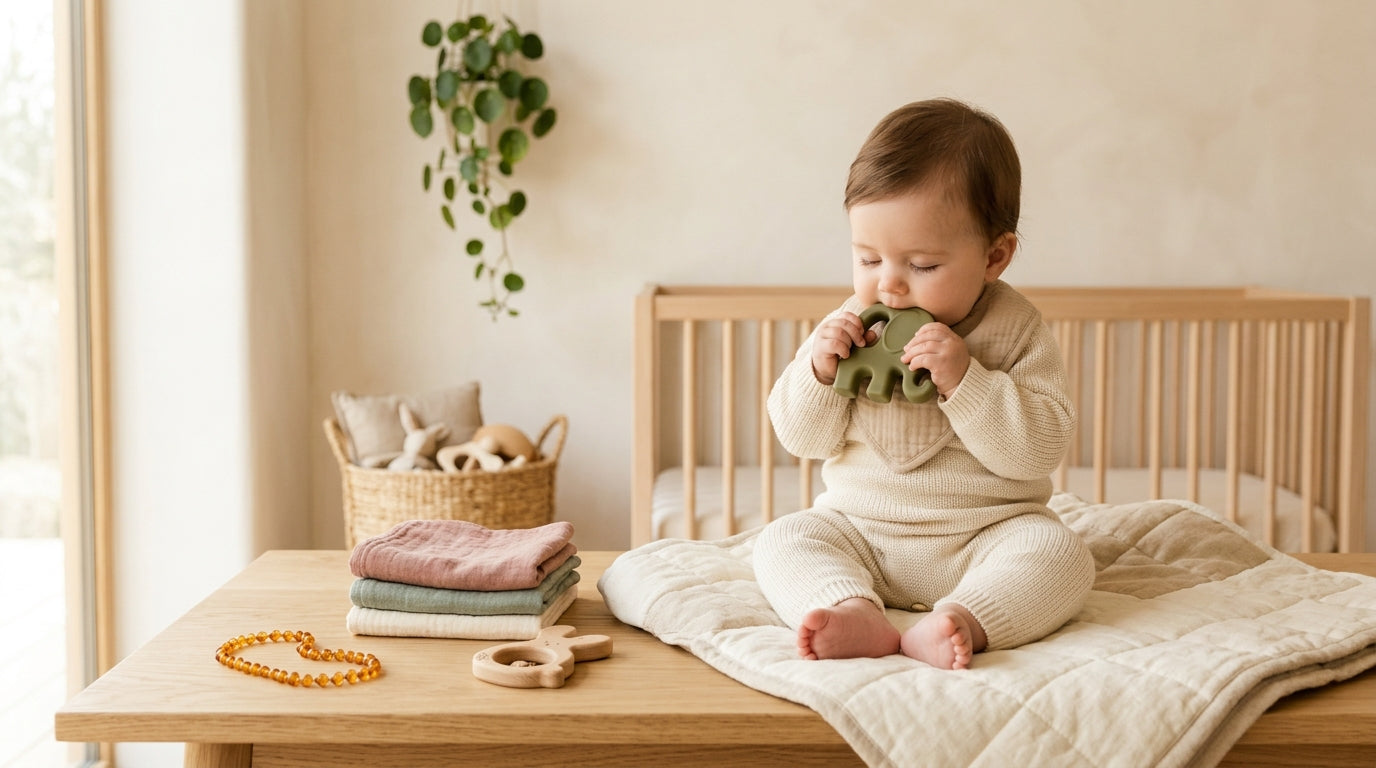
You're only supposed to chill things in the fridge. Our absolute lifesaver was the Panda Teether. It's entirely silicone, so you can chuck it in the dishwasher when it inevitably gets dropped in a puddle, and it has these little textured bumps that Maya would aggressively grind her front gums against for twenty minutes at a time. I'd keep two in the fridge door next to the milk, swapping them out like hockey players on a line change whenever one got warm.
We also had this Violet Bubble Tea teether shaped like a cup with boba pearls. It's perfectly fine and the materials are safe, but it's a bit clunky, and Maya mostly just used it as a heavy projectile to throw at the cat when she was frustrated, so it quickly vanished into the bottom of the toy box.
Brushing a shark's tooth
The most insulting part of the whole ordeal is that the second the tooth finally breaks through the skin—an event that feels like it should be celebrated with a long nap and a strong drink—you immediately have to start brushing it. The dental guidelines suggest using a rice-grain-sized smear of fluoride toothpaste twice a day, which is hilarious because trying to insert a toothbrush into the mouth of a screaming, teething toddler is like trying to brush the teeth of an angry shark.
We abandoned traditional toothbrushes early on and used those little silicone finger-brushes that slide over your index finger. You basically just let them bite your finger while you desperately wiggle it around, hoping the friction removes whatever beige puree they had for lunch. Eventually, the swelling goes down, the feverish red cheeks fade back to normal, and you get about three weeks of peace before the canine teeth decide it's their turn to ruin your life.
If you're currently in the thick of it, staring at the ceiling at 4 am while your child gnaws on their own fist, just know that the teeth eventually come through, the drool eventually stops, and you'll eventually sleep again. Probably.
Ready to stop relying on frozen carrots? Grab the Panda Teether and give your baby (and yourself) some much-needed relief.
Exhausted dad FAQs
Is it normal for my baby to have a bright red rash on their bum while teething?
According to my GP, the teeth don't directly cause nappy rash, but the sheer amount of excess saliva they swallow can supposedly make their stool slightly more acidic, which absolute wreaks havoc on their skin. We went through vats of barrier cream during the worst weeks. If it looks blistered or doesn't clear up, go see a doctor instead of asking Google.
Can I just rub some numbing gel on their gums and go to sleep?
A lot of the old-school numbing gels have actually been pulled from the shelves or heavily restricted because the active ingredients (like benzocaine) aren't safe for tiny babies who might swallow too much of it. Stick to chilled silicone toys, gentle counter-pressure with a clean finger, and infant pain relief if your doctor says it's okay.
Why is teething worse at night?
Because the universe hates us. Also, when babies are lying flat in their cribs, more blood rushes to their heads, which increases the throbbing pressure in their swollen gums. Plus, during the day they're distracted by toys and noise; at night, the only thing they've to focus on is the dull, pulsing ache in their jaw.
When do the molars come in?
I'm so sorry to tell you this, but the first molars usually show up somewhere between 13 and 19 months, and they're massive, blunt instruments pushing through a lot of gum tissue. Start stockpiling the paracetamol and clearing your social calendar now, because those weeks are an absolute write-off.




Share:
The 3 AM Blowout: Finding A Baby Strampler That Actually Works
My Humiliating History With Kids and the Bulky Knit Sweater