

I was standing in the driveway, sweating through my flannel, trying to solve a geometry problem that shouldn't exist. It was 52 degrees in Portland, a classic damp October morning, but my internal CPU was overheating because I couldn't get the car seat harness to click. My eleven-month-old daughter was currently encased in a synthetic, highly flammable plush pumpkin costume we bought at a big box store. Because of the sheer volume of orange polyester stuffing, her arms were sticking straight out to the sides like a starfish. She looked like a bright orange marshmallow that was about to detonate, and the five-point harness of her car seat simply wouldn't stretch over the mass.
My wife came out to the driveway with her coffee, observed my struggle for about thirty seconds in total silence, and then calmly informed me that puffy outerwear in a car seat is a massive safety hazard. Apparently, the thickness of the costume introduces slack into the harness system, meaning in a crash, the baby just compresses the padding and flies forward. I had to rip the velcro off the pumpkin, pull my confused baby girl out of the orange sphere, and strap her in wearing just her diaper and a thin onesie. She screamed the entire way to daycare. That was the exact moment I realized that traditional infant holiday apparel is a completely broken system.
The physics of puffy polyester and firewall protocols
I approach most parenting challenges by looking for the documentation, so that night I went down a massive internet rabbit hole regarding holiday outfits for infants. It turns out that mainstream outfits for October are mostly manufactured using the cheapest synthetic materials known to modern science. When I looked at the tag on the discarded pumpkin suit, it was 100 percent polyester.
If you put an infant who runs hot into a sealed plastic bag of synthetic fibers, their core temperature spikes almost immediately. Babies don't keep stable their body heat very efficiently yet, a feature that feels like a massive oversight in their early development firmware. I had essentially wrapped her in a wearable sauna. Plus, my wife calls our daughter Baby G sometimes, mostly because her name is Genevieve and I spend entirely too much time listening to 90s hip hop, and Baby G happens to have incredibly sensitive skin.
At her nine-month checkup, our pediatrician Dr. Lin was looking at her eczema patches and mentioned that we really shouldn't be exposing her to the harsh flame-retardant chemicals sprayed on cheap seasonal outfits. I guess a baby's skin barrier is still downloading its defense protocols, so soaking her in questionable synthetic compounds just to get a cute photo for Instagram is probably a bad tradeoff. Dr. Lin basically said that organic, breathable layers are the only way to avoid the inevitable heat rash, which made complete logical sense to my engineering brain.
Pivoting to the modular architecture approach
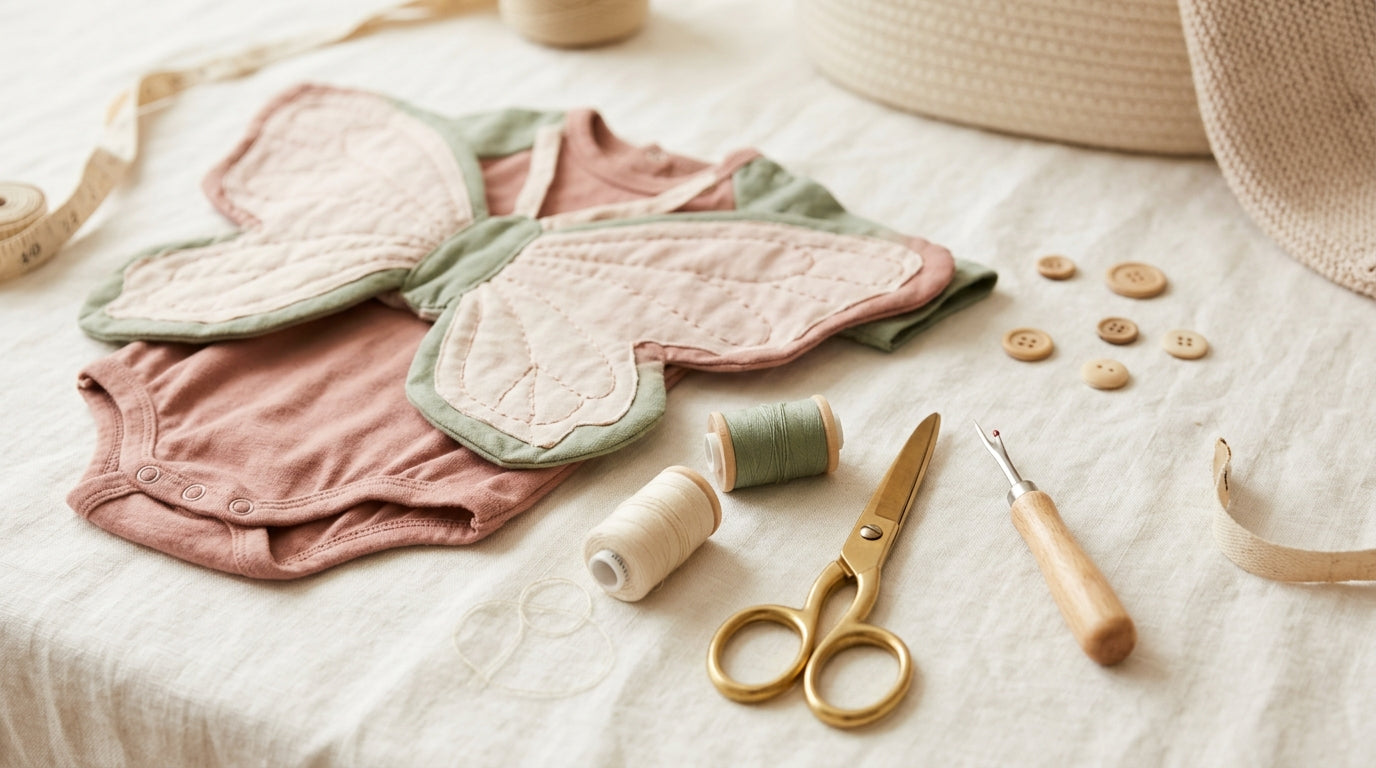
Since the pumpkin was permanently decommissioned, my wife suggested we build a costume out of clothing that actually functions in the real world. We decided to treat the outfit like an API, where we use a solid, high-quality base layer and just add temporary accessories on top.

She ordered the Flutter Sleeve Organic Cotton Baby Bodysuit in this really bright, cheerful yellow. I was initially skeptical of flutter sleeves because they don't seem very aerodynamic for a crawling baby, but I've to admit the fabric is incredibly impressive. It’s 95 percent organic cotton and has just enough stretch that I don't feel like I'm going to snap her tiny arms off when I wrestle it over her head. The fabric is stupidly soft, and she doesn't immediately start clawing at her neck when we put it on her. We decided to make her a bumblebee by just pairing the yellow suit with black leggings and some little fabric wings we can easily detach.
But the most important hardware feature of this bodysuit is the fact that it actually has snap closures at the bottom, which brings me to my primary grievance with the seasonal clothing industry.
The sheer audacity of clothing manufacturers who design a one-piece infant outfit without a bottom hatch is staggering. It's a critical infrastructure failure. If you buy one of those fuzzy animal suits that only zips halfway down the back, you're trapping yourself in a logistical nightmare.
If a blowout occurs—and it'll, because holiday excitement completely disrupts their feeding and digestion algorithms—you absolutely can't pull a soiled tube of fabric up over a baby's head. That's how you spread the contamination area from the diaper zone directly into their hair. You end up having to strip them entirely naked in a damp, freezing breeze just to change a diaper, while they scream and twist like a feral cat.
My wife watched me try to peel a store-bought mermaid tail off Genevieve last week during a trial run and told me I looked like I was trying to defuse a bomb while wearing oven mitts. So yes, we scrapped the store-bought junk entirely and are only using base layers with emergency crotch exits from now on.
The 1980s aerobics instructor patch
Before we settled on the bumblebee concept, I briefly lobbied for dressing Baby G up as an 80s aerobics instructor. It seemed like an easy hack. My wife found the Baby Shorts Organic Cotton Ribbed Retro Style Comfort, which have this vintage athletic vibe with white trim down the sides.
Honestly, these shorts are just okay for me as a costume piece. Functionally, the architecture is sound because the elastic waistband doesn't leave those angry red compression marks on her stomach, and the ribbed cotton stretches perfectly when she does her weird asymmetrical speed-crawl across the living room rug. But aesthetically, putting white trim on an eleven-month-old is a highly optimistic design choice. That white edge gets stained with mashed sweet potato and mysterious floor grime in roughly four seconds flat. Still, if you pair them with some knitted leg warmers and a tiny sweatband, you get a hilarious outfit that doesn't restrict her mobility and lets her take a nap without requiring a full wardrobe change.
Handling the teething variable
The other major issue we ran into while beta-testing costumes is that Genevieve is cutting her top teeth right now, meaning she views everything in her immediate environment as food. She grabs tulle, sequins, and fuzzy synthetic tails and just shoves them directly into her mouth.

We realized that any costume with loose attachments is basically a choking hazard waiting to happen. So instead of fighting it, we're just incorporating her actual chew toys into the aesthetic. We have this Panda Teether Silicone Baby Bamboo Chew Toy that she's currently obsessed with. I honestly thought about just dressing her in black and white, handing her the panda, and telling the neighbors she's a zookeeper. The silicone is food-grade and doesn't collect dog hair when she throws it on the floor to test gravity, which makes my life infinitely easier.
Apparently, putting any kind of mask on a baby under two years old is a hard no because it obstructs their breathing and vision, which seems like a fairly obvious fact that I definitely didn't have to google to figure out.
Layering for unpredictable environments
Living in the Pacific Northwest means the weather can fluctuate between a warm, sunny afternoon and a freezing rainstorm in the span of an hour. Trying to calculate the exact thermal requirements for trick-or-treating is exhausting. You basically just have to dress them in breathable cotton layers and constantly add or remove hoodies depending on whether the sun goes behind a cloud.
If you're also tired of dealing with bulky, flammable synthetic outfits that your kid will wear for exactly forty-five minutes before having a meltdown, you might want to look at Kianao's organic baby clothes for base layers that actually make sense.
honestly, she doesn't know what a holiday is. She just knows whether she's comfortable, whether she's hungry, and whether I'm currently letting her chew on the television remote. By stripping away the massive puffy pumpkin suits and focusing on soft, modular pieces we can reuse until she outgrows them next month, we basically eliminated the system errors. So before you spend forty dollars on a cheap polyester hot dog suit, maybe just dig through your kid's drawer to find a yellow onesie, or grab a sustainable basic that will really survive the wash cycle.
Dad's troubleshooting FAQ for holiday outfits
How do I keep a hat or headband on her head?
You don't. I'm convinced babies have a built-in gyroscope that detects anything touching their scalp, triggering an immediate swipe response. We tried putting little antenna headbands on her for the bee outfit, and she ripped them off in under a second. We just gave up and decided she's a bald bee.
What if we just don't dress her up at all?
Nobody genuinely cares. I stressed out about this for weeks, tracking delivery dates and reading fabric safety reviews, and my wife finally reminded me that our daughter goes to bed at 6:30 PM. The only people who will see her outfit are the three neighbors we talk to and our parents on FaceTime. A normal onesie with a pumpkin printed on it's completely valid.
Is it okay to use baby face paint instead of a mask?
Dr. Lin looked at me like I was insane when I asked about this. An eleven-month-old rubs her eyes with her fists approximately every four minutes. If I put black face paint on her nose, she will smear it directly into her corneas and then onto our beige sofa within moments. Stick to the clothes.
Can I put her in a puffy outfit if she's just riding in the stroller?
Yeah, strollers are a different environment than car seats since you aren't worried about high-speed vehicle crash physics. But honestly, even in the stroller, those giant stuffed pods restrict their movement so much that they get incredibly frustrated. I’d rather just wrap a warm organic blanket around her legs than try to force her into a restrictive polyester cocoon.




Share:
The Absolute Mess Of Buying Baby Gear (And What Actually Works)
What To Do When "Baby Girl Shake That" Invades Your Nursery