

Dear Tom of eighteen months ago.
You're currently sitting on the IKEA armchair that smells faintly of sour milk and big defeat, a twin wedged in the crook of each arm. You're trying to balance two plastic bottles using your chin, a strategically raised knee, and sheer, white-knuckled willpower. Your nose is itching, but you can't scratch it, so you're instead using it to desperately tap your phone screen, frantically Googling "when do babies" and occasionally misspelling it as "when do babie hold bottle" or "babi feeding age" because your eyes are crossing from sleep deprivation and your left thumb has lost all feeling.
You want to know when they're going to hold the bloody things themselves. You're dreaming of a hands-free future where you can drink a cup of tea while it's still vaguely warm, or perhaps even scratch your own face without causing a milk avalanche that will require a full outfit change for three different people.
I'm writing to you from the other side of this milestone to tell you exactly how it happens, what the doctor actually said when you inevitably panicked about it, and why the whole thing is a massive, ironic joke anyway.
Stop waiting for the magic milestone
If you look at the glossy parenting books (which you shouldn't, because page 47 suggests you remain calm during feeds, which I found deeply unhelpful at 3am when Twin A was using my collarbone as a launchpad), they'll tell you that the average age for this miracle is between six and ten months. This is a timeframe so obnoxiously wide that it's essentially meaningless to a man operating on three hours of broken sleep.
The reality is that it doesn't happen overnight. Right now, at four months, Twin B is doing that thing where she just aggressively bats the bottle away like a tiny, drunk boxer, while Twin A simply opens her mouth like a baby bird expecting room service. You think they're nowhere near ready.
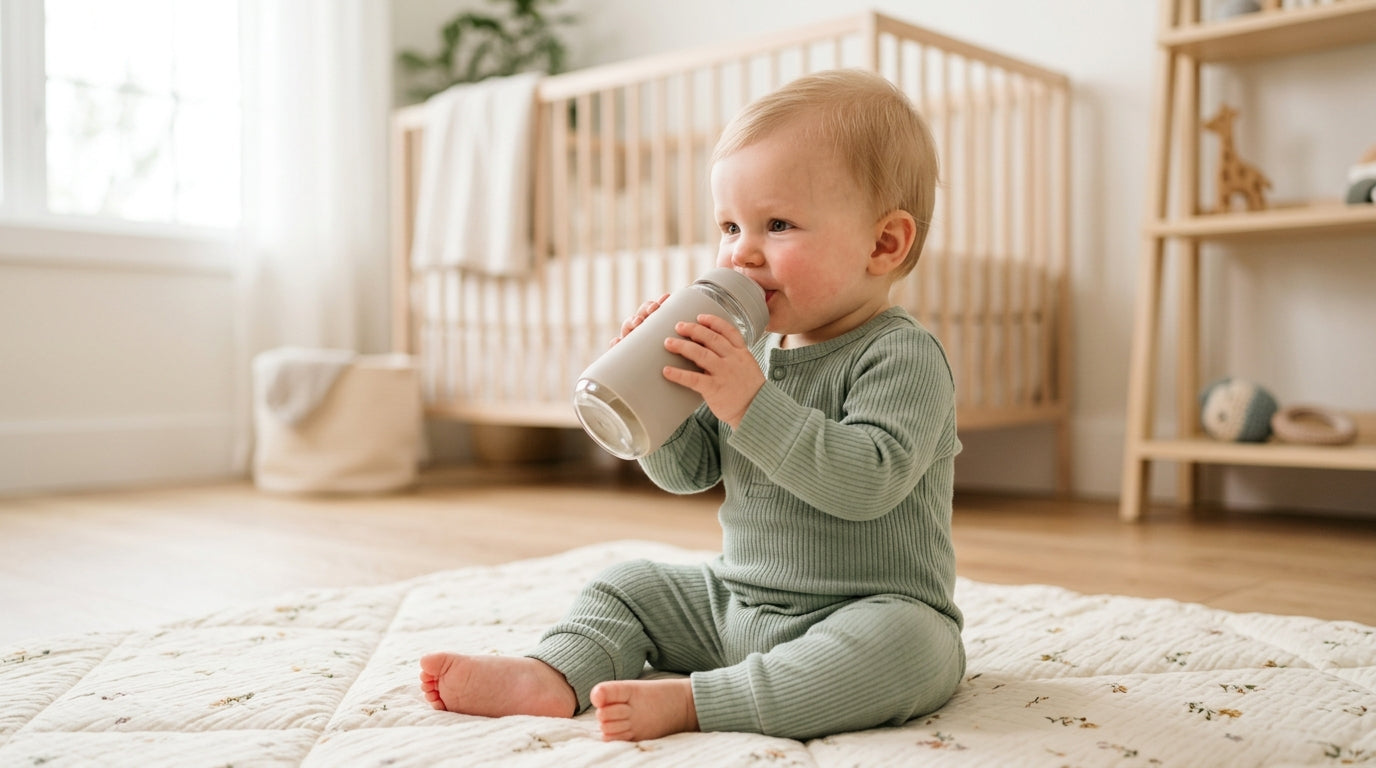
But around six months, they start resting those sticky little hands on the plastic. They aren't supporting the weight—they're just touching it, as if making sure you haven't replaced their beloved formula with tap water. Our GP looked at me with a mixture of pity and exhaustion when I asked her about it, waving her pen vaguely and explaining that until their upper body strength catches up with their appetite, I was doomed to remain the designated bottle-butler.
By eight months, one of them will suddenly grab it with both hands and yank it into her mouth, completely bypassing your assistance, while the other will just refuse to do it until she's ten months old purely out of spite and a deep appreciation for being waited on hand and foot.
The great core strength deception
The thing no one tells you is that holding a bottle has very little to do with their hands and absolutely everything to do with their stomach muscles. Before a baby can hold their own bottle without waterboarding themselves, they've to be able to sit up independently, which requires an amount of core strength I haven't personally possessed since the late nineties.

Our health visitor muttered something about "crossing the midline," which sounded like a geopolitical treaty but apparently just refers to a baby's neurological ability to reach across their own chest with one hand, a skill they need to guide a rogue bottle back to the centre of their mouth.
Which is why all that miserable tummy time actually matters. We spent hours on the floor trying to build up their little shoulders, and I've to admit, having a decent base of operations made it infinitely more tolerable. We practically lived on the Autumn Hedgehog Organic Cotton Baby Blanket, which I bought mainly because the rich mustard yellow colour perfectly camouflaged the inevitable reflux incidents, but it ended up being my favourite bit of baby gear we owned. It’s incredibly soft organic cotton, heavy enough not to bunch up when a baby is thrashing around in frustration, and the little blue hedgehogs gave them something high-contrast to stare at while I laid next to them on the floor, quietly contemplating my life choices.
You’ll notice that once they can sit up on that blanket without immediately toppling over like a drunken sailor, their hands suddenly become free to do other things—like aggressively grabbing your nose, or finally, holding their own milk.
Things that actually help their grip (and things that don't)
You can't force a baby to hold a bottle, but I eventually figured out that handing a six-month-old a fully loaded eight-ounce bottle was roughly equivalent to someone asking me to casually one-hand a keg of beer. It's only too heavy.
If you want to nudge them in the right direction, you've to let them practice with lighter things first, or just hand them an empty bottle to chew on while you’re cooking dinner. We inadvertently trained their grip strength through the sheer volume of teething toys we threw at them when their gums started acting up.
The Squirrel Silicone Teether was brilliant for this exact purpose because it’s shaped like a ring. They could easily hook their chubby little fingers through it and practice bringing it up to their mouths without dropping it on the floor every five seconds. The mint green silicone was soft enough for their miserable gums but sturdy enough that they got used to gripping a curved surface, which seamlessly translated to gripping a bottle later on.
We also had the Llama Silicone Teether, which was fine, though admittedly they mostly used it as a weapon to hit each other during car journeys. It has a heart cutout in the middle that one of them liked to hook a thumb into, but while it was perfectly safe and easy to wash, it didn’t quite have the ergonomic magic of the squirrel ring when it came to teaching them how to really hold a cylindrical object.
If you're looking for things that will survive the twin apocalypse while genuinely aiding their development, you might want to explore the wider organic baby essentials and teething collections that don't look like they were manufactured in a toxic neon plastic factory.
The panic over ear infections and choking
I need to talk to you about the 3am temptation. You will reach a point where you're so tired you'll seriously consider rolling up a muslin, propping the bottle against it, and just closing your eyes for five minutes while they feed.

Don't do it. I know you're desperate, but the dressing-down I got from the paediatric nurse about bottle propping still haunts me. She explained, with terrifying bluntness, that babies choke completely silently. If you wedge a bottle into their mouth and they inhale the milk, they won't cough or splutter to wake you up; they'll just quietly suffocate while you're dozing next to them.
And if the fear of silent death isn't enough, there's the ear infection lecture. Apparently, a baby's Eustachian tube—the bit connecting the throat to the middle ear—is horizontal rather than angled. If you feed them while they're lying flat on their backs, the milk just pools in the back of their throat, wanders into their ear canals, and throws a massive bacterial rave. I thought this was an old wives' tale until Twin A got a double ear infection that required a week of antibiotics and resulted in crying so pitch-perfectly horrific it could shatter glass.
You just have to hold them upright. You have to sit there, awake, keeping them elevated, letting them hold the bottle while you supervise, like a very tired security guard at a milk club.
The absolute irony of cups
Here's the funniest, most utterly tragic part of this whole letter.
You will wait eight to ten months for them to master this skill. You will celebrate the day they finally hold their own bottles with both hands, kicking their legs in delight while you sit back and drink a hot coffee for the first time in nearly a year.
And exactly four weeks later, a letter will arrive from the NHS health visitor reminding you that at twelve months old, you need to throw all the bottles in the bin and switch them to cups so their adult teeth don't grow in sideways.
The second they learn to do the thing you've been desperate for them to do, you're medically obligated to take the thing away from them and replace it with a sippy cup they'll immediately throw at your head.
So, past-Tom, stop trying to rush the timeline. They will grab the bottle when their little abs are strong enough and their brains have figured out that their hands belong to them. Until then, just try to enjoy the quiet moments where they're pinned to your chest, smelling of warm milk and baby shampoo, because very soon they'll be running around the kitchen throwing perfectly good organic snacks at the walls.
Before you completely lose your mind Googling milestones in the dark, you might want to browse some thoughtfully designed gear that honestly supports their clumsy little hands without adding to the chaos.
Frequently Asked Questions About Independent Feeding
Will my breastfed baby ever hold a bottle?
Honestly, they might just skip this entire charade. Our GP mentioned that babies who are exclusively breastfed often completely bypass the bottle-holding phase because by the time you try to introduce one at six or eight months, they're developmentally ready for an open or straw cup anyway. If they look at the bottle like it’s an alien artifact, just wait a bit and hand them a cup instead.
What if they're 10 months old and absolutely refuse to hold it?
If they've the motor skills to pick up a tiny piece of lint off the carpet and expertly place it in their mouth, they've the physical ability to hold a bottle. At ten months, refusal is often just a highly works well management strategy. They know that if they just lie there like a starfish, you'll eventually sigh and do it for them. Assuming your doctor has ruled out any developmental delays, sometimes you just have to guide their hands to the bottle and gently remove yours, letting them realize the milk service has been downgraded to self-catering.
Is it ever safe to use a bottle-propping pillow?
I can't stress this enough: no. Those commercial bottle-propping pillows look like a gift from the sleep-deprivation gods, but they bypass every single satiety cue a baby has. If the milk keeps flowing when they want to stop, it goes straight into their lungs or ears. I know how heavy your arms are, but there's no safe way to prop a bottle and walk away.
How heavy should a practice bottle be?
A full eight-ounce bottle weighs roughly half a pound, which is a massive dumbbell for a creature that just learned how to hold its own head up. When you're trying to encourage them, only put an ounce or two of milk in it at a time. Let them practice lifting something manageable to their mouth rather than getting frustrated that they can't bench-press their breakfast.




Share:
Instant Pot Baby Back Ribs: A Warning To My Panicked Past Self
What the Wendy Ortiz baby daddy drama gets right about parenting