

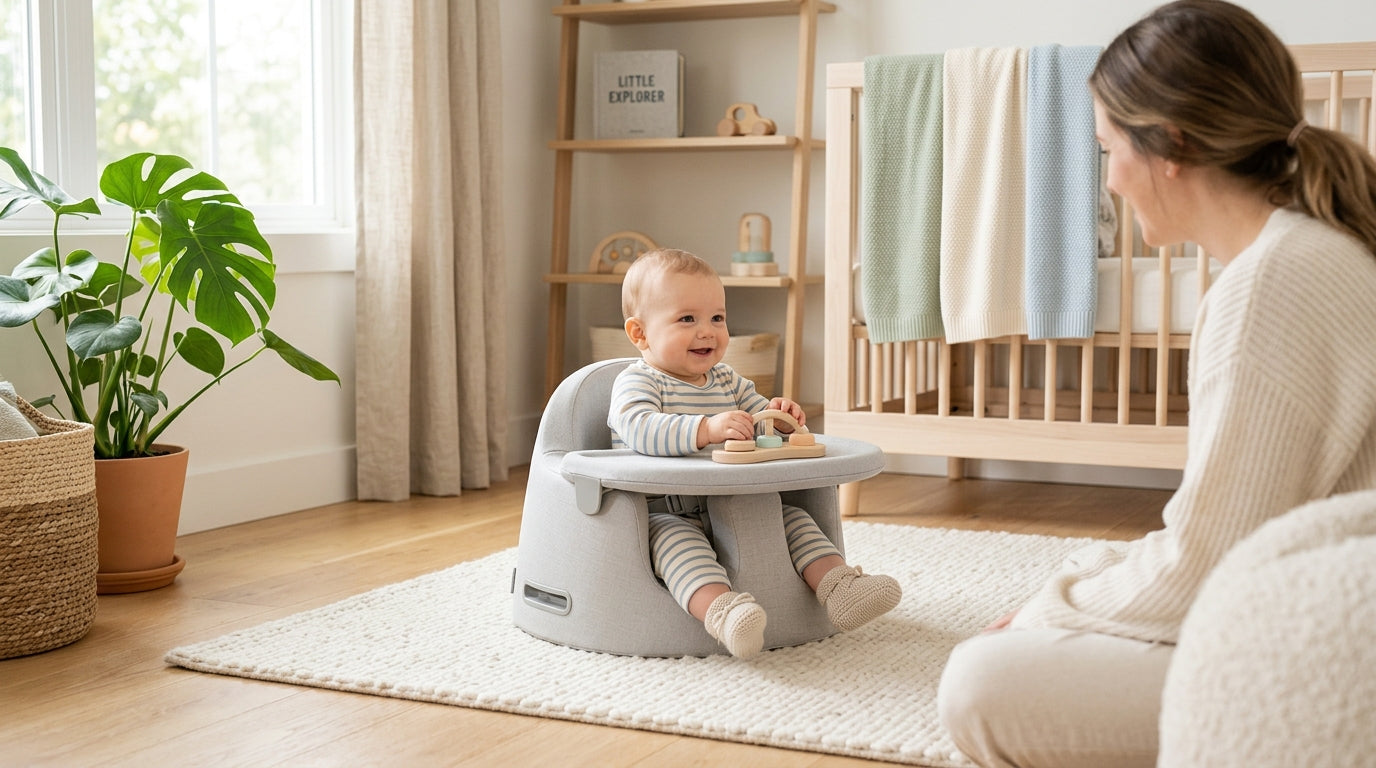
It was 10:14 AM on a Tuesday, and I was staring at my five-month-old son, Leo, who looked exactly like a tiny, extremely drunk man slumped at a bar at last call. He was sitting—or rather, sinking—into one of those squishy, brightly colored bucket seats that literally every mom on Instagram swore I absolutely needed for my registry. I was standing there in my living room, holding a mug of coffee that I had already microwaved three times, wearing yoga pants that had definitely seen some spit-up from the day before, and I just had this sinking feeling of... this can't be right.
There's this massive, pervasive myth in the parenting world that you've to buy these ubiquitous, restrictive little bucket containers to "teach" your infant how to sit up, as if babies wouldn't figure out gravity without a $50 piece of molded foam. But the reality is, we're basically just forcing them into these weird, unnatural postures before their little jelly spines are ready, all so we can have five minutes to drink our cold coffee or, God forbid, go to the bathroom alone.
Anyway, the real breaking point wasn't even the slumping. It was the thigh incident. When I finally put my coffee down and tried to lift Leo out of this popular floor chair, the entire seat came with him. It was literally suctioned to his massive, glorious, Michelin-man thighs. My husband, Dave, had to come over and help me pry our child out of this piece of foam like we were extracting a stubborn cork from a wine bottle. He was pulling the chair down while I pulled Leo up, and honestly, we almost considered using butter.
That was the exact moment I rage-googled "chairs for babies with giant thighs" and stumbled onto the whole upseat baby phenomenon. Which, by the way, sent me down a massive internet rabbit hole about infant posture that frankly gave me more anxiety than I needed on a Tuesday, but here we're.
The whole "slumping potato" problem
So apparently, pediatric physical therapists absolutely hate those traditional bucket seats. I had no idea. I thought Leo looking like a folded-up potato was just a cute, albeit pathetic, developmental stage. But during Leo's six-month checkup, our pediatrician, Dr. Miller—who always looks like he needs a nap exactly as much as I do—casually mentioned that a lot of these floor seats force babies into what they call a "C-curve" spine.
Because the seat dips down in the back, the baby's pelvis tilts backward, and their spine just collapses forward into a C-shape. Which means they aren't actually using their core muscles to sit; they're just passively hanging out by compressing their own internal organs. Awesome. Mother of the year right here.
From my somewhat sleep-deprived understanding of the medical jargon, the Upseat was actually developed with physical therapists to fix this exact issue by creating something called an "anterior pelvic tilt." Basically, the seat is slightly wedged so it tips your baby's hips forward just a tiny bit, which forces them to engage their own abdominal and neck muscles to stay upright. Think of it like when you sit on one of those ergonomic exercise balls at your desk instead of slouching on your couch—you've to use your core or you fall over. Except the Upseat supports them safely so they don't actually tip over.
There's also this whole thing about hip health. I guess forcing a baby's legs straight out and together in a narrow channel can be terrible for their hip joints. The Upseat is designed to let their legs splay outward naturally, which I'm told is way better for preventing hip dysplasia, though frankly I was just relieved that Leo's chubby legs finally had room to breathe without getting stuck.
Thick thighs save lives (but ruin baby gear)
I can't stress enough how much of a game-changer the leg room situation is. Competitor seats have these tiny little leg holes that assume every infant is built like a string bean. The Upseat has four-inch wide leg openings. Four inches! You could fit a small ham in there, which is essentially what Leo's thighs were at that age.

It sounds like such a minor detail until you're dealing with a screaming baby who feels trapped because his circulation is being cut off by a baby chair. With the Upseat, dropping him in and pulling him out was completely frictionless. No butter required.
Let's talk about the actual feeding part (and the mess)
One thing nobody warns you about when you start introducing solids is that if your kid is slumped over, they're basically a massive choking hazard. If you think about it, it makes total sense—if your chin is tucked into your chest and your stomach is compressed, how the hell are you supposed to swallow a piece of avocado?
Because the Upseat seriously keeps them upright, the food can travel directly down to their stomach, which Dr. Miller said helps a lot with digestion and reduces reflux. Leo was a huge spitter-upper, so anything that kept his meals in his stomach instead of all over my favorite sweater was a win.
The seat comes with a large, food-grade plastic tray that snaps on, turning it into a pretty decent feeding station. I'm violently opposed to buying a massive, standalone plastic high chair that takes up half my dining room and will eventually end up in a landfill, so we just strapped the Upseat to one of our regular dining chairs using the included booster conversion straps.
I'll say, if you're venturing into the messy, horrific world of baby-led weaning, your plates and bowls are going to end up on the floor. It's just a law of physics. I usually slap the Silicone Cat Plate right onto the Upseat tray. Honestly, it's my favorite thing in our kitchen. The suction base on it's intense—Leo would grab it with both hands, grunt like a tiny bodybuilder, and it wouldn't budge. Plus, the little cat ear compartments are perfect for separating peas from sweet potatoes, because God forbid those two purees touch and contaminate each other. It's 100% food-grade silicone, which means I'm not stressing about whatever toxic crap leaches out of heated plastic.
I also bought the Silicone Baby Bowl with Suction Base to use with it, and honestly? It's just okay. Like, the suction works beautifully on the tray, don't get me wrong. But it turns out that if a bowl is too deep, Leo just uses it as an excuse to plunge his entire fist into his oatmeal and then paint his forehead with it. So, great bowl, beautifully made, but maybe user error on my part because my child treats deep dishes like a sensory mud bath.
When Maya was younger and transitioning to slightly bigger meals in her booster, we used the Baby Silicone Plate in the Bear Shape. The raised, rounded edges of the bear face really helped her learn to scoop her food without pushing it straight off the edge of the plate, which saved me from scraping dried spaghetti sauce off the hardwood floors quite as often.
(By the way, if you're currently drowning in the chaos of starting solids and want gear that seriously survives the dishwasher, you can check out Kianao’s full line of sustainable feeding products here.)
The part where I admit it's still a "container"
Okay, reality check time. I'm singing the praises of this chair, but honestly, it's still a "container."

There's this terrifying term called "Container Baby Syndrome" that pediatricians throw around now, which basically refers to the fact that we modern parents are constantly shuttling our infants from car seats to bouncers to swings to floor seats, and they never get any actual floor time to develop their gross motor skills.
Dr. Miller was very clear with me: Even though the Upseat is ergonomically vastly superior to the squishy bucket seats, it should still be used in moderation. We're talking 15 to 30 minutes at a time, max. You use it for feeding them, or you use it so you can set them down safely while you aggressively scrub a pan or pee in peace, and then you get them back on the playmat. It's a tool, not a babysitter.
Also—and my anxiety is spiking just typing this because it freaks me out so much—don't ever put this thing on a table or a kitchen island. Never. I know we've all seen the aesthetic TikToks of a mom making a matcha latte while her baby sits serenely in a floor seat on the counter. If you're tempted to put this baby chair on your kitchen island so you can chop onions at eye level while making dinner, just shove that intrusive thought right back down and keep the chair securely strapped to a dining chair or flat on the floor instead, because babies are wildly unpredictable and can launch themselves backward when you blink.
And obviously, don't use it until your baby has really strong head and neck control, which is usually around the 4-month-old or 5-month-old mark. If their head is still bobbling around like a dashboard ornament, they belong on the floor or in your arms.
The "buy less, buy better" philosophy
At around $110, the Upseat isn't exactly cheap. I definitely winced when I hit checkout. But I justify it because it genuinely lasts.
The weight limit goes up to 30 pounds, which means you can use it until your kid is about two and a half years old. It starts as a floor seat for that awkward 4-month-old stage, turns into a feeding seat when they start solids around 6 months, and then converts into a toddler booster seat for the dining table later on.
As someone who gets deeply overwhelmed by the sheer volume of plastic garbage that accumulates in a house once a baby arrives, I love anything that serves three purposes and prevents me from buying more stuff. It's made in North America, free of BPA and phthalates, and when you finally wipe the last smear of peanut butter off it, it’s still in good enough shape to pass on to another family.
So yeah, I threw the squishy bucket seat in the donation bin, and honestly? My back, Leo's thighs, and Dave's sanity have never been better.
Ready to upgrade your mealtime setup? Pair your baby chair with sustainable, non-toxic silicone plates that really stay put. Shop Kianao's feeding collection now!
The Messy, Real-Life FAQ
When can my baby honestly start using the Upseat?
You really have to wait until they've solid head and neck control, which is usually around 4 months old, but every kid is different. If you put them in and their head is just aggressively flopping to the side, take them out! Wait a few more weeks. There's literally no rush to force them to sit up before their body is ready to support a giant, heavy infant head.
Is the Upseat easy to clean when they inevitably smear avocado everywhere?
God, yes. The seat itself is made of this medical-grade polyurethane foam that you can just wipe down with a damp cloth or a baby wipe when you're feeling lazy. The tray is food-grade plastic and can seriously go in the dishwasher, but only on the top rack and on a low heat setting under 140°F, otherwise you might warp it and then nothing will snap together right ever again.
Will my baby's thick thighs get stuck in this thing?
No, that's honestly the best part! The leg holes are four inches wide, which is way larger than the other popular bucket seats on the market. Leo was a massively chunky baby and his legs slid in and out with zero friction, which saved us from repeating the horrifying "stuck-baby-extraction" dance we had to do with our old chair.
Can I use it on my kitchen counter while I cook?
Absolutely not. Never. I don't care how secure they look, babies can suddenly arch their backs with the force of a professional wrestler and tip the whole thing over. It belongs strictly on the floor, or tightly strapped to a sturdy dining chair using the booster straps. My anxiety can't handle the thought of a baby seat on a countertop.
How long can I leave them sitting in it?
Our pediatrician told us to cap it at 15 to 30 minutes at a time. Even though the posture support is way better than other seats, it's still a container that restricts their movement. They need unrestricted floor time to learn how to roll, crawl, and generally exist in the world, so just use the chair for meals or when you desperately need two free hands to make a sandwich.




Share:
My Love-Hate Relationship With The Massive Uppa Baby Stroller
Surviving the Vaccine Schedule for Babies Without Losing Your Mind