

It was 3 AM in late January. The wind off Lake Michigan was rattling our bedroom windows, and my daughter was doing the newborn startle reflex thing. She looked like she was trying to conduct a tiny, frantic orchestra in the dark. I stood over her bassinet, exhausted, trying to wrap her securely in one of those standard hospital blankets. She busted out of my amateur origami in exactly four seconds. I've swaddled hundreds of preemies in the NICU over the years, but this one seven-pound child was completely breaking me. That was the exact moment I realized my mistake. You simply shouldn't try to make a utility cloth do a specialized sleep job when your kid is practically training for a cage fight.
I've a deeply complicated relationship with those classic hospital blankets. You know the ones. They're white with the faded pink and blue stripes, slightly scratchy, and smell vaguely of industrial bleach. I've folded a thousand of these on quiet night shifts until my fingerprints felt numb.
They're an iconic piece of newborn imagery, but they're also incredibly misunderstood by first-time parents. People steal a stack of them from the maternity ward and bring them home expecting them to solve all their midnight sleep crises. They just don't. They lack the necessary stretch. They lack the surface area to get a good wrap.
It's honestly like trying to wrap a massive burrito in a corn tortilla that's three sizes too small. The beans are going to fall out. In this case, the beans are tiny flailing arms, and the result is a baby who wakes up screaming twenty minutes after you finally sat down.
The tape measure test
People ask me all the time if they're buying the right gear for the registry. They want to know, are receiving blankets functionally the same as swaddles. The short answer is no. The long answer involves a lot of wasted money, sleep deprivation, and crying in the laundry room.
Listen, you've to stop confusing your fabrics. When parents ask me if receiving blankets and normal swaddles are the exact same thing, I usually ask them if a bath towel is the same thing as a winter coat. They both cover your body, but you wouldn't wear a towel in the snow. A swaddle is a dedicated sleep tool engineered to mimic the womb. A receiving blanket is essentially a multi-purpose rag that happens to look cute.
The difference comes down to geometry. If you're wondering what size standard receiving blankets actually are, they usually measure around 30 by 30 inches. Some go up to 30 by 40 inches. That's a square. Swaddles are massive by comparison, usually 47 by 47 inches, and they're made of stretchy muslin or jersey knit that actually gives when you pull it.
You can use a giant swaddle as a makeshift blanket in a pinch, but using a stiff 30-inch square to wrap a baby is a recipe for a bad night. You just can't get the tap into you need to tuck the corners under their body weight properly.
Bodily fluids and public bathrooms
So if they aren't for sleeping, what are these receiving blankets actually for with your baby. In my house, they're primary triage equipment. You don't use them to put the baby to sleep. You use them to manage the absolute chaos of keeping a human being alive.

I keep a stack of them in the living room and shove at least three into my diaper bag before we leave the house. Their main job is intercepting bodily fluids. Babies spit up constantly. Sometimes it's a little trickle, and sometimes it's a terrifying geyser of half-digested milk. A flimsy little curved burp cloth from a big box store will soak through in a second. A folded receiving blanket draped over your shoulder gives you actual structural protection.
They also serve as your portable sanitation barrier. I've seen things on public changing tables that would make a sanitation worker weep. You lay one of these down before you put your kid on that hard plastic surface at Target. When the diaper change goes sideways, and it always does, the blanket takes the hit instead of your child's bare back. Then you just roll the whole contaminated mess up and throw it in the wash later.
You can also use them for impromptu tummy time at the park, or as a lightweight nursing cover if you're into that. I see new moms buying fifty-dollar specialized UV-blocking stroller shades online when a cheap receiving blanket draped loosely over the handle does the exact same thing for free.
The hip dysplasia conversation
My pediatrician, Dr. Scott, is completely obsessed with hips. I get it, honestly. I've seen older babies fitted for hip dysplasia braces in the clinic, and it looks pretty miserable for everyone involved. She told me at our two-week checkup that the biggest mistake parents make is wrapping their babies' legs too tight.
When you try to force a swaddle using a standard receiving blanket, the fabric has absolutely zero stretch. To get the arms tight enough to stop the startle reflex, you usually end up pulling the bottom of the blanket tight too, which pins their little legs straight down like a pencil.
Babies aren't supposed to look like pencils. They're supposed to look like little frogs. Their legs need to bend up and out naturally. If you force them straight, you can honestly dislocate the hip joint over time because the socket is still mostly cartilage. My understanding is that the looser the bottom of the wrap is, the safer the hips are, but I'm just going off what the doctors yelled at me about.
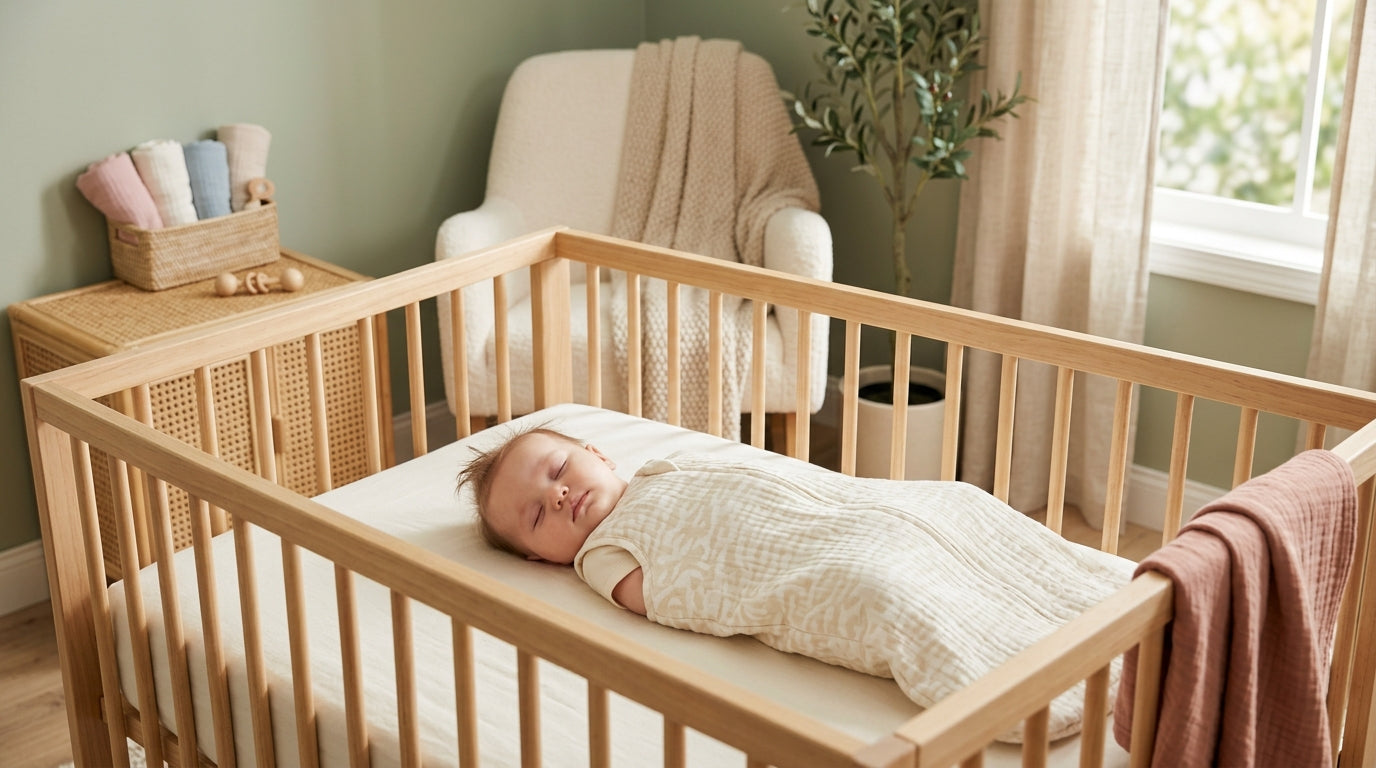
There's also the whole suffocation risk. The safe sleep guidelines say no loose blankets in the crib for the first year. None. If your kid breaks out of a small, tight blanket in the middle of the night, that fabric is now just sitting loose next to their face. The anxiety of checking the monitor every ten minutes just wasn't worth it for me, so I banished all blankets from the crib immediately.
The rules say you've to stop wrapping them the second they show signs of rolling over. Maybe that happens at two months, maybe four months, nobody ever really knows until they find their kid upside down one morning and have a minor heart attack.
Choosing fabrics that don't feel like cardboard
Since you're going to be rubbing these things against your kid's face multiple times a day, the material honestly matters. You want something that survives being washed on hot every other day without turning into sandpaper.

I ended up buying the Colorful Leaves Bamboo Baby Blanket from Kianao. This is legitimately my favorite piece of fabric in our house. It's a blend of organic bamboo and cotton. Bamboo has this weird natural ability to wick moisture away from the skin. Chicago summers are brutally humid, and the air sits on you like a wet towel. Draping this over my daughter's legs in the stroller kept her from turning into a sweaty, cranky mess. It's also supposedly antimicrobial. I don't really know the exact chemistry behind it, but I do know it doesn't smell like sour milk by the end of the day, which is a massive win in my book.
We also have their Organic Cotton Polar Bear Blanket. It's fine. It does the job. The little blue bears are cute and the organic cotton is obviously better than the synthetic polyester stuff that makes babies break out in hives. But it doesn't have that same silky, heavy drape as the bamboo one. I mostly just throw this one on the living room rug for her to do tummy time on because I don't care as much if the dog accidentally steps on it.
If you're dealing with sensitive skin, you kind of have to manage the layers underneath the blanket too. I usually keep my daughter in the Sleeveless Organic Cotton Bodysuit as a base layer. It has just enough stretch to get over her giant head without a wrestling match, and the organic cotton doesn't trigger the random patches of eczema she gets on her chest. You just layer the bodysuit, drape the bamboo blanket over your shoulder, and wait for the inevitable spit-up.
How many you seriously need
People always want a specific number for the registry. They want to know exactly how many blankets will prevent a laundry crisis. I usually tell them to buy six to eight, depending on how often they're willing to run the washing machine.
If you only have three, you'll be doing laundry at midnight. If you've twenty, they'll just take up space in a drawer and you'll feel guilty about buying them. Six is the magic number. Two in the diaper bag, two in the wash, and two sitting on the back of the couch waiting for a disaster.
Just throw the dirty ones in the wash on cold, use a detergent that doesn't smell like a perfume factory, and try to remember to move them to the dryer before they get that weird mildew smell. They get softer the more you wash them anyway, which is nice because babies are incredibly judgmental about rough fabrics.
They outgrow the swaddle phase so fast, yaar. One day they're an immobile potato, and the next they're trying to crawl off the changing table. But you'll use a good receiving blanket for years. My toddler still drags her bamboo one around the house like a security cape. It has a few permanent stains on it, but she doesn't care, and neither do I.
If you're trying to figure out what genuinely deserves a spot in your diaper bag, you can look at the organic baby blankets collection to see the bamboo options that won't make your kid sweat through their clothes.
The messy questions nobody asks the doctor
Can I just use paper towels for spit-up instead of carrying blankets everywhere?
I mean, you could, but you're going to go through three rolls a week. Paper towels also have this terrible habit of disintegrating when they get wet and leaving little crusty white flakes all over your baby's neck folds. A cloth blanket absorbs the mess without falling apart, and it's much softer when you've to aggressively wipe milk out of their eyebrows.
Will my mother-in-law judge me if I don't tightly wrap my baby the traditional way?
Probably. Desi aunties love a tight swaddle. They will tell you the baby needs to be bound tightly so their legs grow straight. This is medically inaccurate and a great way to ruin their hip joints. Just nod politely, take the baby back, and loosen the blanket the second she leaves the room. Your kid's orthopedic health matters more than family politics.
Is it seriously dangerous if they break out of the blanket in the crib?
Yes. A loose piece of fabric in a crib with an infant who can't reliably turn their head is a genuine suffocation hazard. That's why we use wearable sleep sacks with zippers now. Save the square blankets for when they're awake and you're staring right at them.
Why does my baby scream when I put them down on a cold blanket?
Because it's cold. Babies have terrible temperature regulation. If you leave a cotton blanket sitting in a drafty room and then strip them naked and put them on it, they're going to panic. Sometimes I just hold the blanket against my own body for a minute to warm it up before I lay them down for a diaper change. It takes ten seconds and stops a meltdown.




Share:
Why I threw my baby's amber teething necklace in the trash
The Michelin Man Myth: Dressing Your Baby for Winter Survival