

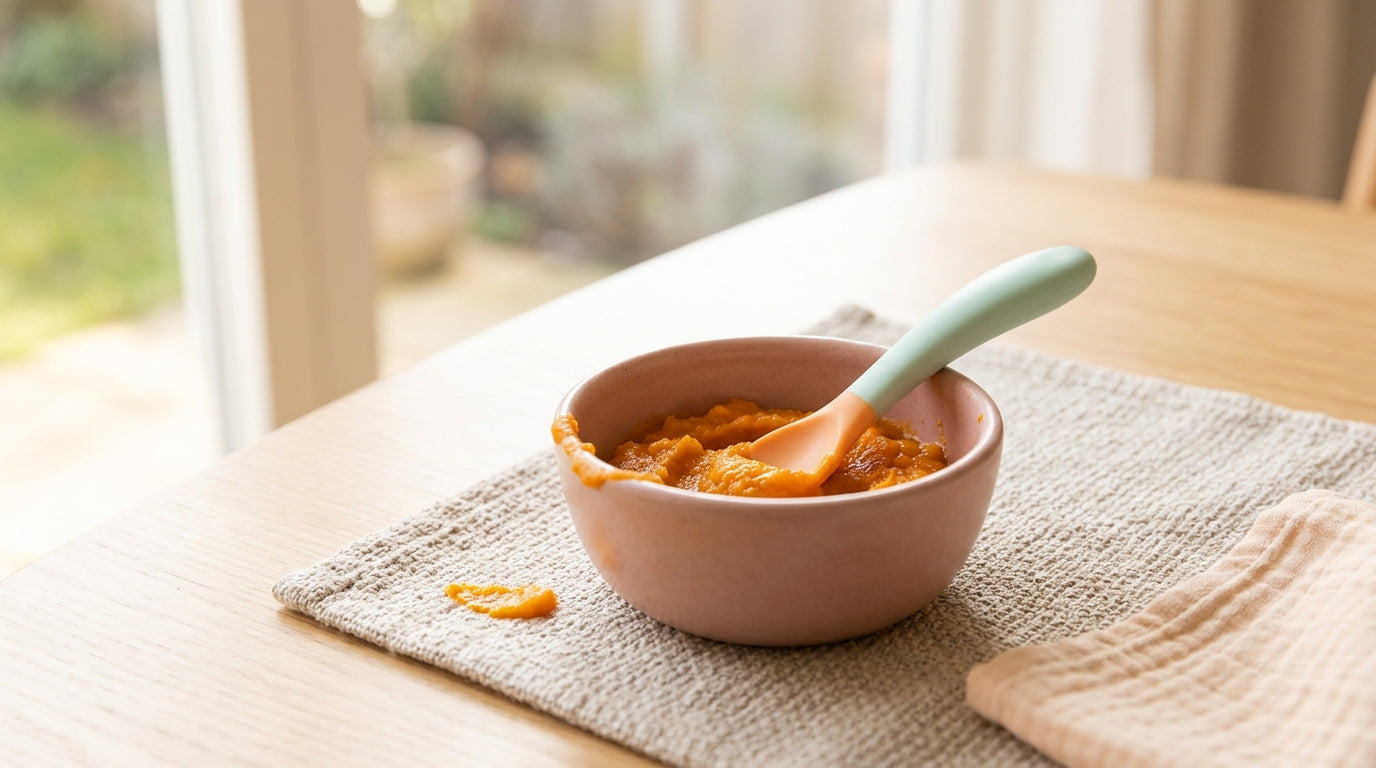
It was 2019, and there was pureed sweet potato on my living room ceiling fan. Not a light splatter, y'all. A heavy, gravity-defying clump. My oldest son, bless his heart, had just karate-chopped the hard plastic baby spoon I was trying to airplane into his mouth, and I was sitting there covered in orange mush, wondering how humanity survived this long if eating was this complicated.
I was a first-time mom, operating on three hours of sleep, and I was doing everything wrong. My own mother had handed down this terrifying metal-tipped spoon from the early 90s, insisting it was what I learned to eat with. Every time it clanked against his bare gums, he screamed, I sweat through my shirt, and we both ended up crying. I had spent hours the night before scrolling through articles trying to find the best baby spoons, but honestly, nobody tells you that handing a six-month-old a utensil is basically handing a tiny, uncoordinated drunk person a catapult.
I'm just gonna be real with you: teaching a baby to feed themselves is not the aesthetic, pastel-hued journey Instagram makes it out to be. It's a sticky, gag-inducing, laundry-multiplying marathon. But by the time my third baby rolled around last year, I had finally figured out how to survive it without re-painting my kitchen.
What my pediatrician actually told me about the gag reflex
After the ceiling fan incident, I panic-called our pediatrician, Dr. Davis. My son wasn't just making a mess; he was gagging so hard on his food I was convinced I was going to have to do the Heimlich maneuver every Tuesday at lunch. I dragged him into her office, sure that his throat was broken or that I was failing some fundamental test of motherhood.
She just kind of laughed, handed me a tissue for the sweat on my forehead, and told me that a baby's gag reflex is just way further forward in their mouth than ours is. She said something about the reflex naturally moving back or integrating around six or seven months, but honestly, all my sleep-deprived brain heard was "he's not choking, he's just being dramatic."
Dr. Davis explained that gagging is actually a safety feature, a totally normal part of them figuring out how to move mush around their tongue without inhaling it. She also politely suggested I put away the medieval metal spoon my grandma swore by, because metal on raw, teething gums is a recipe for a hunger strike. You want something soft, something that feels more like a chew toy than a piece of silverware.
The gear that actually helps (and what to skip)
If you want to know the secret to getting a baby ready for a spoon, it seriously starts before you ever introduce food. They have to figure out how to get their hand to their mouth on purpose without punching themselves in the eye.

With my second baby, I realized that teething and learning to eat go hand-in-hand. When their gums are throbbing, they just want to gnaw on things. I'm completely obsessed with the Panda Teether from Kianao. I'm not exaggerating when I say this flat little silicone panda saved my sanity while I was trying to pack Etsy orders in my living room. Because it has that wide, flat shape, it was super easy for his chubby little fists to grip, and he spent weeks just practicing bringing it to his mouth to gnaw on those textured edges. By the time we seriously handed him a pre-loaded spoon a month later, his hand-eye coordination was already dialed in. He knew the target.
Now, my mom read somewhere that kids need to develop their "palmar grasp" to hold a spoon properly, so she bought us the Gentle Baby Building Block Set. They're totally fine, I guess. The colors are pretty and they're squishy, so they don't hurt when you step on them barefoot in the dark. But I'll be honest, they didn't magically teach my kid how to scoop oatmeal. My middle child mostly just used them as soft projectiles to chuck at the dog while I was desperately trying to negotiate one more bite of peas.
The real issue with the puree phase is the laundry. Unless you want to strip your baby naked three times a day, you need clothes that can take a beating. I stopped dressing them in stiff, fussy outfits and moved entirely to things like the Organic Cotton Baby Bodysuit. It stretches enough that I can yank it over a head covered in dried avocado without getting it in their hair, and because it’s organic cotton, it seriously washes clean instead of holding onto those greasy stains like cheap synthetic fabrics do.
If you're gearing up for this circus, maybe grab some easy-to-wash basics from a solid baby clothes collection so you aren't ruining the good hand-me-downs from your sister.
Why long aesthetic handles are the devil
Listen to me carefully: don't buy those long, skinny, aesthetically pleasing wooden spoons that look like miniature canoe oars. I bought a set with my first kid because they matched my dining room table, and it was the dumbest fifteen dollars I've ever spent.

Babies don't hold things like we do. They grab stuff like cavemen, wrapping their whole entire fist around the base. When you give an eight-month-old a spoon with a long, thin handle, they can't balance it. It operates like a lever, and the moment they try to bring it to their mouth, the food flings backward over their shoulder. Worse, if the handle is too long and they manage to get the business end in their mouth, there's nothing stopping them from shoving it all the way back to their tonsils and triggering that massive gag reflex we talked about.
You need a spoon that's short, fat, and ugly. It needs a chunky handle that fits perfectly inside a tiny, sweaty fist, and it absolutely must have some kind of choke guard. A choke guard is just a wide base right before the scooping part that physically stops the baby from deep-throating the utensil. It's not pretty, but neither is watching your baby turn purple over mashed bananas.
And please, for the love of everything, don't even get me started on boiling and steaming your own organic farmer's market root vegetables in a two-hundred-dollar baby food maker when they're just going to spit it on the cat anyway.
The glorious decoy trick
By the time baby number three arrived, I was operating purely on survival instincts. I didn't have the patience for the food-throwing, the spoon-snatching, or the wrestling matches. That's when I finally mastered the decoy trick.
Around ten months old, babies realize they've free will, and they absolutely demand to be in control of the feeding. If you try to hold the spoon, they'll grab your wrist like a tiny bouncer, fight you for the handle, and food goes flying. Instead of battling them, just strap them into the highchair, slap some thick greek yogurt on the end of a short silicone wand, hand it to them, and let them hold it while you sneak in bites with a second, identical spoon.
Having their own spoon satisfies their deep, biological need to be the boss of the kitchen, while your decoy spoon really gets some calories into their stomach. You don't have to follow a strict timeline or force them to sit up perfectly straight and wait for cues; just hand them a chunky handle, let them lean forward on their own time, and pray they don't immediately smear it in their own eyebrows.
Eventually, usually around 18 months or so, their brains kind of click. The wild banging slows down. They figure out how to scoop instead of just stabbing at the bowl. It's a slow, messy progression, but one day you'll look over, and they'll be quietly feeding themselves applesauce while you honestly get to drink your coffee while it's still hot.
Check out Kianao’s full collection of baby essentials before you start this sticky chapter, and may the odds be ever in your favor.
FAQ: Surviving the spoon years
When do they genuinely stop throwing the spoon on the floor?
Honestly? When they realize you're no longer entertained by picking it up. For us, the "drop game" peaked around 10 to 12 months. They aren't trying to make you mad; they're literally testing gravity to see if the spoon falls down every single time. It does. Give them a decoy to hold, keep the messy one out of reach, and just ride it out. It usually clicks before they turn two.
My baby just chews on the handle instead of the food part, is that fine?
Totally fine. Especially around 6 to 9 months, their gums are on fire from teething. A silicone baby spoon feels amazing on sore gums. Let them gnaw on the wrong end! It's still teaching them how far they can stick an object into their mouth without gagging, which is half the battle of learning to self-feed anyway.
How many of these things do I genuinely need to buy?
Don't buy the 20-pack. You don't need twenty. I'm incredibly cheap and I promise you only need about three or four good ones. You want enough that you can have one in the dishwasher, one in the diaper bag, one in the baby's hand, and one in yours for the decoy trick. Any more than that and they just end up permanently lost under the car seats anyway.
What do I do when they refuse to let go of it after the meal is over?
Trade them. If you try to pry a spoon out of a tired toddler's death grip, you'll lose, and they'll scream. I always bring a wet washcloth to the table at the end of the meal. I offer the washcloth, they grab it to chew on the warm water, and they drop the spoon. Works like a charm about 80% of the time, and the other 20% I just let them take the dirty spoon into the living room because I'm too tired to fight.
Should I be correcting their grip if they hold it weird?
No, bless their hearts, just leave them be. They're going to hold it like a caveman with a club (the palmar grasp) for a very long time. Their tiny hands literally don't have the muscle development yet to hold a utensil like a pencil. As long as the food is somewhat making it into their facial region, they're doing great.




Share:
The Oxford Street Kids Clothes Shop Incident and Other Regrets
The Absurd Reality of High-End Baby Clothes