

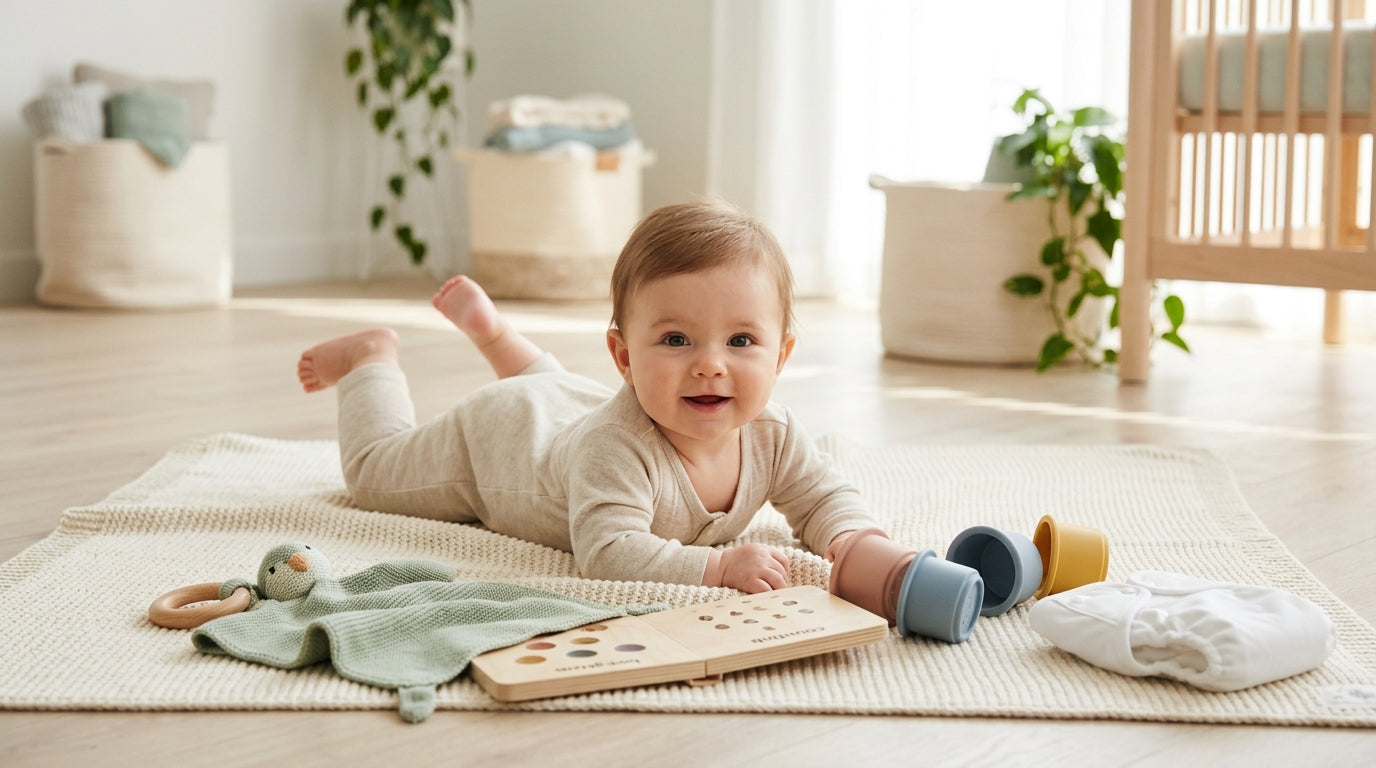
It was 2:14 AM on a Tuesday. The baby monitor on my nightstand was glowing with the kind of ominous infrared light that usually precedes a jump scare in a horror movie. I stared at the pixelated screen, trying to process the visual data. When I had installed the baby into the bassinet three hours earlier, he was securely positioned on his back, arms at his sides, breathing in a steady, predictable rhythm. Now, he was entirely face-down. He looked like a stranded turtle that had given up on life. My heart rate instantly spiked to roughly 140 bpm. I forcefully nudged my wife, Sarah, frantically whispering that he had breached the perimeter and was currently suffocating in the mattress. She cracked one eye open, glanced at the monitor, muttered that he was fine, and went back to sleep. I, on the other hand, spent the next three hours watching his pixelated back rise and fall, completely paralyzed by the realization that my son was now mobile.
Before this moment, I thought motor milestones were just fun little achievements you unlocked. I viewed my son’s development like an RPG skill tree—you check off "holds head up," you gain a few experience points, and eventually, you unlock "walking." I didn't realize that each new skill acts like a rogue firmware update that permanently breaks the existing sleep module. You spend your days casually wondering what age babies roll over, thinking it's just going to be a cute trick for the grandparents, and then suddenly you're thrust into a high-stakes game of nocturnal troubleshooting where none of your previous protocols work anymore.
What Dr. Lin told me about the timeline
Because I approach parenting like debugging a highly unstable application, I immediately brought my spreadsheet of his sleep positions to our doctor, Dr. Lin. I wanted a concrete timeline. I wanted to know the exact standard deviation for this behavior. She looked at my data, sighed the way senior developers sigh at junior engineers, and told me that the timeline for babies is wildly unpredictable.
Apparently, there's no magical alarm clock that goes off in a baby's brain. Dr. Lin vaguely suggested that somewhere around three or four months, babies might accidentally flip from their tummy to their back. This isn't because they're strong, but mostly because their heads are basically bowling balls, and if they tilt slightly off-axis while pushing up, gravity just aggressively takes over. Then, she said, somewhere between five and seven months, they somehow summon enough core strength to go from their back to their tummy. That second maneuver is the hard one. It requires them to arch their back, twist their hips, and lever themselves over without the use of momentum.
But honestly, it's all just a massive, terrifying guess. If you're anxiously trying to figure out at what age do babies roll over, you're going to be disappointed by the lack of hard data. Every kid is running on different hardware. Some babies are in the 99th percentile for weight and take longer to roll simply because they've more mass to move, while lighter babies might just fling themselves over at 12 weeks. I only know this because my browser history from that week is an unhinged string of sleep-deprived typos, mostly consisting of things like "babi face down in crib breathing" and "when do babie stop doing barrel rolls at 4am."
The great swaddle deprecation of month four
Let me tell you about the real crisis of the rolling milestone. It isn't the rolling itself. It's the immediate, non-negotiable security protocol changes that come with it. The second your kid shows even a microscopic hint of twisting their hips or kicking their leg over their body, the swaddle is officially deprecated.

I genuinely mourned the swaddle. The swaddle was a structural engineering marvel. It was the only thing keeping his primitive startle reflex from causing him to punch himself in his own face every twenty minutes. When he was wrapped up like a tactical burrito, he slept. When we had to transition to arms-out sleeping, it felt like trying to sleep in a room with a malfunctioning wind-up toy. You have to somehow quit the swaddle cold turkey, accept that your child will now flail around in the dark like a tiny inflatable tube man at a used car dealership, and just pray they figure out how to self-soothe before your PTO completely runs out.
For about three weeks, our house was a disaster. He would roll onto his stomach in his sleep, wake himself up because he didn't know how he got there, and then scream at the top of his lungs until I went in and flipped him back over like a pancake. Ten minutes later, he would do it again. It was an infinite loop of exhaustion. I kept asking Sarah why we couldn't just tape him to the mattress, which earned me a lecture on safe sleep practices and a reminder that I was being irrational.
Meanwhile, everyone talks about tummy time like it's an Olympic training camp you've to run every day to build their core strength, but honestly, we just put him on the floor while we folded laundry and he eventually figured out the physics of his own body.
If you're dealing with the chaos of this transition right now, you might want to look at upgrading your sleep setup. You can browse Kianao's organic sleep essentials here to find something that works for the arms-out phase.
The hardware you actually need for this phase
Once the swaddle was forcefully retired from our toolkit, we had to find alternatives that wouldn't pose a suffocation risk but would still keep him from freezing in our drafty Portland house. My wife ordered the Plain Bamboo Baby Blanket from Kianao. I'm naturally skeptical of baby products. I initially assumed it was just another piece of overpriced textile marketed to anxious millennials.

I was actually wrong about this one. Because I obsessively track the ambient temperature in his nursery with three different sensors, I noticed that he gets really sweaty in synthetic fabrics. This bamboo stuff apparently thermoregulates. He stopped waking up with that damp, clammy neck situation. We started using it as his designated transition blanket for supervised daytime naps when he was practicing his rolling. The fabric is weirdly heavy but breathable, and honestly, the lack of chaotic animal patterns appeals to my highly minimalist brain. It just works, and I don't have to think about it, which is the highest compliment I can give a product.
We also ended up with the Organic Cotton Baby Blanket in the Purple Deer pattern. It's perfectly fine. It’s definitely soft and does the job, but my wife is way more into the woodland aesthetic than I'm. I usually just fold that one up and shove it in the bottom of the diaper bag as a backup. It feels a bit less breathable than the bamboo one, but it holds up well when he inevitably spits up on it.
Then there was the teething complication. Apparently, for my son, the physical stress of learning to roll over synced perfectly with his teeth shifting around in his skull. We got the Squirrel Teether to try and help with the damage. I mean, it’s a piece of silicone shaped like a rodent. It's okay, I guess. He aggressively gnawed on the little acorn part for about three days when the frustration of being stuck on his belly made him angry-chew everything in his line of sight. But now that he's older, he mostly just throws it across the living room to watch me fetch it. It's easy to wash, which is nice, but don't expect a piece of silicone to miraculously solve the existential dread your baby feels when they roll over and get stuck.
The confusing logic of sleep positioning
The most baffling part of this entire developmental milestone is the contradictory medical advice regarding sleep. When we left the hospital, the nurses drilled "back is best" into my skull with such intensity that I was convinced placing a baby on their stomach was a federal crime.
But then, Dr. Lin casually mentioned that once they can fluidly roll in both directions—meaning they can reliably get themselves out of a face-down position—you don't actually have to wake up in the middle of the night to flip them over. You still have to put them down on their back initially, but if they execute a barrel roll at 3 AM, you just leave them there.
This felt deeply wrong to my anxious dad brain. It felt like ignoring a critical system error. For the first month after he mastered rolling, I'd just lie awake in bed, staring at the monitor, watching him sleep face-down with his butt straight up in the air, internally debating whether I should risk waking him up to fix his posture. Eventually, the sheer exhaustion won out. You just have to trust that their basic survival instincts are finally coming online, stop checking the camera every four minutes, and let them sleep in whatever bizarre, contorted yoga pose they've chosen.
If you're currently staring at a baby who treats their crib mattress like an Olympic gymnastics mat and you're terrified they're going to tangle themselves in their current bedding, you probably need to rethink your entire sleep inventory. Grab one of our breathable, temperature-regulating blankets before tonight's inevitable acrobatic routine begins.
Dad-to-Dad Troubleshooting FAQs
Is it bad if my baby only seems to roll one way?
I spent two solid weeks entirely convinced my kid’s left side was mechanically broken because he would only ever roll to the right. He looked like a Roomba stuck in a corner. My wife had to gently remind me that I've slept exclusively on my right side for the last six years and I seem to be functioning fine. They eventually figure out the return trip, usually on a random Tuesday just when you've finally given up worrying about it.
Can I keep using the swaddle if they aren't fully rolling yet?
You really shouldn't, especially if they look like they're actively trying to break out of a straightjacket. Once they start pulling their knees up to their chest and twisting their lower half, the swaddle goes from being a helpful sleep tool to a massive safety hazard. You just have to bite the bullet, throw the swaddles in a box, and suffer through the horrible transition period where they slap themselves awake for a week.
What am I supposed to do when they roll onto their stomach and instantly start screaming?
This is going to happen constantly. They use all their energy to roll onto their stomach, instantly realize they're now stranded without the upper body strength to fix their mistake, and then scream at you to intervene. You basically just become a human spatula. You flip them back over, they pause for five seconds, and then they immediately roll back onto their stomach and start screaming again. It's infuriating, but it passes once they build up their arm muscles.
Does this milestone permanently ruin their sleep schedule?
It absolutely ruined our sleep for about three weeks straight. Every night was a disaster of false alarms and crying. But then, almost overnight, he figured out that sleeping on his stomach was seriously way more comfortable than sleeping on his back. Now, the second I put him down in the crib, he instantly face-plants into the mattress, tucks his knees under his chest, and sleeps for eleven hours. So, it gets worse before it gets infinitely better.




Share:
The Truth About That Welcome To Derry Baby Trend Wrecking Sleep
What Age Do Babies Walk (And Why The Timeline Is A Total Lie)