

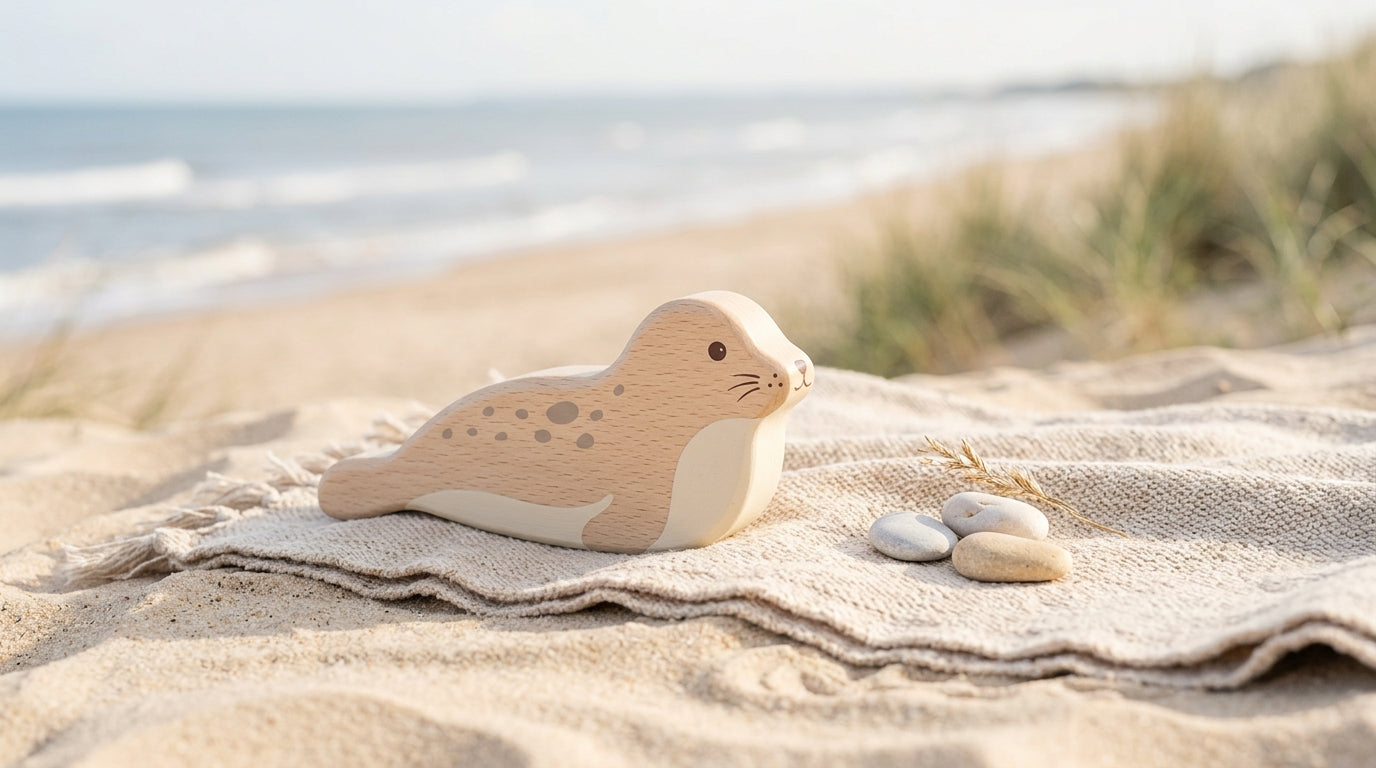
We were halfway across a devastatingly windy, aggressively grey stretch of the Norfolk coastline when one of the twins pointed a sandy, half-eaten breadstick at what appeared to be an abandoned sleeping bag. It was a bleak Tuesday in October, the kind of day where the sea and the sky merge into one oppressive shade of depression, and I was already mentally calculating how long it would take to hoover the sand out of the car boot.
The sleeping bag shifted, coughed loudly, and lifted a face that looked entirely too much like a wet Golden Retriever.
It was a baby seal, and it was aggressively alone.
This immediately triggered a very specific kind of parental panic, the sort where you suddenly realize you're responsible for keeping two unpredictable, wildly uncoordinated humans from interfering with nature, whilst simultaneously trying to remember what you’re legally required to do when confronted with a protected marine mammal. You just end up grabbing whatever part of your children’s clothing you can reach and dragging them backward while muttering apologies to an animal that doesn't speak English.
The mysterious lump on the Norfolk coastline
I don't know what I expected a baby seal to look like in the wild, but this one just looked like an overstuffed grey sausage that had given up on life. It was lying in what I later learned is called the "banana pose" (head and tail lifted off the sand), which is supposedly how they keep stable their body temperature, though it looked exactly like the posture my daughter adopts when she throws a tantrum on the floor of Sainsbury’s because I won't let her eat a raw onion.
Naturally, the twins thought it was a dog. A strange, legless dog that needed petting.
I had one under each arm, hauling them away from the tide line, while they furiously kicked their wellies off into the North Sea. There was an older gentleman nearby with binoculars who seemed very invested in judging my parenting, though he offered precisely zero help in containing the children. I’m told there are specific hotlines you can call when you find stranded wildlife, but frankly, I just yelled vaguely at a woman walking past in a hi-vis jacket who looked like she might have some authority.
Apparently marine mothers just leave them there
The most alarming part of this whole ordeal was the realization that the pup wasn't actually abandoned, but simply waiting for its mother. I read on a damp, peeling leaflet near the public toilets later that mothers will frequently just dump their offspring on the beach for up to 24 hours while they pop off into the ocean to forage for fish.
Imagine that. Imagine just popping off to Tesco for a salmon fillet and leaving your baby on the pavement because they were too slow to keep up with you. The absolute dream. I can barely leave the room to use the loo without someone attempting to scale the bookshelf, but this mother seal just parked her child on the sand and went out for a seafood dinner.
The bloke with the binoculars eventually wandered over to inform me that seal pups gain about two kilos a day just from drinking their mother’s high-fat milk. That sounds biologically impossible to my sleep-deprived brain, but it certainly explains why the pup looked so impressively round. It also explained the horrific crying noise it started making—a pathetic, bleating "maaaa" that echoed down the beach. It sounded exactly like my daughter when she realizes I’ve given her the blue plastic cup instead of the slightly different blue plastic cup.
Dressing for a seaside hostage situation
If you're going to spend forty-five minutes pinned behind a windbreak, maintaining a legal distance from a wild animal while your children attempt to eat fistfuls of wet sand, you really need them to be wearing the right gear.

I had the girls stuffed into the Organic Cotton Baby Bodysuit Sleeveless Infant Onesie under their jumpers, which I can honestly say is one of the few items of clothing that survived this trip intact. Most baby clothes feel like they're made out of recycled scratchpads the second they get damp, but these organic cotton ones actually held up to a mixture of sea spray, toddler sweat, and half-masticated breadstick. The envelope shoulders were a godsend later when we got back to the car and I had to peel a sandy, soiled bodysuit downward over a screaming child's body rather than pulling it over her head (a maneuver that usually ends with me wearing whatever came out of her nappy).
In a moment of supreme, laughable optimism before we left the house, I had packed the Gentle Baby Building Block Set. I had this cinematic vision of us sitting peacefully on a rug, building soft little towers while breathing in the sea air. The reality is that I threw a couple of these blocks onto the sand to distract them from the seal, and the twins immediately tried to bury them. They're perfectly decent blocks—they float in the bath and they don't hurt when you inevitably step on them at 3am—but they're absolutely no match for the allure of a live marine mammal. I spent ten minutes digging a macaron-colored square out of a tidal pool.
What actually saved my sanity was the Panda Teether. One of the twins has been aggressively teething for what feels like three consecutive years, and the sight of the seal had somehow triggered a need to chew on everything in sight. I jammed the silicone panda into her hands, and she mercifully sat in the sand gnawing on its little bamboo detail while glaring at the wildlife.
Looking to upgrade your own arsenal of toddler distraction tools? Check out our organic baby toys collection before your next ill-fated trip to the coast.
The great hundred-yard toddler wrangle
There's a rule, apparently enforced by the sheer judgment of every local within a five-mile radius, that you must stay at least a hundred yards away from a resting pup. This is roughly the length of a football pitch. Trying to explain the concept of a hundred yards to a two-year-old is like trying to explain tax law to a pigeon.
You basically have to drag your squirming children backward by the scruff of their coats while simultaneously scanning the horizon for dogs. Because dogs, it turns out, are the absolute worst thing that can happen to a seal pup. A loose cockapoo bounding up to a pup will cause the mother (who's apparently always watching from the waves, like a very wet, very judgmental sniper) to abandon her baby permanently to save herself. I spent half the morning acting as a human shield, waving frantically at a man whose off-lead terrier was treating the beach like its own personal racing circuit.
What our GP said about animal bites
There was a brief moment where one of the twins made a break for it. She got about ten feet before I tackled her into a sand dune.

My desperation to keep them away wasn't just about marine conservation; it was largely about bacteria. During a previous incident involving a neighborhood cat and a highly suspicious scratch, our GP cheerfully informed me that animal mouths are basically biological weapons. He said getting bitten by wild animals usually means an immediate, panic-inducing trip to A&E and a week of heavy, gut-destroying antibiotics on the NHS.
Seals might look like aquatic puppies, but their mouths are a terrifying playground of bacteria. I'm barely surviving the pathogens my children bring home from nursery; I absolutely don't have the bandwidth to deal with whatever medieval plague lives in a sea mammal's gums.
Fish school and other things I barely understand
Eventually, a volunteer from a local marine rescue honestly did show up, wielding a clipboard and an aura of intense calm that I deeply envied. She confirmed the pup was just resting and that its mother was probably nearby, judging us all.
She also told me that when pups honestly are abandoned and taken to the rescue centre, they've to attend "Fish School." The volunteers literally drag dead fish on strings through the water to teach the orphaned babies how to hunt, because apparently, this is not an instinctual skill. I felt a deep, big kinship with those volunteers. I, too, spend most of my days dragging food in front of small, ungrateful creatures, hoping they'll figure out how to consume it without getting it all over the walls.
By the time we finally dragged ourselves back to the car, the twins were coated in a thick layer of grit, the breadstick was gone, and I felt like I had aged a decade. The seal was still there, comfortably napping in its banana pose, completely unbothered by the chaos it had caused. I strapped the girls into their car seats, handed them their teethers, and decided that for our next outdoor adventure, we’d aim for something slightly less legally protected. Maybe a nice, concrete pavement.
If you're bravely venturing into the wild with your own unpredictable little creatures, make sure they're dressed for the occasion. Explore our organic baby clothing collection for gear that honestly survives the trip.
Things you probably shouldn't ask me about the beach
What should you do if your kid really runs up to a wild animal?
Panic, mostly. But officially, you just have to scoop them up as quickly as humanly possible and retreat. I usually resort to the "football carry" (tucking the child under one arm while they kick the air) and apologize loudly to everyone in the vicinity. Don't try to take a photo. Just run.
Are silicone teethers honestly safe to drop on the sand?
Look, nothing is safe once it hits wet sand. It immediately turns into sandpaper. But the nice thing about food-grade silicone is that you can just aggressively rinse it off with whatever water you've left in your bottle, wipe it on your sleeve, and hand it back. It survives the dishwasher when you get home, which is more than I can say for most plastic toys.
How do you get sand out of a squirming toddler's clothing?
You don't. You just accept that your car, your hallway, and your bed will now contain sand until they leave for university. Stripping them down to their organic cotton layers before putting them in the car seat minimizes the damage, but you'll still be hoovering the boot in three months' time.
Is it normal for a two-year-old to try to eat seaweed?
My health visitor gave me a deeply tired look when I asked a similar question about grass. As long as they don't seriously swallow a massive clump of it, they'll usually realize it tastes like salty rubber and spit it out on your shoes. Just keep an eye on them and maybe bring extra snacks so they aren't tempted to forage like a seagull.




Share:
The Truth About Those Hypnotic Dancing Fruit Videos
The baby scale anxiety trap (and why we threw ours out)