

There's a very specific, cold dread that washes over you when you attempt to put a standard newborn baby-grow onto a two-kilogram human. I was standing next to Twin A’s clear plastic hospital cot, entirely sleep-deprived and sweating through a hospital-grade apron, trying to wrestle her into a generously gifted size 50 sleepsuit. Within three seconds, she looked like a deflated parachute. The neck hole had somehow slipped down over her shoulder, the fabric was pooling dangerously around her chin, and her tiny foot was entirely lost somewhere in the knee section. The monitor beside us immediately began to beep because she had kicked off her oxygen sensor in the cavernous depths of the trouser leg.
Before the girls arrived four weeks ahead of schedule, several well-meaning relatives had given me the exact same piece of advice regarding premature baby clothes, assuring me that I should just buy standard newborn sizes and roll up the sleeves because they grow so fast. This is, without a shadow of a doubt, the worst advice you can give a parent of a premature baby, completely ignoring the basic laws of physics and the terrifying reality of keeping a tiny, translucent creature alive.
The terrifying thermodynamics of baggy cotton
My paediatrician at the hospital—a man who always looked like he was one minor inconvenience away from a stress nap—gently intercepted my attempts to swaddle Twin A in her oversized parachute. He explained in very tired tones that putting a premature baby in clothes that are too big is essentially the same as putting them in a refrigerator.
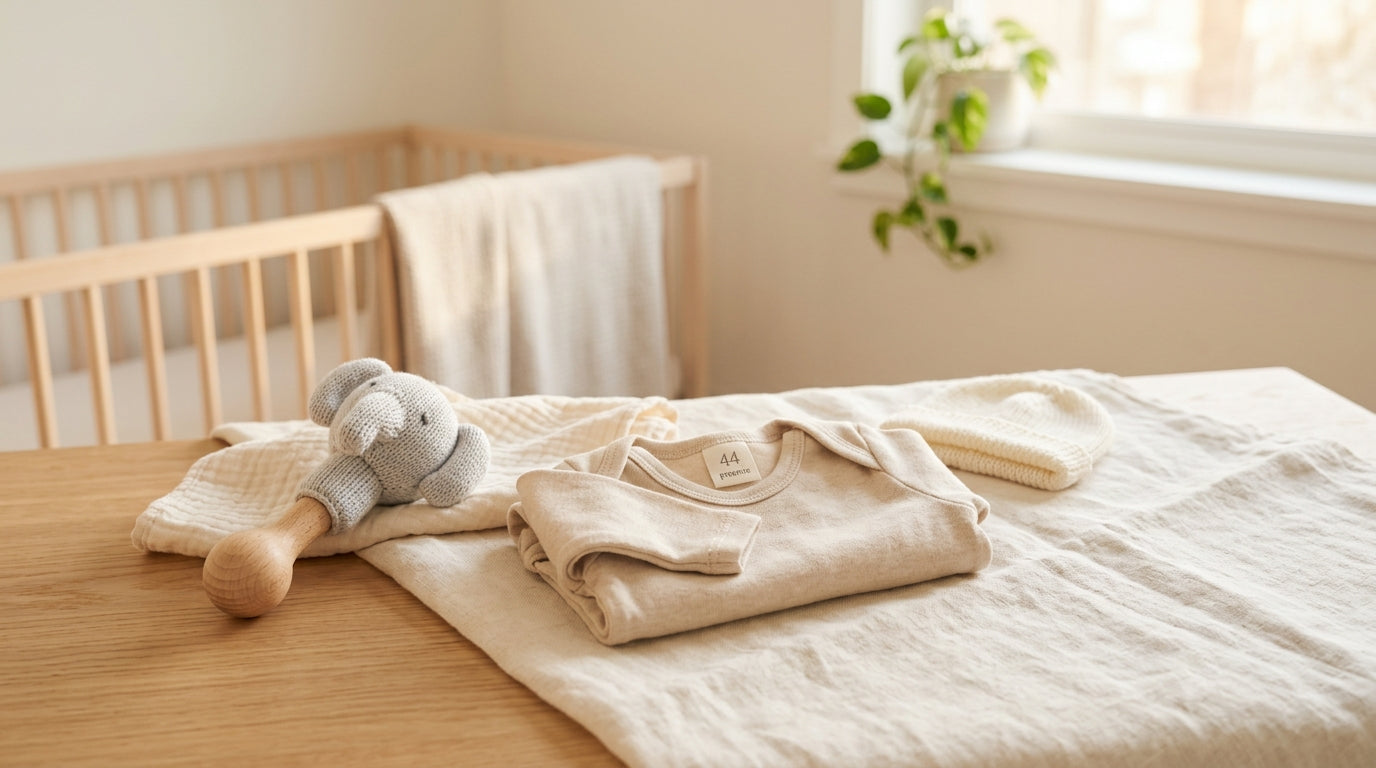
From what I vaguely understood through my panic, babies who arrive early haven't had time to cook up their own brown fat, which means they're entirely useless at regulating their own body temperature. If their clothes aren’t touching their skin, the ambient air just swoops in and steals whatever minuscule amount of heat they’ve managed to generate, sending their core temperature plummeting while you sit there wondering why their hands feel like little frozen prawns. The European sizing system actually makes sense of this madness with what they call "Größe 44" (size 44, denoting the baby's length in centimetres), which is explicitly designed to hug a body that weighs roughly the same as a bag of flour.
This is where the material becomes a slightly obsessive hyper-fixation. We had this Kianao wool-silk wrap bodysuit that quickly became the only thing I felt safe putting her in. Wool apparently traps the heat in some sort of microscopic thermal pocket, while the silk stops it from feeling like a brillo pad on their extremely undercooked skin, though I'm mostly just repeating the vague science my wife relayed to me while crying over an NHS leaflet. All I know is that when she wore the size 44 wool-silk blend, her temperature chart stopped looking like a terrifying roller coaster and the nurses stopped glaring at me.
Defusing the bomb (or dressing a baby with wires)
Nobody adequately prepares you for the sheer volume of cabling attached to a premature baby. For the first week, they lived in their incubators wearing absolutely nothing but a nappy and a tiny knitted hat, looking like miniature, aggressive sunbathers.

But when they finally graduated to open cots, we had to dress them. Between the feeding tubes taped to their cheeks, the monitoring wires snaking from their chests, and the little glowing pulse oximeter strapped to their big toes, dragging a tight cotton neck-hole over their wobbly, fragile heads felt like a game of Operation where the penalty for losing was inducing a medical emergency. You quickly learn that anything you've to pull over a premature baby's head is an instrument of torture, designed by someone who has clearly never met a baby.
Wrap designs are the only way you survive this phase with your sanity intact, simply laying the open garment flat on the mattress, placing the baby on top like a very delicate sandwich filling, and folding the fabric around the labyrinth of medical wires.
We received a beautifully packaged, extremely expensive novelty dinosaur outfit with a stiff zip and rough polyester spikes down the back, which I promptly threw directly into the hospital bin without a second thought.
The paper-thin skin situation
When they're that small, their skin doesn't even look finished. You can see every blue vein mapping out their tiny shoulders, and it looks so desperately thin that I was convinced a rogue clothing label would slice them open.
Standard clothes are riddled with internal seams that feel fine to my calloused adult hands but leave angry red pressure marks on a premature baby within ten minutes. Finding clothes in size 44 that actually considered this was maddening, which is why I ended up hoarding a couple of pairs of Kianao’s organic cotton premature trousers. They had this massive, soft waistband that didn't dig into their umbilical cord stump—a horrific little crusty appendage that I was constantly terrified of knocking off—and the seams were either totally flat or ingeniously hidden so they couldn't chafe.
I'll admit, however, that we also had one of their premature baby hats, and honestly, it was just okay. It technically did the job of preventing heat from escaping through the scalp, but because early babies often have oddly long, narrow heads from lying on their sides so much, my girls managed to squirm the hat down over their own eyes like tiny bank robbers at least six times a day, though frankly I think that’s more of an anatomical failing on their part than a design flaw.
How much of this tiny gear do you actually need?
The argument you'll have with yourself (and your partner, and your mother-in-law) is whether it’s worth buying clothes that the baby will only wear for three to four weeks before suddenly inflating into a standard size 50. I'm here to tell you that those three weeks are the most exhausting, terrifying, edge-of-your-seat days of your entire life, and struggling with ill-fitting clothing at 3am while a feeding tube beeps at you is easily not worth the ten quid you saved.

You don't need a massive wardrobe, but you do need a highly functional uniform that you wash on constant rotation while crying into your morning coffee. If I had to do it again, I'd strictly limit myself to exactly this, refusing to buy a single item more:
- Four wrap-style bodysuits in size 44 (specifically wool-silk if you can swing it, because it genuinely helps with the temperature panics)
- Three pairs of soft trousers with a massive, forgiving waistband
- Two pairs of socks that really have some elastic memory so they don't immediately fall off into the incubator bedding
- Cardigans that don't have metal poppers, because metal gets freezing cold in drafty hospital corridors
You can honestly skip everything else, ignoring the miniature denim jackets and the microscopic formal wear entirely, focusing only on items that open completely flat and can be browsed quietly on your phone while sitting in the dark next to a humidified cot.
Escaping the ward and going home
The day they tell you that you can take your tiny, fragile human home is a confusing mix of elation and absolute terror. Suddenly, you don't have a team of highly trained doctors to casually ask if the baby's feet are supposed to look quite that purple.
Dressing them for that car ride home in clothes that seriously fit is the first time you feel like you might really be capable of keeping them alive, carefully threading their tiny arms through size 44 sleeves that don't need rolling up six times, and buckling them into a car seat that still looks comically large no matter how many inserts you use. It's a deeply vulnerable time, and having gear that just quietly works without adding to the sensory overload of early parenthood is worth its weight in gold. If you're currently staring at a pile of massive newborn clothes and wondering how you're going to make this work, take a breath and find the functional, tiny things that will honestly protect them.
The messy, honest FAQ
How long do babies genuinely stay in size 44?
In my highly unscientific experience, they hit a growth spurt the exact second you finally cut the tags off the last size 44 bodysuit. Realistically, if they're born around 2 to 2.5kg, you'll get about three to five weeks out of them before their legs start looking like overstuffed sausages and you can safely graduate to standard newborn sizes.
Can't I just shrink size 50 or 56 in the tumble dryer on a really hot setting?
I tried this in a moment of sheer desperation with a lovely organic cotton sleepsuit, and it just resulted in a bizarrely proportioned garment that was still too wide in the neck but completely unwearable in the torso, making Twin B look like a heavily armed medieval peasant. So no, shrinking doesn't alter the actual cut and proportions of the neckline, which is the most dangerous part if it slips over their face.
Why do the hospital nurses insist on wrap clothes?
Because they're the ones who have to help you untangle your screaming, fragile baby from the oxygen saturation monitor cables when you've foolishly tried to drag a tight collar over their head. Wrap clothes mean the baby barely has to move, which keeps their heart rate stable and stops everyone in the room from having a minor cardiac event.
Are wool-silk blends really worth the fuss for a month?
Honestly, yes, even though washing them requires slightly more mental bandwidth than aggressively throwing cotton into a 60-degree wash. The way wool manages their fluctuating body temperature when they're completely incapable of doing it themselves gave me the only solid three hours of sleep I had during that entire first month.
What if they weigh less than 2 kilos?
If you're dealing with a baby in the 1.5kg to 1.8kg range (which we skirted dangerously close to), even size 44 is going to look a bit roomy. At that stage, they'll likely be in an incubator anyway, baking nicely in their nappy under hospital supervision, so by the time they're medically cleared to wear full outfits in an open cot, the size 44 will usually be the perfect fit.




Share:
A Letter to My Past Self About the Great Baby Bib Migration
Why baby wolle restposten changed my mind about knitting