

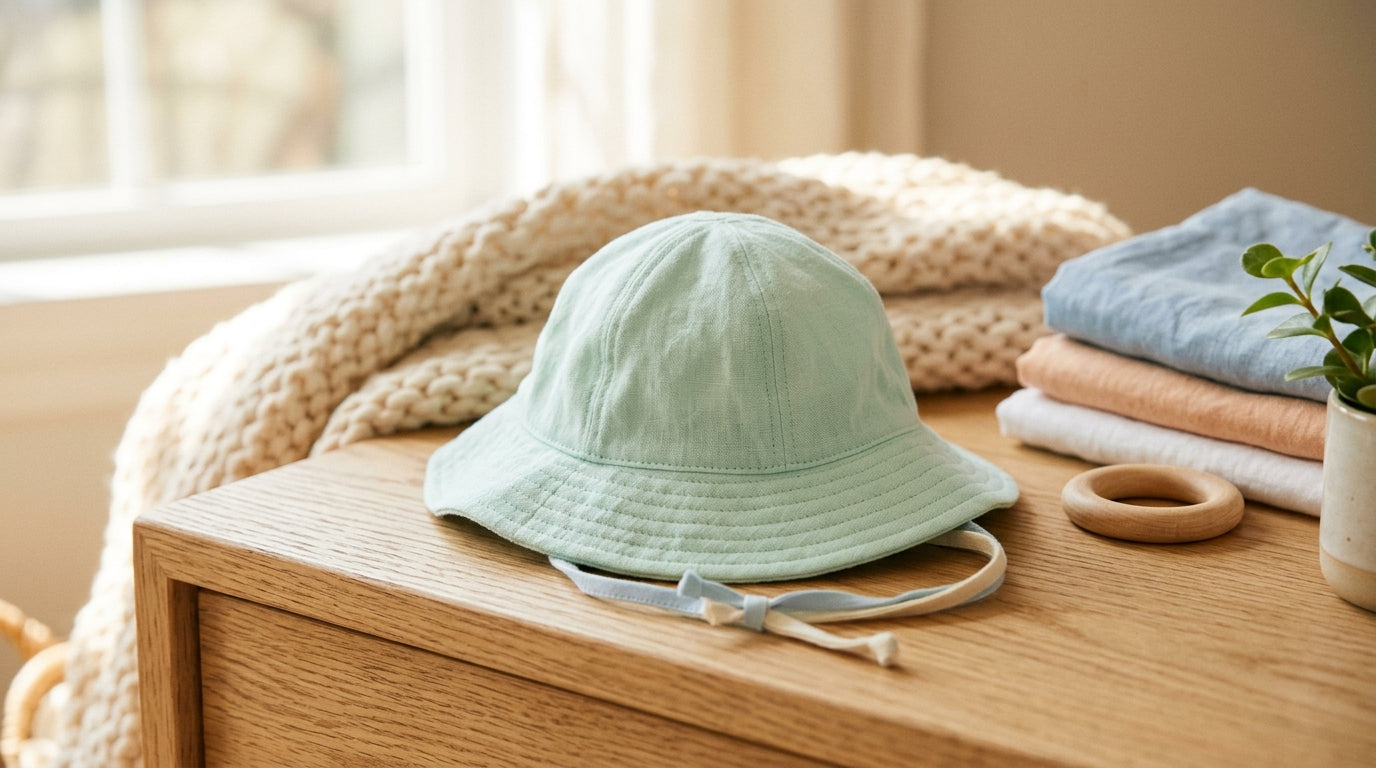
We're standing in the middle of a park in southeast Portland, the wind's blowing cottonwood seeds right into my open mouth, and I'm desperately trying to tie a floppy piece of UPF fabric under my 11-month-old's chin while he thrashes like I'm trying to uninstall his primary operating system. My wife Sarah is watching me from the picnic blanket with that specific look she reserves for when I try to fix the leaky sink with duct tape. She casually points out that I could've just bought a baby sun hat with a breakaway toggle instead of fighting a losing battle against a tiny, angry octopus. I realized right then that my entire mental model for handling baby sun protection needed a massive firmware update.
Before becoming a dad, I honestly thought keeping a kid safe in the summer just meant tossing a t-shirt on them and standing under a tree. I was running on completely outdated data. Apparently, keeping a baby safe from UV radiation requires the kind of logistical planning usually reserved for deep-space missions.
My beta-stage understanding of infant skin architecture
I learned the hard way that a baby's skin isn't just a smaller version of our skin. It's practically a beta release. Our pediatrician casually mentioned at one of our endless checkups that baby skin's roughly five times thinner than adult skin, which frankly sounds like a massive design flaw. She told us their little bodies haven't even figured out how to produce enough melanin to handle basic UV exposure yet.
When he was under six months old, the doctor warned us against slathering him in chemical sunscreens because his porous little skin would just absorb everything like a sponge, leaving shade and physical clothing as our only real firewalls. I used to worry constantly about the chemical breakdown of different mineral sunscreens, but honestly, if you just keep their physical hardware covered up you don't have to read those terrifying ingredient lists anyway.
So, we entered the hat phase. I started tracking his outdoor time on a spreadsheet because I'm that guy, and quickly realized that finding the right headgear is a total nightmare. I literally took a tape measure to a cute little bucket hat my mom bought us and realized the brim was barely two inches wide. Sarah gently informed me that dermatologists actually suggest a minimum 3 to 4-inch brim just to cast a shadow long enough to protect their neck and ears. Anything less is basically just decorative.
The sneaky multi-directional laser grid
Living in the Pacific Northwest really messes with your perception of solar danger. We get maybe three months of actual direct sunlight a year, so my default assumption was always that gray, overcast skies meant we were safe from the baby sun threat. WRONG. I was scrolling through some medical journals at 3 AM and found out that up to 80% of UV rays blast straight through the cloud cover anyway, completely ignoring our atmospheric defenses.

But the thing that really sent me spiraling was learning about reflective rays. You think you're safe sitting under a massive beach umbrella on the Oregon coast? The sun is a sneaky hacker. Those UV rays just bounce right off the sand, the water, and the concrete, ricocheting up under the umbrella and hitting your kid right under the chin.
It completely destroys the concept of "shade." Sunlight isn't just coming from above; it's a multi-directional laser grid shooting up from the ground. This is why those weird-looking legionnaire flap hats exist, and why a wide brim is absolutely mandatory even if you're sitting in the shadow of a building.
Heat dissipation and system crashes
One of my biggest rookie mistakes was how I checked his temperature. I'd grab his little hands or feet, feel that they were cool, and assume he was perfectly fine. Sarah caught me doing this and sighed heavily, explaining that checking a baby's extremities for temperature is like checking your laptop's internal CPU heat by touching the trackpad. You have to feel the back of their neck or their chest. If that area feels hot and sweaty, the kid's system is overheating.
This brings me to the absolute panic of dressing him for warm weather. Babies overheat terrifyingly fast. I finally broke down and bought the Organic Baby Romper Short Sleeve because I couldn't deal with the anxiety of him wearing synthetic blends. I'll be honest, getting his squirmy little legs into it when he's doing the alligator death roll isn't exactly fun, but the fabric is 95% organic cotton and incredibly breathable. He hasn't had a single heat rash since we started using it, which means one less thing for me to furiously google at midnight.
And speaking of overheating, our pediatrician delivered a massive warning about sleep protocols that terrified me. Hats are major outdoors, but she said to never, ever let a baby sleep indoors with a hat on. A baby's head is basically their main exhaust port for dumping excess body heat. If you block that thermal vent while they sleep, their core temp spikes, which she mentioned is a significant risk factor for SIDS. So the moment we cross the threshold into the house, the hat gets yanked off immediately.
Debugging outdoor mealtimes and teething
Trying to feed an 11-month-old on the back patio during the summer is its own unique form of chaos. You're trying to keep the baby sun hat on their head, keep the wasps away, and actually get food into their mouth. We picked up the Walrus Silicone Plate to try and contain the mess. I'll give you my honest assessment: it's perfectly fine. The suction base works decently well on a completely clean, flat table. But my son is basically a tiny QA tester looking for physical vulnerabilities, and he figured out that if he wedges his thumbnail right under the walrus's left flipper, he can break the suction seal in about four seconds flat and launch his peas into the yard. It's cute, it's easy to throw in the dishwasher, but don't expect it to defeat a determined toddler hacker.

What actually saves our outdoor patio time is dealing with his teething. When his gums are bothering him, the heat just makes him ten times more miserable. We use the Panda Silicone Teether and it's legitimately fantastic. Sarah figured out a hack where she throws it in the fridge for ten minutes before we go outside. The silicone acts like a cold heat-sink for his inflamed gums. It's got these little textured bamboo bumps that he obsessively chews on while I sit there obsessively checking my weather app to monitor the UV index.
Surviving the midday system quarantine
My weather app tells me exactly when the UV index spikes, which usually hits critical levels between 10 AM and 4 PM. Instead of fighting the sun, applying greasy mineral sunscreens, and constantly adjusting his hat, we just go into total system lockdown and stay inside.
To keep him from getting cabin fever and destroying our living room router, we set up the Alpaca Play Gym Set. I really like this thing because it doesn't look like a neon plastic factory exploded in our house. It's a simple wooden A-frame with a crocheted alpaca and a rainbow. He spends a solid twenty minutes trying to pull the wooden rings down with all his body weight, which miraculously tires him out enough for his afternoon nap, while I get to drink my coffee before it gets cold.
Parenthood sometimes feels like you're constantly writing patches for a software program that changes its own source code every night. But figuring out the hat situation really gave me a tiny bit of confidence. I still don't know what I'm doing half the time, but at least I know my kid's skin is protected from the giant laser in the sky.
If you're also trying to optimize your kid's summer gear without losing your mind, you might want to browse Kianao's organic baby clothes collection for stuff that won't make them overheat.
Ready to upgrade your outdoor protocol? Check out the full line of breathable summer layers and accessories before the next heatwave hits.
My messy, sleep-deprived FAQ on sun protection
Why can't I just use regular sunscreen instead of fighting him to wear a hat?
Our pediatrician explained that babies under six months just absorb all those chemicals right into their bloodstream because their skin barrier is so thin. Even now that my son is 11 months old, we still prioritize the hat because trying to coat a squirming baby's scalp in thick mineral sunscreen is physically impossible, and honestly, the hat blocks 98% of rays instantly without the greasy mess.
What's the deal with UPF ratings vs regular cotton?
I thought a regular t-shirt was fine until I read that a standard white cotton tee only has a UPF of about 5. That means it's letting massive amounts of radiation through. You need gear with a UPF 50+ rating, which they achieve by weaving the fabric super tight mechanically, rather than just dipping it in chemicals.
How do I stop my kid from ripping the hat off every three seconds?
You don't, really. It's a battle of attrition. We found that a breakaway chin strap helps keep it anchored just enough, but make sure it has that safety breakaway feature so they don't accidentally choke themselves if it gets caught on a stroller strap. Distraction helps too—shove a cold teether in their hand the second you put the hat on.
Is it really that dangerous to leave the hat on while they nap in the stroller?
Apparently yes. If you're walking around outdoors and they fall asleep, you still need to keep the sun off them, but if you transition indoors or move into deep shade, pull the hat off. Their heads dump all their excess body heat, so trapping that heat while they sleep throws off their internal temperature regulation completely.
Does an umbrella count as enough protection?
I learned the hard way that it definitely doesn't. UV rays bounce off concrete, sand, and water like billiard balls. If you're under an umbrella, the sun is just bouncing up from the ground and hitting your baby's face anyway. Shade is great, but it has to be paired with a wide-brimmed hat to seriously work.




Share:
Why That Baby Swing Is A Lifesaver (And A Total Anxiety Trap)
The Real Baby Steps Uncensored: Surviving the Messy Parenting Journey