

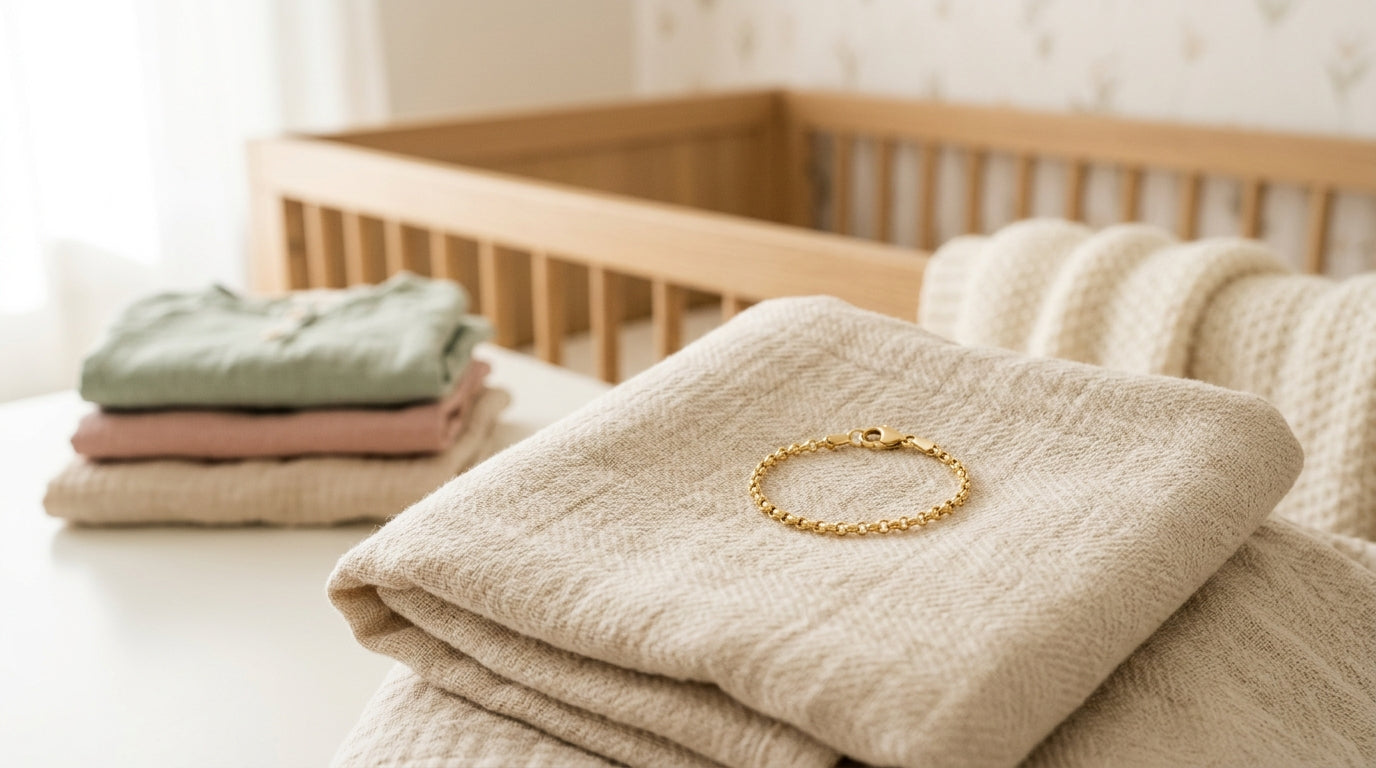
Maya's mom arrived from Chicago at 7:14 PM, exactly twelve minutes after we finally managed to shut down the baby's waking cycle. She dropped her bags in the hallway and immediately handed me a velvet box that weighed absolutely nothing. I opened it under the dim living room light, terrified the hinge would squeak and trigger a system reboot in the nursery. Inside the velvet was a tiny, impossibly fragile loop of metal. "For her 100 days," my mother-in-law whispered proudly, completely ignoring the fact that my daughter was technically on day 342 of deployment on this earth. I just stared at the thing. It was a 14-karat baby gold bracelet. My brain immediately started throwing critical system errors, bypassing any normal human emotion and going straight to calculating choking hazards, skin contact dermatitis probabilities, and the tensile strength required to snap the tiny metal links.

The hardware specs of tiny jewelry
I spent the next three hours lying rigid in bed next to my peacefully sleeping wife, my phone brightness turned all the way down to 1%, scouring metallurgy subreddits and pediatric safety forums. Apparently, when you're looking at baby gold, the karat rating is basically the core hardware spec that determines if you're holding a dangerous liability or just an overpriced accessory. Pure 24K gold is as soft as room-temperature butter, meaning a determined infant could dent it with a single emerging tooth, which makes it a terrible material for a tiny human who currently tests the structural integrity of our house by slamming everything she finds against the coffee table.
We were dealing with 14K, which means it’s mixed with alloys to increase durability so the kid can’t easily snap the links and inhale them like a dropped Cheerio. But then you've to calculate the alloy variables. If the alloy contains nickel, my daughter’s extremely sensitive skin—which recently generated an angry red rash because her bath water was exactly 99.4 degrees instead of the requested 98.6—would probably react violently. It's an impossible equation. You want it soft enough to be pure, but hard enough not to break, but hypoallergenic enough not to trigger an immune response.
The clasp itself was a tiny lobster claw mechanism that required adult fingernails and an infuriating amount of fine motor control to open, which I guess is the actual security feature.
The pediatrician risk assessment protocol
I couldn't handle the localized panic of just Googling things at midnight, so I brought the little velvet box to our 11-month checkup, presenting it to our doctor like it was a piece of recovered alien technology. She looked at me with that specific mix of pity and exhaustion reserved for first-time dads who track diaper output on a spreadsheet. According to my wildly sleep-deprived interpretation of her medical advice, babies and jewelry mix about as well as a toaster and a bathtub. She basically said that putting a metal chain on an infant is an unforced error because they explore their entire environment exclusively by trying to swallow it.

Her safety protocol was brutally simple, and I immediately texted it to my wife so I wouldn't lose the data. If the baby is wearing it, an adult must be actively monitoring the hardware. Not cooking dinner while the baby is in the next room, not checking emails on the couch, but maintaining a direct, unbroken line of sight. You put the tiny metal thing on for the family photo, and the millisecond the camera flash goes off, you uninstall it. You absolutely don't let them sleep, nap, or sit in a rear-facing car seat with it on, because if it catches on something or snaps, you won't hear the failure happen over the sound of the highway.
User testing goes immediately wrong
We decided to do a controlled test run during a Sunday afternoon FaceTime call with the Chicago grandparents. We dressed her in her Kianao Organic Cotton Baby Bodysuit, which is fine, it covers her torso and hides the phantom stains that materialize on all her clothes regardless of what she eats. The fabric is soft enough that it doesn't trigger her eczema patches, and the envelope shoulders mean I can pull the whole thing down over her body instead of over her head when she has a catastrophic diaper failure. Anyway, we got the bodysuit on, and I carefully attached the baby g to her wrist, sweating heavily through my t-shirt.
The second the clasp clicked, her internal sensors flagged the anomaly. She stopped moving. She stared at her wrist. Then, with the terrifying speed of a striking cobra, she lifted her arm and opened her mouth.
I practically dove across the living room carpet to intercept. I desperately needed a decoy to override her sudden urge to eat heirloom jewelry. I grabbed the Kianao Bubble Tea Teether off the coffee table, and I can't stress enough how much this specific piece of silicone has preserved my grip on reality this month. When she hit the molar phase, her baseline behavior shifted to feral raccoon, and we cycled through six different toys before finding out this weird little bubble tea thing is the only patch that fixed the bug. It has these textured boba pearls on the bottom and a heart cutout on top that she aggressively gnaws on for twenty uninterrupted minutes. I shoved it into her free hand, she grabbed it, completely forgot about the gold on her other wrist, and started chewing on the silicone boba with terrifying intensity.
If you're also living with a tiny roommate who wants to test the chewability of everything from expensive jewelry to your collarbones, you might want to check out Kianao's teething collection before you completely lose your mind.
Calculating the sizing variables
Here's another data point I didn't have before this week: the tolerances for error on infant wristwear are basically zero. I spent the entire FaceTime call nervously checking the fit of the chain until Maya finally slapped my hand away and told me I was annoying the baby. Apparently, the standard metric for safety is that you should be able to slide your pinky finger between the metal and the skin, which sounds highly scientific until you realize your baby is constantly squirming and flexing her hand. If it’s too tight, it leaves angry red indentations and you panic about circulation. If it’s too loose, it slides right off their sweaty little hand and disappears into the couch cushions forever, and suddenly you're out three hundred dollars.

This piece had extension loops, which is essentially adjustable hardware that lets the product scale as the user expands. But even with the smart engineering, her total continuous wear time clocked in at exactly seven minutes.
We placed her under the Wooden Baby Gym to get a decent photo with the natural light pouring in from the window. She swatted at the little wooden elephant hanging from the top bar, the metal bracelet clinked sharply against the solid wood, the unexpected auditory feedback startled her, and she immediately started screaming.
Test over. Bracelet removed. Placed securely back in the velvet box.
Why we keep the tiny metal circle
It has been sitting on my dresser for twenty-one days now. I stare at it every morning while I'm trying to figure out how to compile code on four non-consecutive hours of sleep. I used to think gifting a baby gold bracelet was just an illogical, highly risky practice of strapping expensive metals to a creature that routinely spits up strained peas into her own eyeballs. It made zero analytical sense.
But I think my operating system is finally catching up to the concept. It’s not actually functional hardware for the current version of my daughter. It’s a data archive. It's a physical, indestructible backup drive of this specific, exhausting, terrifying moment in our lives. When she's thirty years old, she's going to look at this microscopic loop of 14K gold and realize she was once small enough to wear it. She'll realize someone loved her enough to buy it, and that her deeply neurotic dad was paranoid enough to restrict her usage of it to seven heavily supervised minutes while holding a silicone bubble tea toy.
So yeah, the baby gets to keep the shiny hazard. We're just strictly enforcing the awake-and-supervised protocol until she's at least in middle school, or maybe until she moves out of the house. I haven't finalized the timeline yet. Just take the tiny metal chain off before you put them in the crib, check the links for sharp edges every single time you open the box, and don't buy cheap alloys that will turn their delicate wrists green while you're not looking.
If you're looking for things that are actually meant to be in your baby's mouth instead of family heirlooms, browse our collection of baby-safe toys and play gear to set up a much safer play environment.
My messy midnight FAQ on baby jewelry
Can babies sleep with bracelets on?Absolutely not, according to my pediatrician and every terrifying forum I read at 3 AM. Even if they look completely peaceful and haven't moved in an hour, a loose chain can catch on a crib slat, a swaddle blanket, or their own face. It’s a strangulation and choking hazard waiting to happen in the dark, so you need to take it off the second their eyes start getting heavy.
What karat gold is actually safe for a baby?It's a weird balancing act that feels like solving a math problem you didn't study for. 24K is way too soft and will dent or break if they yank it against a table. 10K is too hard but has too many random alloys like nickel that will probably make them break out in a rash. The general consensus I found from spiraling online seems to be 14K or 18K because it’s hard enough to survive a baby pulling on it but pure enough not to cause an allergic meltdown on their skin.
How do you clean baby drool off jewelry?Because my daughter managed to get it near her mouth for exactly two seconds before I intervened, I had to figure this out immediately. Don't use harsh chemical jewelry cleaners. I literally just used warm tap water, a tiny drop of the mild soap we use for her bottles, and an embarrassingly soft microfiber cloth to wipe off the mixture of saliva and whatever she ate for breakfast.
Are amber teething necklaces safer than a baby gold bracelet?My doctor practically yelled at me when I asked this question just to cover all my bases. Apparently, amber necklaces are just massive choking hazards disguised as holistic medicine. If the string breaks, you suddenly have thirty tiny beads loose in the crib. At least a solid gold bangle or a heavy-duty soldered chain doesn't shatter into a dozen pieces when a baby tugs on it, but honestly, neither of them should ever go in the mouth.
When is jewelry genuinely safe for kids?I honestly have no idea, but my current working theory is "when they can pay for their own cell phone bill." From what I read, most safety guidelines suggest waiting until they're at least three or four years old before letting them wear anything casually, because by then they supposedly stop trying to swallow everything they see. Until then, it stays in the velvet box on my dresser.




Share:
Why I Stopped Treating the Baby Growth Chart Like a High Score
Finding The Perfect Baby Goat Name For Toys and Nursery Themes