

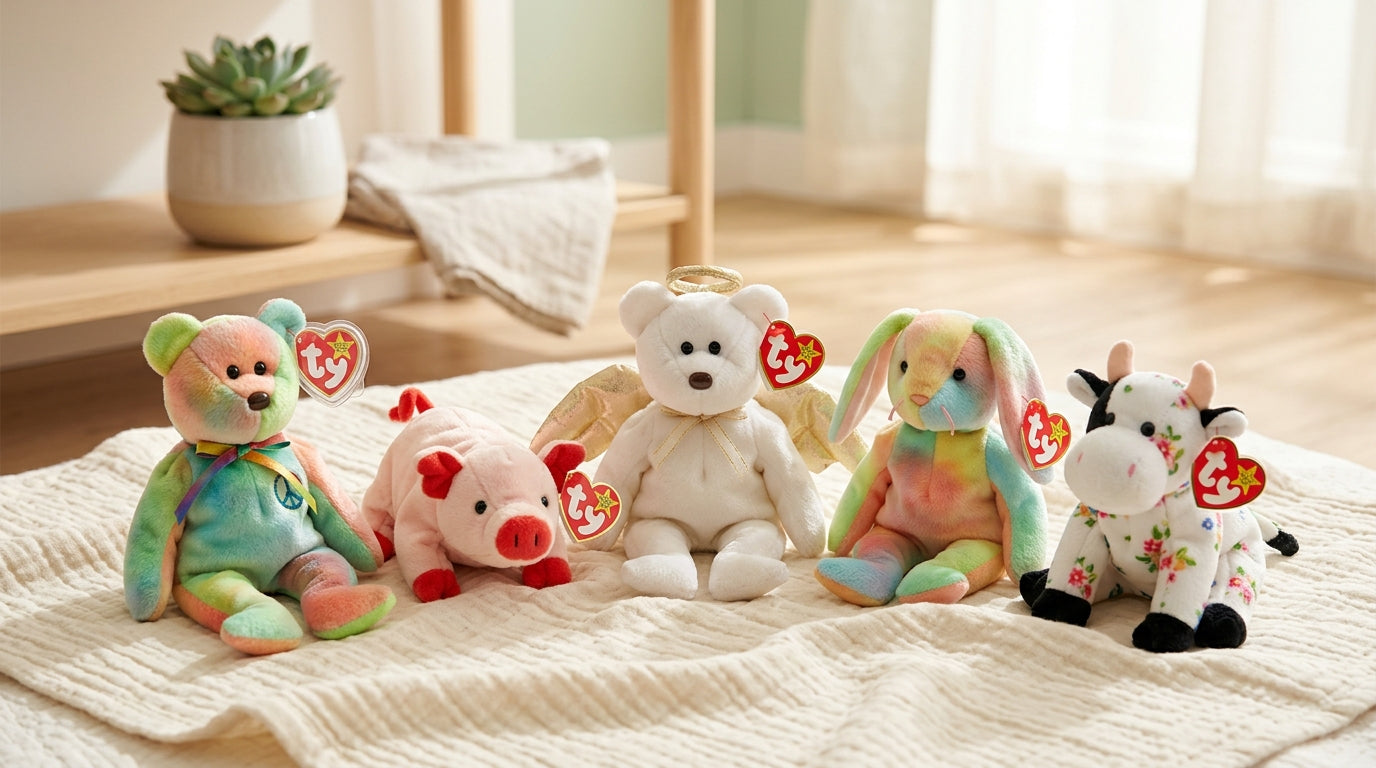
Rain is aggressively hitting my Chicago apartment windows while I try to wrestle a screaming toddler away from the front door. The UPS driver just dumped three massive, duct-taped Rubbermaid bins in the hallway. I recognize my mother-in-law's handwriting instantly. She had promised to send my kid's so-called college fund over from her basement. I crack open the lid while my son clings to my leg, breathing in the undeniable scent of 1998 attic dust. It isn't savings bonds. It's hundreds of pristine nineties plush toys, all suffocating in tiny plastic tag protectors.
Listen, I love my desi mother-in-law, but I'm staring at a mountain of synthetic fur and wondering how I'm going to explain that these things aren't paying for anyone's tuition. She genuinely believes she just handed us the keys to early retirement.
Let's talk about those plastic tag protectors for a second. The absolute delusion of the late nineties is staggering. Grown adults were buying plastic clamshells to protect cardboard heart tags on toys they bought at a gas station counter. I can't even process the level of collective hallucination it took to convince millions of people that a purple bear was the next gold standard. I opened one bin and found fifty of these rigid, sharp-edged plastic clips just waiting to be swallowed by an unsuspecting toddler. They look like tiny bear traps.
I spent my nursing career doing pediatric ER triage, and I've seen a thousand of these tiny plastic choking hazards pulled out of kids' mouths. Parents bring their gagging babies in, panicking because their kid found a vintage piece of plastic on the living room floor. If you're handing a vintage plush to your kid, you take the tag off, you throw the plastic protector in the recycling, and you don't look back.
Unless you've a first-generation model with a misspelled tag from 1993, your collection is worth exactly five dollars on a good day. That's the entire financial reality.
The great pellet debate and toxic nostalgia
My doctor told me last month that the real issue with giving old toys to babies isn't just the choking hazard from the tags, it's what they're actually stuffed with. Apparently, before 1998, these things were filled with PVC pellets. I guess PVC is some kind of toxic plastic nightmare that leaches phthalates into whatever it touches.
I'm not a chemist, but the general consensus seems to be that you don't want your teething kid sucking on twenty-five-year-old degraded polyvinyl chloride. It just sounds like a terrible idea. My doctor vaguely waved his hands and mumbled something about endocrine disruptors when I asked for details, which is doctor-speak for keeping it out of your house. Ty Inc supposedly switched to safer PE pellets later on to be more eco-friendly, but who has the time to check the tiny white tush tags of three hundred stuffed animals while a toddler is actively trying to climb the curtains. It's just easier to assume they're all slightly poisonous.
This is exactly why I ended up chucking a vintage red lobster across the room when my son got his mouth on it last Tuesday. I aggressively swapped it out for the Llama Teether I bought online. I'll be honest, this thing is my favorite piece of baby gear right now. It doesn't have toxic vintage pellets, it's just pure food-grade silicone. It saved my sanity during a brutal week of molar emergence when he wouldn't sleep for more than forty minutes at a time.
The little heart cutout makes it easy for his clumsy hands to hold without dropping it every five seconds. I can just throw it in the dishwasher when it gets covered in that gross mixture of drool and whatever crumbs he found under the sofa. It doesn't promise to fund his college, but it keeps him quiet, which is a far more valuable currency in this house.
Market realities and maternal fatigue
People constantly ask me if they should check eBay before donating their bins to a thrift store. I'm telling you right now, the listings you see for half a million dollars are completely fake. It's just people fishing for a sucker, or money laundering, or some other internet scam I don't fully understand.

If you search for the value of these things online, you'll see a lot of noise about how certain rare editions are a hidden goldmine. The reality of any beanie babies worth is pretty grim because the market is totally oversaturated with millions of identical toys. My mom texted me the other day, asking if I kept the special babi she sent over. I had to call her back and explain that her misspelled text about a vintage babie plush wasn't going to buy us a house in the suburbs. She was disappointed, but immigrant parents always hold out hope for a weird financial loophole.
If you really want your kid to have an animal shape to gnaw on, there are better options than an old toxic bear. I've the Malaysian Tapir Teether in my diaper bag too. It's fine, I guess. The brand pushes this whole educational wildlife conservation angle which is a bit much for a six-month-old who just wants to chew on something because his gums are throbbing. He doesn't know what a tapir is, and frankly, neither did I until I read the packaging. But it's sturdy, completely BPA-free, and doesn't smell like a damp basement, which is more than I can say for the nineties plastic mountain sitting in my living room.
If you're trying to figure out what actually works for a teething kid without exposing them to decades-old plasticizers, you can browse through some safer teething toys that weren't manufactured during the Clinton administration.
What to actually do with the furry mountain
So you've a pile of vintage toys taking up half your nursery. Don't put them in the crib, because the seams rot after twenty years and one split thread means your floor is covered in tiny plastic beads that look exactly like candy to a baby.

Instead of hoarding plastic bins in your attic hoping the market rebounds while simultaneously putting your kid at risk of choking on degraded synthetic fur, just bag up the common ones for a local charity shop and maybe keep one or two for highly supervised tea parties when they're older.
For actual teething and daily play, I lean heavily into natural materials anyway. The Handmade Wood and Silicone Teether Ring is what I usually toss in the stroller. It's just untreated beechwood and silicone beads. Nothing complicated, no nostalgic baggage, and it won't trigger a safety recall because the materials are incredibly straightforward. Plus, it really looks nice sitting on the coffee table, unlike a neon green frog with button eyes.
In the end, I packed two bins back up and shoved them into the deep storage of our apartment building. I kept one floppy dog that didn't have PVC pellets, cut all the tags off with surgical precision, and let my son drag it around the living room. He looked at it, wiped his nose on its ear, and threw it behind the sofa five minutes later. So much for a precious vintage legacy, yaar.
Before you dive into the deep end of vintage toy appraisal and start calling auction houses, maybe just make sure your kid has something modern and safe to chew on today. Go check out the non-toxic gear at Kianao and save yourself the massive headache of sorting through nineties trash.
Questions I get asked while running on zero sleep
Should I get my collection officially appraised by a professional?
Listen, unless you've unlimited free time and a remarkably high tolerance for disappointment, don't bother. The professional appraisers charge more for their time than the toys are seriously worth. Most of them will just tell you what you already suspect deep down. Just accept that we all got scammed by a brilliant marketing tactic in 1997 and move on with your life.
Can I wash vintage plush toys in the washing machine to make them safe for babies?
You can try, but it's a massive gamble. The fabric on these things is older than some of the nurses I work with. Sometimes they survive a gentle cycle in a mesh delicates bag, and sometimes they explode plastic beads all over your washing machine drum, ruining your appliance and your afternoon. Hand wash them in the sink if you care that much, or just don't give them to your kid.
Are they safe for babies if I completely remove all the tags?
Not really. Even without the obvious choking hazard of the tag and the plastic clamshell, the internal seams are incredibly old. My doctor made a deeply concerned face when I asked about it, muttering about degraded plastics and weak threads. I wouldn't trust them with any kid under three who still puts everything they find in their mouth. It's just not worth the anxiety.
How do I tell if my old toys have the toxic PVC pellets or the safer PE pellets?
You have to look at the little white tush tag sewn onto the back of the toy. It'll say either PVC or PE in tiny letters. If it says PVC, it's older and technically rarer, but also much more toxic for a kid to chew on. If it says PE, it's safer but probably worthless financially. It's a lose-lose situation, beta.
Why do I see these toys selling for thousands of dollars on the internet?
Because the internet is full of lies. Anyone can list an item for any price they want. Just because someone lists a purple bear for fifty grand doesn't mean a single human being on earth is really paying that. If you filter the search results to show only completed, sold items, you'll see a depressing wall of single-digit numbers. Don't let fake listings trick you into hoarding bins of plastic.




Share:
Stop misusing aquaphor baby healing ointment on rashes
Dear Past Sarah: The Ash Baby GIF Meme Is Not A Medical Crisis