

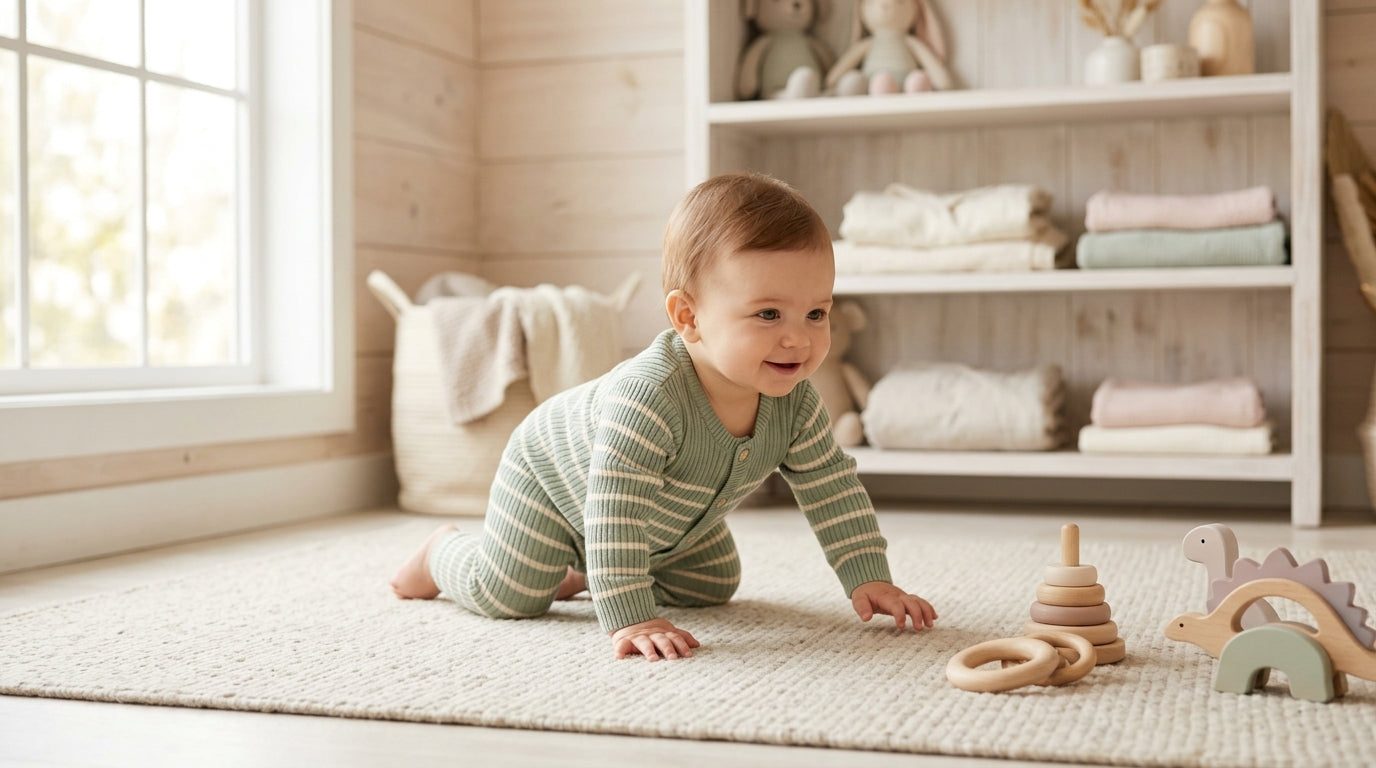
I was literally sitting on our living room rug with a stopwatch and a spreadsheet. My daughter was exactly eight months and four days old, lying perfectly still on her stomach, looking at me like I had lost my mind. According to the overly optimized timeline in my head, she was supposed to be fully mobile by now. I had spent the previous night deep in the anxiety trenches of a Reddit thread, panic-typing why is my babie not moving into my phone at 2 AM while my wife, Maya, slept peacefully next to me.
The pressure is absurd. You see other infants in your feed executing flawless military crawls at six months, and suddenly you feel like your kid’s development is lagging behind some invisible release schedule. My mother-in-law even texted that morning to ask if the "babi" had started exploring the house yet, a typo that only spiked my blood pressure further. Babies are unpredictable, but I like data, and the data I had was telling me we were missing a core milestone.
My doctor debugging my spreadsheet
We went in for a routine checkup, and I brought my color-coded tracking app to show Dr. H. I started listing my concerns about her lack of forward momentum, expecting him to hand me a referral for some kind of intense physical therapy. Instead, he looked at my phone, laughed, and completely blew my mind.
He told me that in 2022, the CDC actually removed crawling from their official developmental milestones list. My brain basically blue-screened at this information. For generations, this has been the milestone. But apparently, a milestone only makes the official list if 75% of infants achieve it by a specific age. Because roughly 7% of kids skip the crawling phase entirely—opting to just sit there until they randomly pull themselves up on a coffee table and start walking—it doesn't fit the strict statistical definition anymore.
Dr. H explained that if an infant isn't scooting by nine or ten months, it’s not an automatic system failure. The real metric is whether they're coordinating both sides of their body, sitting independently, and showing some kind of curiosity about their environment. Crawling is basically just an optional software patch, not the main operating system.
The bizarre physics of floor mobility
When the firmware update finally does happen, it almost never looks like the textbook pictures. I spent weeks waiting for the classic hands-and-knees, alternating-limb movement that you see in diaper commercials. I can dismiss that classic style in one sentence: it's entirely boring and almost no child starts out doing it correctly.

Instead, my daughter invented a maneuver I can only describe as the Reverse Roomba. Apparently, their upper body strength installs way faster than their leg coordination. She would push up with her arms, fail to engage her knees, and inadvertently shove herself backward until she was wedged under the sofa. She would then scream because the toy she wanted was now three feet further away. It was a spectacular design flaw.
Then there’s the commando belly-drag, where they pull themselves across the floor with their forearms like they're trying to sneak past enemy lines. Some kids do a stiff-legged bear walk. Some just sit on their butts and use their heels to row themselves forward across the carpet. As long as both sides of their body are doing the work, my doctor said the actual aesthetic of the movement doesn't matter at all.
Running the tummy time protocol
Even though it’s not a strict milestone, pediatric physical therapists apparently still love crawling because it’s a massive full-body workout. It builds shoulder stability and develops the tiny hand muscles they’ll eventually need to hold a pencil. But you can't just tell a baby to do pushups. You have to trick them into it.
Maya found some data from the Cleveland Clinic suggesting a formula: 10 minutes of tummy time per day for every month of age. So a four-month-old needs 40 minutes scattered throughout the day. I tried timing this precisely until Maya told me to stop acting like a gym coach and just let her exist on the floor.
We started using the "bait" technique. You just abandon your dignity, lay on the rug with them, and put a highly desirable object just outside their blast radius to provoke a forward lunge. We had mixed results with our gear.
Someone gifted us the Handmade Wood & Silicone Teether, which is visually beautiful and objectively a great sustainable product. But honestly, as a mobility incentive, it’s just okay. The wooden ring is a bit clunky for sliding across our rug, and when my daughter finally reached it, she mostly just used it to hammer the floorboards like a tiny, angry judge. It's great for chewing, but terrible as bait.
What actually worked flawlessly was the Squirrel Teether Silicone Baby Gum Soother. I don’t know what kind of psychological hold this mint green silicone rodent has on my kid, but she's obsessed with the little acorn design. I'd place it exactly four inches out of her reach. The sheer determination in her eyes as she tried to propel her body toward it was terrifying but highly good. Because it’s lightweight and entirely food-grade silicone, she could easily grab the ring once she finally closed the distance, and it didn't dent our floors when she inevitably chucked it across the room.
If you're currently trying to optimize your own floor time setup, exploring our sensory and wooden toys collection is a great place to find the perfect motivation for your little one.
Traction control and slippery apartments
One variable I entirely failed to account for was friction. We live in a Portland apartment with very slick, refinished hardwood floors. My daughter would get up on all fours, and her little knees would immediately slide out from under her like a cartoon character on ice.

I thought baby clothes were just tiny, expensive tubes of fabric, but Maya pointed out that synthetic materials were basically turning our kid into a human Swiffer. We switched out her wardrobe and tried putting her in the Baby Leggings Organic Cotton. I'm generally skeptical of apparel claims, but the ribbed texture on these actually gave her knees enough grip to push off the floor without sliding. They have an elastic waist that didn't pinch her stomach when she contorted herself into weird yoga poses, and the organic cotton somehow survived the thousand abrasive trips she took across our rug once she finally figured out forward propulsion.
Taking off their socks so their toes can grip the floor also apparently makes a massive difference. You basically have to treat them like a rock climber—bare extremities and grippy joints.
When the panic is seriously justified
Because I'm naturally anxious, I did ask Dr. H when I should genuinely worry about mobility. The red flags are surprisingly specific, which is a relief because it means you don't have to stress over minor delays.
He told me to watch for asymmetry. If a baby is only dragging one side of their body, or exclusively using their right arm and leg while the left side just hangs out, that’s a bug that needs reporting. Extreme stiffness or extreme floppiness are also reasons to call the doctor. And if you hit the 10-to-12-month mark and your kid is showing zero interest in moving, reaching, or exploring their environment in any capacity, it’s worth scheduling an evaluation. But if they're just taking their sweet time figuring out the mechanics of their own knees, you just have to wait it out.
Once they do figure it out, your life is over anyway. You have about 48 hours to anchor every bookshelf in your house before they realize they can use the dog as a step-stool. Enjoy the stationary phase while it lasts.
Ready to upgrade your baby's floor-time wardrobe for better mobility? Shop our organic cotton essentials today.
Frequently Asked Questions from the Floor
What if my kid just scoots on their butt everywhere?
Apparently, this is totally fine. Butt-scooting is a legitimate, recognized form of infant transit. My doctor said as long as they're using both sides of their body symmetrically to row themselves across the living room, they're checking the gross motor skill box. It looks ridiculous, but it works.
Does tummy time really matter that much?
I hated doing it because my daughter would just face-plant and scream, but yes, it's the foundational code for all mobility. It forces them to fight gravity, which builds the neck and shoulder strength they need to eventually push up. If they hate the floor, try laying on your back and putting them chest-to-chest with you. It counts as data.
Should I buy knee pads for my crawling baby?
I almost ordered tactical baby knee pads on Amazon at 3 AM, and Maya rightfully stopped me. Unless you live on a bed of gravel, their knees are perfectly fine on normal floors. Extra padding just makes it harder for them to feel the ground and balance. Just put them in some ribbed cotton leggings if they need a little traction.
How early do I need to babyproof the house?
Do it yesterday. I assumed I'd have a warning period between "sitting" and "moving," but babies go from zero to sixty in the span of a Tuesday afternoon. Anchor the heavy furniture and hide the cables before they figure out how to put themselves in danger.
Is it bad if my baby skips the crawling phase entirely?
Not necessarily. About 7% of kids go straight from sitting to pulling up on furniture and walking. They bypass the floor-crawling patch entirely. As long as their doctor says their overall muscle tone and coordination are on track, you just get to skip the phase where they try to eat lint off the carpet.




Share:
When Should Babies Roll Over? The Unofficial Milestone Guide
When is kat timpf's baby due? The late pregnancy waiting game