

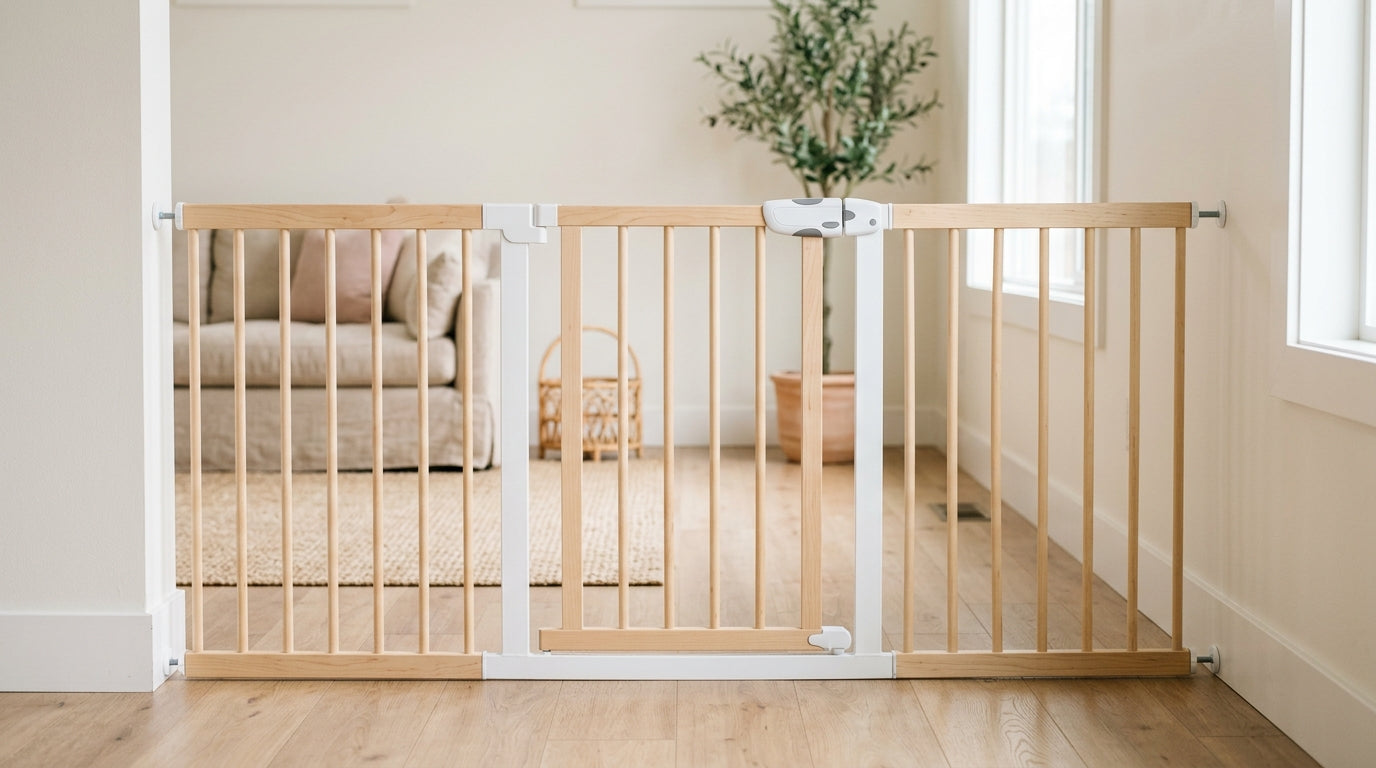
My mother-in-law told me to just line up the heavy dining room chairs to block the living room archway. My neighbor at the park swore by those wooden accordion things from the nineties, completely ignoring the massive strangulation risk. The pediatrician casually mentioned we needed a barrier before my son realized he could crawl, but offered absolutely zero logistical advice on how to actually accomplish that.
I live in a Chicago home with one of those sweeping, overly dramatic archways between the living room and the kitchen. Standard baby gates looked like toothpicks in a canyon. I figured buying an extra wide baby gate would be a simple ten-minute internet purchase.
Three weeks, two returns, and one deeply frustrating argument with my husband later, I realized this is actually a structural engineering project.
If you live in an open concept home or a vintage apartment with weird nooks, you're going to face this eventually. Your baby will become mobile. You will look at your massive living room opening and panic.
The physics of the gap
Listen, spanning a large space isn't just about finding longer metal tubes. It's about tap into.
When you buy a wide baby gate, you're basically installing a giant lever in the middle of your house. The longer the gate, the more physical force a tiny human can generate simply by leaning their body weight on the center of it.
I've seen a thousand of these admissions during my time in the pediatric ER. A parent buys a standard gate, adds three extension pieces to cover a sixty-inch gap, and uses tension cups because they don't want to ruin their living room paint job. The kid pushes on it, the tension gives way, and suddenly you've a baby surfing a metal fence onto the hardwood floor.
I remember one specific night shift where a dad brought in a toddler with a golf-ball-sized lump on his forehead. The father just kept staring at the broken tension rod in his hands, completely bewildered that his thirty-pound kid had managed to overpower it.
I think the official safety guidelines say these barriers are only tested for kids up to two years old. My pediatrician suggested taking ours down the minute he started using the horizontal bars as a ladder. It feels like a guessing game most days. You just have to assume your child is actively plotting to defeat whatever security system you install and plan accordingly.
Stop avoiding the drill
Everyone wants a pressure-mounted extra wide baby gate. Nobody wants to patch drywall when they eventually move out.
Get over it.
Tension rods are barely acceptable for a standard thirty-inch bathroom doorway. When you're spanning across an open concept floor plan, or trying to block off a brick fireplace, pressure cups are just a polite suggestion to a toddler. You have to screw the hardware directly into a wall stud.
My husband spent three days staring at the wall with a stud finder, hoping a different, damage-free solution would magically present itself. I finally took the drill away from him and did it myself while the baby was napping.
Joan, the triage nurse I used to work with, always joked that drywall is just chalk wrapped in paper. You can't anchor a heavy metal barrier to chalk. If you use those little plastic drywall anchors instead of finding real wood, your kid will rip the entire rig out of the wall by Tuesday.
Throw out those vintage accordion death traps, measure your actual wall gap before you go to the store, and just accept that you're going to have to find a stud and drill into real wood today.
The nightmare of narrow doors
Let me tell you about the most infuriating part of these massive barriers.

You buy a product that spans nearly two hundred inches across your room. You think you've solved everything. Then you try to walk through it.
To compensate for the structural weakness of being so wide, manufacturers make the actual walk-through door comically tiny. Mine is sixteen inches wide.
I'm usually carrying a laundry basket, a thrashing toddler, and the e baby monitor. I've to turn completely sideways, suck in my breath, and unlatch a complicated dual-action lock with my pinky finger while balancing on one foot.
I spilled an entire mug of hot coffee down my leg last week because I tried to squeeze through the opening without turning my hips. I've permanent bruises on both sides of my body from misjudging the clearance.
Also, there's always a metal threshold bar across the floor that you'll trip over in the dark, so just make peace with that now.
Managing the collateral damage
Once we finally got the hardware mounted and leveled, my son walked right over and started chewing on the painted metal bars.
Like a tiny inmate.
The drool was everywhere. It looked like a snail had crawled across my newly installed barricade. Babies will find the hardest, most inappropriate surface in your house to soothe their gums.
I had to start redirecting him with the Squirrel Teether Silicone Baby Gum Soother. Listen, this thing is actually useful. It's made of food-grade silicone, which my pediatrician suggested might harbor less bacteria than those plastic water-filled rings from the pharmacy. That's probably true, especially since I just throw it in the dishwasher every night with the dinner plates.
I've no idea why he prefers chewing on a mint green squirrel over his actual pacifier. But the ring shape is easy for his little hands to hold. He sits by the baby g barricade, watching me cook, aggressively gnawing on the squirrel tail. The swelling in his gums visibly goes down when he uses it, and it keeps him quiet, which is all I really ask for at five in the evening.
Speaking of the kitchen, the entire reason I installed this barricade was to keep him away from the hot oven while I make dinner.
Usually, I trap him in his high chair on the safe side of the gate with some snacks to buy myself twenty minutes. We use the Baby Silicone Bear Plate for this.
It's fine. The bear face is cute enough and the depth is right for slippery fruit.
They advertise the suction base as being completely unmovable. Maybe it's, if you live in a new build with pristine marble countertops. On my vintage, heavily scratched wood dining table, a determined baby can absolutely break the seal. I watched him methodically peel it off the table yesterday. He didn't even look angry. He just looked curious as he flipped it over and launched pureed carrots onto the rug.
It does survive the microwave and the bottom rack of the dishwasher without melting though. That puts it ahead of most baby gear in my house.
Baseboards will break your spirit
Nobody warns you about the floor trim when you buy an extra wide baby gate.

You finally locate the wall studs. You level the hardware. But your house has thick vintage baseboards.
The bottom of the gate needs to sit flush against the wall, but the top has a two-inch gap because of the wood trim sticking out at the bottom.
You end up having to buy weird wooden spacer kits or cutting blocks of scrap wood to put behind the upper mounts just to make the thing stand up straight. I spent three hours watching low-quality installation videos recorded by dads in their basements to figure this out.
To deal with the tripping hazard I mentioned earlier, I started laying our Organic Cotton Baby Blanket with Squirrel Print over the bottom rail at night.
I stubbed my toe so hard on the metal floor bar last month that I saw stars. That's when the blanket trick started. It acts like a visual marker so I don't break my foot when I'm doing late night water runs.
The blanket is soft and the organic cotton holds up surprisingly well to being stepped on repeatedly. It washes clean every time, which is more than I can say for the actual rugs in my living room.
If you need soft layers that can survive the chaos of a toddler zone, check out the organic baby blankets collection to find something durable.
Lowering your expectations
Installing a massive barrier in your home is mostly about managing your own expectations.
It will look ugly. It will ruin the aesthetic of your modern living room. It will be incredibly annoying to walk through holding a load of laundry. And your kid will probably figure out how to unlatch it by their second birthday anyway.
But it'll keep them from falling into the fireplace or tumbling down the basement stairs, so we do what we've to do.
If you're drowning in the logistics of keeping a tiny human alive in a house full of hard corners, browse our full line of practical survival gear. Explore the Kianao organic baby essentials collection to find things that honestly work for your daily routine.
Things nobody tells you about wide gates
How wide can a pressure mounted barrier really go?
Honestly I'd never trust a tension rod for anything wider than a standard thirty-inch bedroom door. Once you start adding those extension pieces to span a hallway, the middle gets incredibly weak. If your kid leans their full weight against it, the whole thing will just bow and snap out of the wall cups. It's not worth the anxiety, just get the drill out.
What do I do if I've thick baseboards?
You're going to have to rig it. You can buy specialized baseboard installation kits that come with adjustable brackets if you want to be formal about it. Or, if you're tired and cheap like me, you find a piece of scrap wood that matches the thickness of your baseboard, paint it white, and screw it into the wall stud at the top mounting point. It creates a flush vertical line for the hardware. It looks terrible up close but it works perfectly.
Are those retractable mesh screens safe for large spaces?
My pediatrician seemed highly skeptical of mesh screens for anything involving stairs or significant drops. Kids are smart, beta. If the mesh isn't pulled tight enough, they figure out how to slide under it on their bellies like little soldiers. I think they're acceptable if you just want to visually block off a kitchen or a home office while you're in the room, but I wouldn't bet a child's life on a piece of rolled-up fabric.
Why are the walk-through doors so ridiculously narrow?
Physics, yaar. If they made the swing door thirty inches wide, the remaining stationary panels wouldn't be able to support the weight of the door swinging open and shut. The structural integrity of a massive span relies on having mostly rigid panels. You just have to learn how to walk sideways through your own house for the next two years.
Do I really have to take it down when they turn two?
Probably. The medical advice usually says to remove it when they hit thirty pounds or thirty-six inches tall. Basically, once your kid is tall enough to throw a leg over the top bar, it stops being a safety device and turns into a very dangerous piece of gymnastics equipment. Once they can climb it, you just have to take it down and start trusting them, which is terrifying.




Share:
Why Family Ties Baby Keem Is Wrecking Your Smart Speaker
The Truth About Those Evo Baby Dragon Decks Everyone Is Playing