

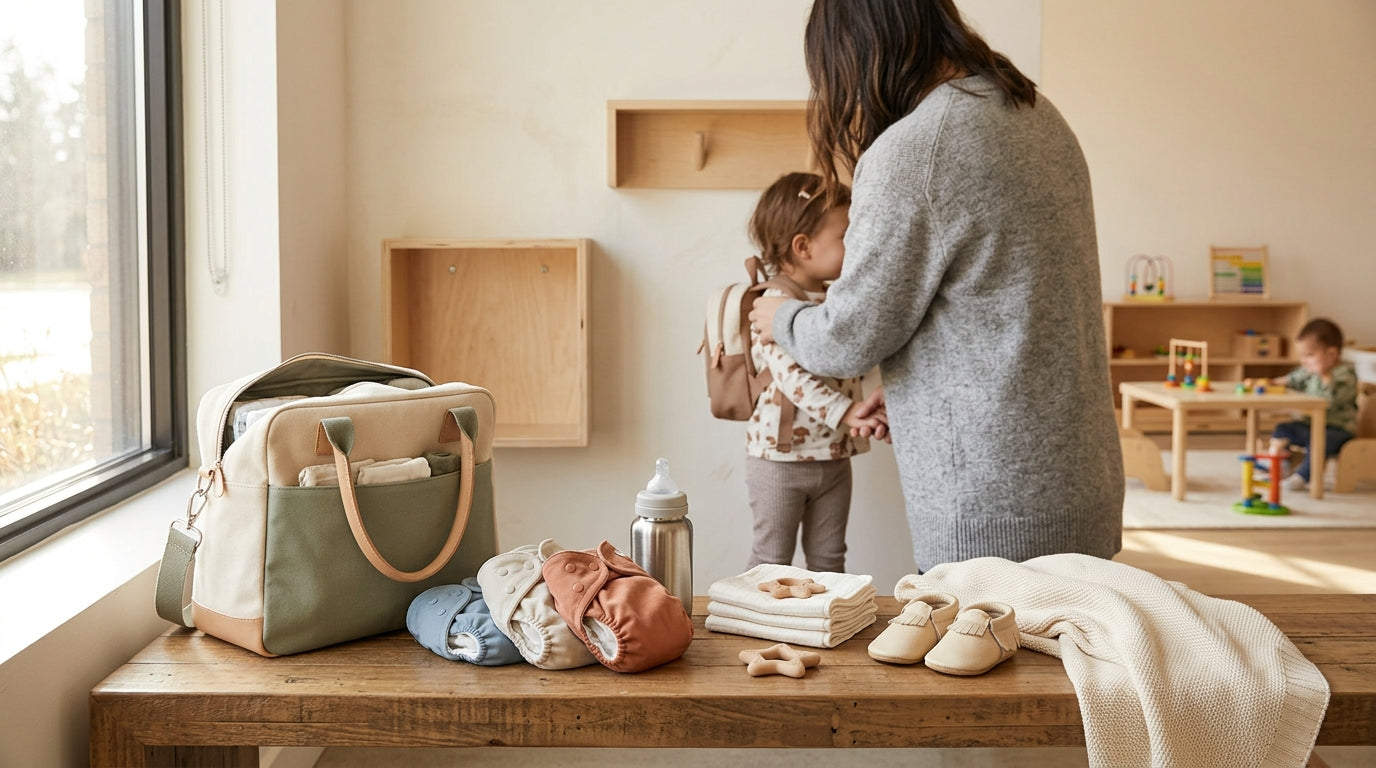
I'm currently sitting in a 2014 Skoda Estate, engine off, staring blankly at a laminated sign that reads "Little Acorns" through a windscreen smeared with what I sincerely hope is just mashed banana. My twin daughters, Isla and Freya, are in the back seat aggressively negotiating the ownership of a single broken rice cake. We're exactly four minutes away from the morning handover, which means I've two hundred and forty seconds to locate Freya’s left shoe, wipe the yogurt out of my own hair, and mentally prepare for the emotional whiplash of drop-off.
If you're standing on the precipice of handing your child over to professional caregivers, you probably have a highly idealised vision of how this is going to go. I certainly did. Before we started this journey, my understanding of childcare was entirely theoretical. I assumed the girls would trot in, learn conversational French over a plate of organic quinoa, and I'd spend my newfound free hours writing a novel or perhaps finally fixing the squeaky hinge on the kitchen door.
The reality is vastly different, much louder, and involves an amount of administrative panic I was entirely unprepared for.
The desperate midnight geography of finding a place
Remember the specific flavor of terror you felt when you first typed "baby daycare near me" into your phone at three in the morning? I do. The twins were barely six weeks old, I hadn't slept a full night since a random Tuesday in late October, and I was suddenly gripped by the absolute certainty that if I didn't get them on a waiting list immediately, they would be barred from formal education forever.
In my pre-parenting life, I believed you simply walked into a nice building, shook hands with a friendly woman in a cardigan, and agreed on a start date. The after is a brutal lesson in scarcity. You end up visiting places that smell faintly of bleach and desperation, nodding enthusiastically when the manager tells you there’s a spot opening up in fourteen months because a current toddler is relocating to Leeds. You become willing to overlook geographical inconvenience, remortgage the house, and offer them your firstborn—which is ironic, considering that's exactly what you're trying to give them.
By the time you actually secure a spot, the relief is so deep you temporarily forget that you now have to actually hand your baby to a stranger.
The great immunity gauntlet of doom
I used to believe we had a fairly robust immune system in our house. We ate vegetables. We went for bracing walks on Hampstead Heath. Then week two of nursery hit, and I realised our previous existence had been lived in a sterile bubble of naive health.
Our GP—a wonderfully tired woman named Dr Evans who always looks like she needs a strong cup of tea—warned me at their one-year check-up that starting childcare meant running an obstacle course of microbiological horrors. I nodded politely, assuming she meant a few sniffles and maybe an extra dose of Calpol now and then. I didn't realise she was preparing me for biological warfare.
Within fourteen days, my living room was a fully operational triage centre. We were hit by a cascading sequence of respiratory viruses, a mysterious rash that turned out to be hand, foot, and mouth disease, and something that just caused both twins to smell vaguely of old pennies. I read somewhere on a terrifying late-night forum that this illness spike drops off after about nine months as their little immune systems adapt, though my current understanding of medical science is entirely filtered through dosing syringes and sheer panic. You basically have to accept that for the first year, your child will have a permanently runny nose that defies all known laws of fluid dynamics.
Packing the bag of absolute chaos
The before-and-after of the nursery bag is a tragic comedy. Before day one, I packed a bespoke canvas tote with three colour-coordinated organic cotton outfits, a small wooden puzzle, and a handwritten note explaining that Isla prefers her milk lukewarm while Freya likes a specific song sung to her while she burps.

The after is just me frantically shoving a multipack of wipes and whatever clean trousers I can find into a supermarket carrier bag while shouting about the time.
You learn very quickly that nursery staff don't care about your aesthetic sensibilities because they're dealing with industrial levels of bodily fluids. They care about wipeability. We bought the Bibs Universe Silicone Baby Bib entirely by accident after Freya executed a rotational sneeze while eating a vividly purple beetroot puree that resulted in me throwing away a fairly nice rug. I love it purely because it has a massive trough at the bottom that catches everything they drop, and the space rocket design distracts Isla long enough for me to force a spoon of porridge into her mouth. The nursery staff love them because they can literally just take them to the sink and hose them down like a muddy patio instead of adding to the mountain of laundry.
I also confidently packed the Handmade Wood & Silicone Teether Ring for the first few weeks. Don't get me wrong, it's a lovely object with untreated beechwood that doesn't scream 'plastic landfill' like half the stuff in our house, and it was mildly useful when they were cutting incisors. But eventually, Freya realised she could use the wooden ring to hook the cat by its collar and drag it across the kitchen floor, so it was swiftly confiscated. It’s fine, but mostly it just lives at the bottom of the changing bag now, collecting rogue biscuit crumbs and judgment.
The handover ritual and the art of leaving
I thought the morning drop-off would be a gentle, collaborative process where I'd sit on a tiny chair, do a small jigsaw puzzle with them, and slowly extract myself as they became absorbed in finger painting.
The handover is actually more like a Formula 1 pit stop.
The staff at these places are ruthlessly efficient, heavily caffeinated angels who don't have time for your parental guilt. You don't try to explain the intricacies of baby d's erratic weekend sleep schedule, and you definitely don't linger in the doorway making sad eyes at your offspring. You establish a specific routine—a high-five, a kiss on the forehead, a generic phrase like "have a good play"—and then you walk away without looking back, much like an action hero walking away from an explosion. If you go back because you heard a single sob, you reset the clock on their adaptation and the nursery manager will look at you with deep, deep disappointment.
Food politics and the suction plate survival strategy
Nobody warned me about the bureaucratic nightmare of daycare food regulations. If your child so much as breathes heavily on a bottle of milk, the staff are legally obligated to pour the rest of it down the sink after an hour, meaning you end up freezing backup bags of milk like a doomsday prepper.

Getting them ready for the communal dining table also meant we had to violently correct their table manners at home, mostly to stop them treating plates like frisbees. We started using the Silicone Cat Plate purely out of self-defence. It has a suction base that's so genuinely aggressive I once tried to pry it off the highchair tray and nearly lifted the entire chair off the kitchen tiles. It has these little cat ear sections where you can put peas (which they'll ignore entirely) and sweetcorn (which they'll mash violently into their own eyebrows). It somehow taught them that plates stay glued to the table, a skill the nursery workers deeply appreciate when managing twelve hungry toddlers at once.
Naps are a spectator sport
At home, nap time requires blackout blinds, a very specific white noise machine playing the sound of a Himalayan waterfall, and the entire household walking on tiptoes like cat burglars. I was terrified they would never sleep at nursery.
It turns out, peer pressure is a powerful sedative.
The nursery manager told me on day one that they adhere strictly to safe sleep rules, which means no swaddles, no heavy duvets, and certainly no weighted sleep sacks. I used to fret they’d freeze on the walk there in the November drizzle, so we wrap them in the Happy Whale Bamboo Baby Blanket for the pram ride in. It's ridiculously soft and massive, and occasionally I just use it as a makeshift scarf when I've forgotten my own coat in the morning rush. But once they're inside that building, the staff only put them down on a small plastic mat in a room where fifteen other toddlers are actively screaming, and they miraculously pass out. I don't know what dark, ancient magic these women possess, but I'd pay handsomely to learn it.
If you're trying to figure out what gear seriously survives this daily gauntlet without falling apart or looking like a neon plastic nightmare, you might want to browse through Kianao's baby gear collections—most of it can be wiped clean with a wet cloth, which is honestly the highest compliment I can give any object right now.
The strange grief of getting your time back
Here's the absolute most brutal truth about the whole transition. You spend the first year or two desperate for a break. You complain to your partner, you complain to your friends, you fantasise about sitting in a quiet room and doing absolutely nothing for just one hour.
Then the first day arrives. You do the drop-off. You survive the tears. You walk back to your car, you drive home, you make a cup of coffee, and you sit down in the glorious, uninterrupted silence of your own house.
And it's awful.
The emptiness is physically heavy. You miss the chaos. You catch yourself looking at the clock every twelve minutes wondering if they're eating, if they're scared, if they miss you at all. The guilt of paying someone else to look after your child hits you like a wet sack of cement. It passes eventually—usually around the time you realise you can watch a television programme with swearing in it at two in the afternoon without headphones—but that initial transition is rough on the soul.
But then you pick them up honestly. They smell vaguely of somebody else's washing powder and industrial cleaning wipes, they've paint in places that defy logic, and they look at you like you're a returning rock star. They survived. You survived. Tomorrow, you get to do it all over again.
Before we get to the panicked questions I usually end up answering at the playground while watching Freya try to eat a handful of woodchips, remember that whatever you're feeling about this transition is entirely normal.
The messy questions everyone really asks
Do they honestly sleep at nursery or will I deal with a gremlin all evening?
They sleep, but it’s a different kind of sleep. For the first few weeks, the sheer mental exhaustion of being around that many other children means they'll likely pass out in the car on the way home and wake up deeply confused and angry. Expect the hour between getting home and bedtime to be a volatile diplomatic hostage negotiation.
What happens if my baby just flatly refuses a bottle from the staff?
This was my biggest panic with Isla. The reality is that babies won't voluntarily starve themselves, though they'll hold out just long enough to make everyone sweat. The staff have dealt with this a thousand times. They will try different cups, spoons, or just distract them until they forget they're protesting. Eventually, hunger wins over stubbornness.
Is it normal to sit in the car park crying for twenty minutes after drop-off?
If you don't cry in your car at least once during the first week, you're probably a sociopath. I spent my first drop-off sitting in the Skoda listening to a sports radio phone-in, weeping quietly while eating a stale digestive biscuit. It's a massive biological separation; give yourself a minute.
Do I really need to label every single sock?
Yes. If you don't label it, it belongs to the void. I've lost more socks in the Little Acorns baby room than I've in thirty-five years of using washing machines. Buy a custom stamp with their name on it and stamp everything, including the fruit you send in. I'm only half joking.
How many backup outfits do they honestly need in the bag?
However many you think is reasonable, double it. If they've a blowout, they'll somehow soil the trousers, the vest, the jumper, and the socks. Three full outfits is the absolute minimum if you don't want to receive a humiliating phone call at 2pm asking you to bring in spare trousers because your child is currently wearing a borrowed pair of leggings that are three sizes too big.




Share:
The Real Baby Definition: Throwing Out The Dictionary Right Now
The 3 AM hostage negotiation and the baby daisy aesthetic