

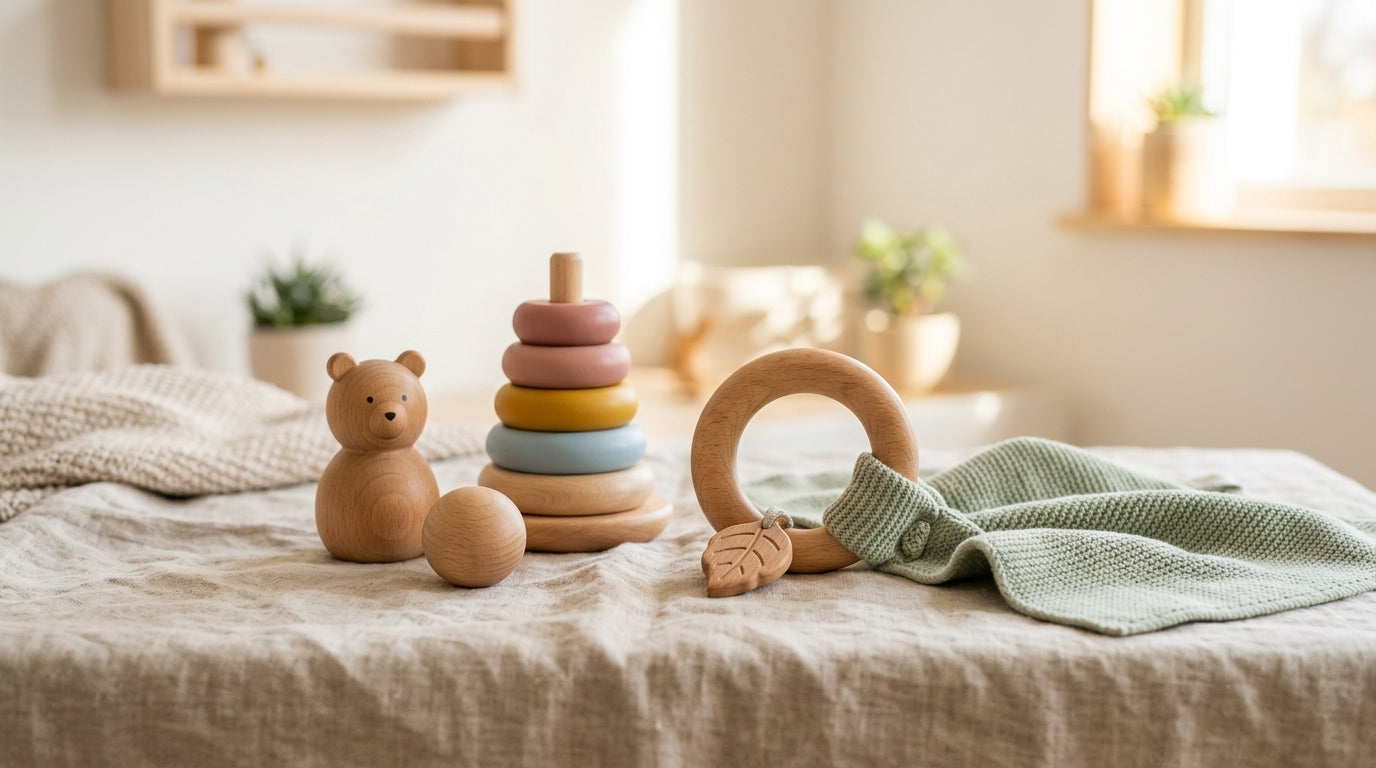
Listen, it was 11 PM on the night of my son's first birthday. The living room smelled like smashed vanilla frosting and desperation. I was sitting on the rug, surrounded by a mountain of brightly colored cardboard and plastic, doing what any former pediatric triage nurse would do. I was sorting the gifts into piles based on their potential to send us to the emergency room.
My mother-in-law had gifted a plastic, battery-powered DJ table that sang the alphabet in a terrifyingly cheerful British accent. An aunt brought something with flashing strobe lights that I'm fairly certain could trigger a seizure. Someone else brought a stuffed bear with button eyes that looked like they would pop off with one good tug.
I pushed the flashing DJ table into the hallway. Then I looked at the small pile of wooden blocks my sister had brought. They were heavy. They were quiet. They didn't require triple-A batteries. That night began my very cynical, highly paranoid journey into figuring out what actually matters with toddler playthings.
The medical reality of a twelve-month-old
If you read the parenting forums, they make turning one sound like a magical awakening where your child suddenly desires to build architectural marvels. My pediatrician laughed when I asked about cognitive milestones at our one-year visit. She reminded me that at this age, my kid is basically a very mobile, slightly drunk golden retriever.
They're in the thick of the oral phase. Everything goes in the mouth. I don't mean some things go in the mouth. I mean every single object they encounter is assessed first by the hands, and second by the gums. I spent my shifts at the hospital pulling the strangest things out of toddlers' throats. Coins, plastic battery covers, bits of foam. When you're shopping for spielzeug ab 1 jahr, you're essentially shopping for a chew toy that also happens to teach motor skills.

Then there's the pincer grasp. This is that little medical miracle where they learn to use their thumb and index finger together. Suddenly, my son was picking up invisible specks of lint from the carpet with the precision of a neurosurgeon. They need toys that let them practice this. Not buttons they can just smash with their whole palm while a machine does the work for them.
We're also dealing with cruising and walking. The center of gravity on a one-year-old is a joke. They pull up on anything. They fall constantly. A heavy wooden toy stays put. Flimsy plastic tips over and takes the kid down with it. Cardboard is useless because they'll just eat it.
Falling down the safety rabbit hole
Because I know exactly what stomach acid does to cheap paint, I started looking into how wooden toys are actually regulated. You would assume everything sold for babies is safe. You would be completely wrong.

There's this European standard called DIN EN 71-3. It sounds like a boring serial number, but it's the only thing standing between your child and a mouthful of toxic lacquer. It keeps stable heavy metals in toys. When a wooden toy is certified under this, it means the paint is water-based and saliva-resistant. The Germans call it speichelfest. I call it the bare minimum requirement for anything entering my house.
Wood also splinters. Cheap wood, anyway. If you buy a five-dollar wooden train set from a discount bin, you'll be pulling a sliver out of your kid's tongue by Tuesday. Quality matters here in a way it just doesn't with socks or bibs. Solid wood, rounded edges, non-toxic finishes. That's the triage criteria.
What survived the living room purge
I boxed up the singing DJ table and the strobe-light monstrosities. I donated them to a daycare that probably hates me now. I decided to stick mostly to natural materials. It wasn't because I wanted an aesthetic, beige nursery for social media. It was because wood makes sense. It has natural weight. It gives them tactile feedback. Dropping a wooden block on the floor teaches cause and effect beautifully because it makes a satisfying, solid thud.
But you don't need a toy store in your living room. You need three or four things that work.
If you want to bypass the plastic junk entirely, just browse a curated wooden toys collection that already checks the safety boxes so you don't have to obsess over the paint composition at 2 AM like I did.
The honest product assessment
We acquired a few specific pieces over the next few months. Some were brilliant. Some were humbling.

The first was a wooden motor activity cube. I had seen a hundred variations of these. We got the wooden activity cube from Kianao. Listen, I loved this thing, but not for the reasons the manufacturer intended. Yes, it has the little beads on the wire and the shape sorter. But my son used it primarily as a reliable anchor. He would drag himself up on it, realize he was standing, panic, and then chew aggressively on the rounded top corner. The water-based paint held up to months of his four tiny teeth scraping against it. It's heavy enough that it never tipped over when he leaned his entire body weight on one side. It's a solid piece of triage equipment.
Then we tried a set of classic wooden stacking rings. Every child development book says this is the ultimate toy for the pincer grasp and spatial awareness. My son looked at it, dismantled it in four seconds, and then spent the next three weeks using the wooden rings as projectiles to throw at our cat. He eventually figured out how to put them back on the peg, but mostly it was just a weapon. It's a lovely toy, perfectly sanded, but know your child. Mine is apparently a tiny lumberjack with anger issues.
The real winner was the wooden push walker. Not a plastic walker that flies out from under them on hardwood floors. A heavy, solid wood base. I put a few bags of flour in the cart section at first to weigh it down even more. He would push it from the sofa to the kitchen island, his little legs shaking, looking incredibly proud of himself. Sometimes he would just sit in front of it and spin the wooden wheels. It gave him independence without the constant risk of a face-plant.
The rotation strategy that saved my sanity
Here's a secret pediatric experts talk about that actually works in real life. Toy rotation.
When you've twenty toys on the rug, a one-year-old gets overwhelmed. They will pick up a block, drop it, pick up a car, drop it, and then eventually just sit down and cry. Too much visual noise fries their tiny circuits.
I started hiding eighty percent of his wooden toys in the hall closet. I left out the activity cube, a few blocks, and a small wooden car. That was it. He played longer. He seriously focused. When he started getting bored three weeks later, I swapped the car for the stacking rings. He acted like I had just handed him the keys to a new Mercedes. The illusion of novelty is a very powerful tool, yaar.
You don't need to buy every wooden developmental tool on the market. You need a few core items that serve multiple purposes. A block can be stacked. It can be knocked down and be pretend food. It can be something to hold in each hand while walking just to feel balanced. This is what the educators call open-ended play. I call it getting your money's worth.
Skip the battery aisles. Avoid the cheap splinters. Invest in a few heavy, safe pieces of wood and let them figure it out. If you're ready to swap the noisy plastic for something that won't give you a migraine, look for pieces that will survive the toddler years and upgrade your toy rotation with items they can safely chew on.
The messy realities of toddler toys (FAQ)
How do I clean wooden toys when they inevitably get covered in sticky toddler fluids?Keep them away from the dishwasher and the sink basin. Wood is porous. If you soak it, it'll warp, crack, and harbor bacteria. I use a damp cloth with a tiny drop of mild dish soap to wipe away the saliva and crushed crackers. Wipe it dry immediately. If someone in the house has a stomach bug, I wipe them down with a heavily diluted water-and-vinegar mix. It smells like a salad dressing for an hour, but it works.
Are wooden toys really safer than plastic?In my experience, yes, provided they're high quality. Cheap plastic cracks into sharp shards when a toddler throws it against a tile floor. I've seen those cuts in the ER. Solid wood might dent your floor, but it won't shatter into a weapon. You just have to make sure the wood is finished properly and uses non-toxic, speichelfest paints because it'll end up in their mouth.
My one-year-old just throws the wooden blocks. Is this normal?Completely normal and incredibly annoying. They're learning about gravity, cause and effect, and trajectory. They're testing what happens when they release an object. It's a cognitive milestone masquerading as bad behavior. Move the breakable things, put down a thick rug, and let them throw soft or safe objects for a while until the phase passes.
Why are high-quality wooden toys so expensive?Because you're paying for safety testing, solid raw materials, and non-toxic finishes rather than mass-produced, molded petroleum. Think of it as an investment in a few good tools rather than buying a massive bin of disposable junk. You only need three or four good wooden items at this age anyway. The cost per use evens out when they play with the same walker for ten months straight.
What if my child prefers the cardboard box the toy came in?Then your child is operating flawlessly according to the factory settings of a one-year-old. Let them play with the box. Once they chew off a corner and try to swallow it, throw the box away and point them back to the wooden blocks. They will come around.




Share:
That Terrifying Sound: When Babies Start Grinding Their Teeth
Finding a Bettdecke für Allergiker When Your Baby Hacks All Night