

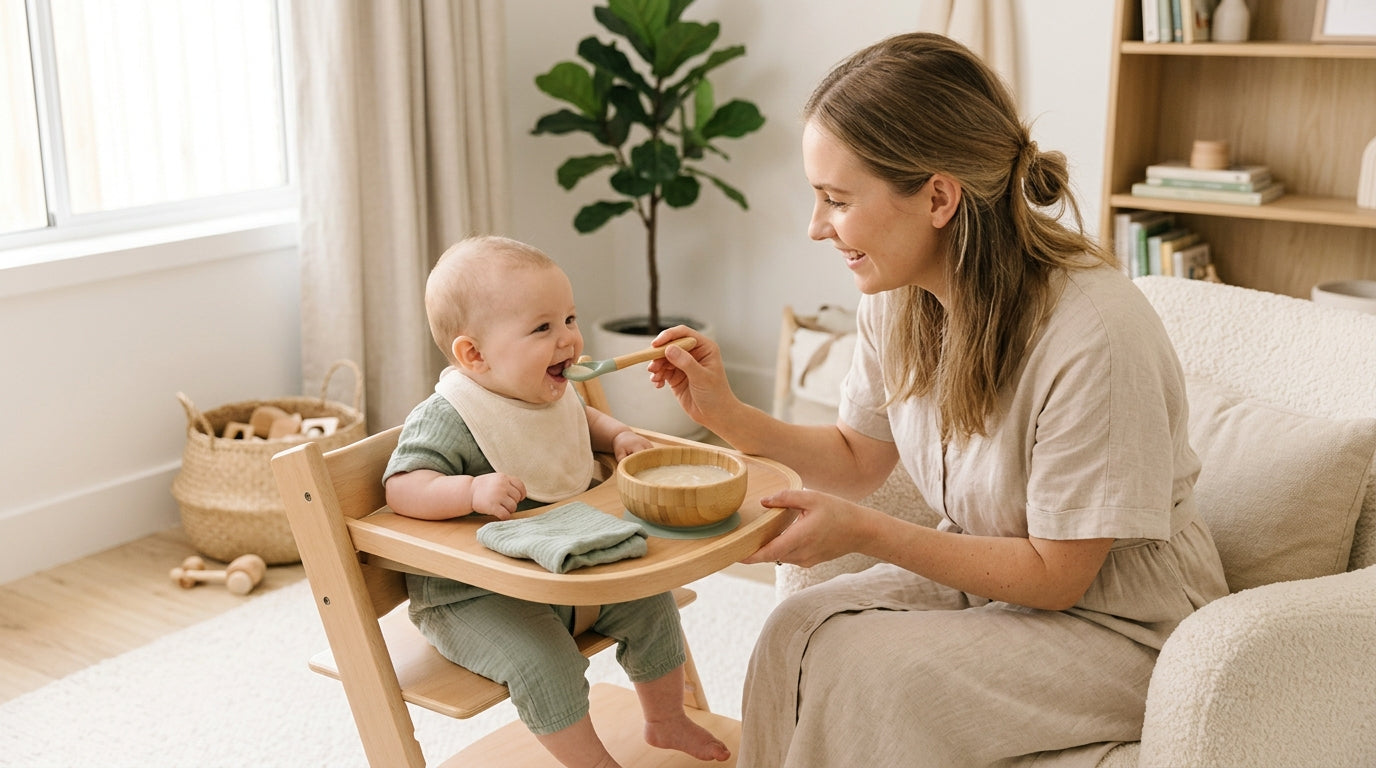
My mother-in-law was hovering by the kitchen island at two in the morning, holding a cardboard box of generic infant flakes and shaking it at my husband like it was a maraca. She whispered that if we just put a scoop in his bottle, he would sleep through the night. It's what they did with my husband, she reminded us for the fourth time that week, and he turned out fine.
I was too tired to explain the intricacies of infant digestion. I just stared at the box, calculated the choking risk in my head, and went back to warming the breastmilk.
There's this generational obsession with baby rice. For decades, it was the undisputed champion of first foods. You had a baby, you waited a few months, and then you mixed this bland, dusty powder into a bottle or a bowl to bulk them up. It was practically a cultural mandate. But modern pediatrics has completely changed the script on this, and honestly, trying to explain it to the older generation is like talking to a brick wall.
Listen. If you're standing in the grocery store aisle right now, staring at fifty different types of boxed grains and wondering if you're going to ruin your child by picking the wrong one, put the box down. The transition to solids is already a logistical nightmare without the added guilt of heavy metal exposure.
The bottle sludge situation
Let's talk about the cereal in the bottle myth. I've triaged a thousand coughing, sputtering infants in the pediatric ER, and you'd be shocked how many of them were choking on a thick sludge of formula and dissolved grains. People think it's a magic sleep hack. It's not.
My pediatrician, who has the bedside manner of a tired mechanic, told me point-blank that adding cereal to a bottle is basically pouring wet cement down a very narrow pipe. Babies have a delicate swallowing mechanism. When you thicken their milk, they get confused. They're expecting a liquid, and suddenly they're aspirating a semi-solid mass.
Aside from the choking hazard, it just makes them gain weight too fast in a way that's not healthy. They bypass the whole biological process of learning how to move food around in their mouth. Unless a doctor specifically tells you to do it for severe reflux, just keep the food and the milk completely separate. Your baby will sleep through the night when their neurological system is ready, not because you stuffed their stomach with carbohydrates.
The dirt on heavy metals
Then there's the arsenic issue. I remember reading the reports and feeling like someone was playing a cruel joke on parents.
Rice is basically a sponge. It absorbs inorganic arsenic from the soil and water way more efficiently than other crops. Arsenic is a carcinogen, and because babies are tiny, their intake relative to their body weight is massive. My doctor handed me a pamphlet about FDA limits and parts per billion, but my brain sort of shut off after the word neurotoxin.
The irony is that brown rice, which we've all been conditioned to believe is the holy grail of health food, is actually worse for babies. Apparently, the arsenic concentrates in the outer bran layer. So the highly processed white rice is technically safer from a heavy metal standpoint. It makes zero sense, but that's parenting in a nutshell. You try to do the organic, wholesome thing, and it turns out you're just feeding them more toxins.
The medical consensus right now is not to panic if your baby had a bowl of rice last week. It's safe in moderation. The problem is when it becomes the only grain they eat, multiple times a day, for months on end.
Figuring out when they're actually ready
Everyone is in such a rush to feed their babies real food. You see a four-month-old on social media eating a piece of avocado, and suddenly you feel behind.

There's this biological mechanism called the tongue-thrust reflex. When babies are tiny, their tongue automatically pushes anything foreign out of their mouth to prevent choking. If you try to feed a baby who still has this reflex, you're just going to spend twenty minutes scraping cereal off their chin and putting it back in their mouth. I did this exactly once before realizing how pointless it was.
They need to be around six months old. They should be sitting up with minimal support and holding their head steady. If they look like a wobbly drunk person in the high chair, they're not ready for solids.
The realities of the high chair
When we finally started real food, I thought it would be cute. I bought wooden bowls. I envisioned peaceful mornings of spoon-feeding. Instead, it was an absolute massacre of flying purees and sticky hands.
I eventually gave up on the aesthetic wooden bowls and bought the Walrus Silicone Plate. I usually hate animal-shaped feeding gear because it feels unnecessary, but I was desperate. The suction base on this thing actually works. My son spent a good ten minutes trying to pry it off the high chair tray, got mad, and then finally surrendered and ate his food. It has deep sections so I can separate the oatmeal from the fruit, mostly because mixing them looks disgusting. It survives the dishwasher, which is my only real requirement for anything that enters my kitchen at this point.
If you're wading into the chaotic waters of first foods, you might want to look at some of Kianao's solid food and finger food essentials. Just accept that your floor will be dirty for the next two years.
Other things you can feed them
Since we decided to skip the daily rice routine, we had to find alternatives. There's no biological law that says a baby has to start with rice.

We went with oat cereal. It mixes the exact same way. One tablespoon of the powder, four or five tablespoons of breastmilk or formula, mixed until it looks like thin wallpaper paste. Barley and quinoa work too, and they carry a fraction of the heavy metal risk.
If you really want to cook whole rice for your kid, my nurse friends swear by this exhausting boiling method. You use a four-to-one water-to-rice ratio, boil it for five minutes, dump the toxic water out, add fresh water, and simmer it. It supposedly removes half the arsenic. Personally, I don't have the energy to perform water-ratio alchemy on a Tuesday night. I just serve oats.
Also, a quick medical sidebar about rice. It's hypoallergenic, which is why everyone loves it. But there's a rare condition called FPIES. It's a delayed allergic reaction that rice can trigger, where the kid just starts vomiting violently hours after eating it. I saw a case once during my pediatric rotation. It's terrifying because you don't associate it with the food they ate four hours ago. Just file that away in your anxiety bank.
Managing the sensory mess
Feeding a baby is less about nutrition and more about sensory tolerance. They're going to smear it in their hair, their eyes, and their armpits.
I stopped trying to keep his clothes clean. I strip him down to his Organic Cotton Baby Bodysuit for every meal. It's sleeveless, so I don't have to scrub oatmeal out of the cuffs, and the organic cotton seems to handle the constant washing without falling apart. The envelope shoulders are great because when he inevitably covers himself in puree, I can pull the whole thing down over his legs instead of dragging sweet potato over his face.
He is also teething at the same time he's learning to eat, which is a cruel biological overlap. Half the time he just wants to chew on the spoon. We keep the Panda Teether on the table. It's just a flat piece of silicone shaped like a bear, nothing groundbreaking, but he gnaws on it between bites when his gums are bothering him. It's fine. It does the job and I can throw it in the sink with the dishes.
What you honestly need to remember
The transition to solid food is heavily marketed to make you feel incompetent. You don't need a special blender. You don't need to buy specific brand-name flakes. You definitely don't need to alter your baby's milk to trick them into sleeping.
Ditch the outdated advice, grab some oatmeal or mashed avocado, and just follow your baby's lead. Keep the milk in the bottle, the food on the plate, and a wet towel nearby. It will be messy, they'll probably hate the texture of everything for the first two weeks, and then one day they'll just figure it out.
Before you dive into the kitchen chaos, check out Kianao's complete collection of baby feeding gear and organic essentials to make the process slightly less painful.
The messy questions everyone asks
How do I get my mother-in-law to stop putting cereal in the bottle?
You blame the pediatrician. Don't try to argue the science of infant digestion with someone who raised kids in the nineties. Just say your doctor was incredibly strict about it and threatened to lecture you at the next appointment. Throw the medical establishment under the bus. We're used to it.
Can I just give my baby regular leftover rice from our dinner?
Uncooked rice has these bacterial spores that survive the cooking process. If you leave cooked rice sitting on the stove or in the fridge too long, those spores multiply and cause serious food poisoning. If you're feeding leftover rice to a baby, make sure it was cooled quickly, stored properly, and eaten within a day. Never reheat it more than once.
If brown rice is so toxic, should adults stop eating it too?
We have much larger body masses, so our risk is lower. But yes, brown rice does hold more arsenic. If you eat it every single day, you might want to switch to white basmati or sushi rice occasionally. The arsenic thing is not just a baby problem, they're just more vulnerable to it because they weigh fifteen pounds.
My baby spits out everything I feed them, are they broken?
They're just confused. They have spent six months drinking a warm, sweet liquid, and now you're shoving a cold silicone spoon full of bland paste into their mouth. They probably still have the tongue-thrust reflex. Give it a break for a few days and try again.
What's the actual difference between baby oatmeal and regular oatmeal?
The baby version is milled into a finer powder so it mixes smoothly with milk, and it's fortified with iron. Babies run out of their natural iron reserves around six months, which is why fortified cereals are pushed so hard. You can blend regular rolled oats into a powder yourself, but you'll need to find another way to get iron into their diet, like pureed meats or beans.




Share:
The Only Survival Gear You Actually Need for a Newborn
Why The Baby Rubber Plant Is Perfect For Your Nursery