

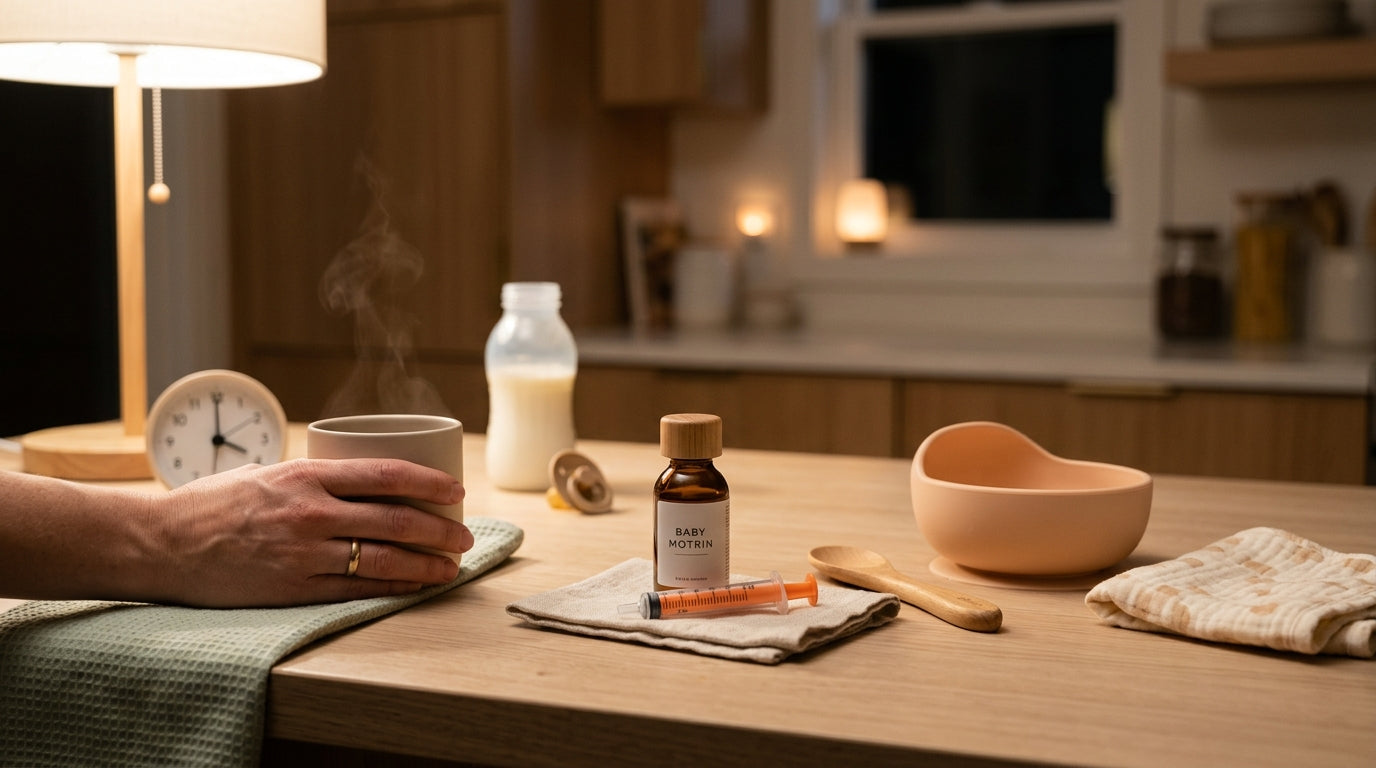
There's a highly specific, deeply stressful kind of maths you only ever do at 3:17 in the morning, standing barefoot on a cold kitchen tile while a tiny, feverish human wails from the nursery. I usually have a sticky bottle of liquid ibuprofen in one hand, my phone flashlight wedged awkwardly under my chin, and I'm squinting at a plastic syringe where the printed measurement lines have aggressively rubbed off. My American mother-in-law calls it baby Motrin, we usually call it Nurofen or just liquid ibuprofen here in London, but the universal truth remains the same: trying to calculate liquid medicine ratios in the dark while operating on two hours of sleep is a form of psychological torture.
You'll probably feel the desperate urge to just guess the amount based on what looks right or blindly trust the age chart on the back of the box, which I highly suggest you avoid doing.
The lie printed on the side of the box
Let's just smash the biggest myth of the pediatric pharmaceutical industry right now. The colourful chart on the packaging pretends the dose is based on age. It completely isn't. The side of the packet will cheerfully suggest that a one-year-old gets a certain amount and a two-year-old gets another, completely ignoring the rather important fact that my twin girls, born three minutes apart, have a massive two-kilo weight difference.
My GP—who looks like she hasn't slept a full night since 2018 either—told me to throw the age chart straight out the window. It's entirely about weight. You have to figure out the dosage for infant Motrin by their actual weight because that's how their tiny organs process the active ingredients. When you blindly guess the baby's Motrin dose based on their last birthday, you're either under-dosing them (meaning the fever won't break and absolutely nobody is going back to sleep) or you're giving them dangerously too much. Grab a scale, weigh your squirming child like a sack of potatoes, and write that number directly on the fridge in permanent marker so you don't forget it during the next midnight panic.
The mysterious six-month kidney upgrade
There's an incredibly strict, non-negotiable rule about not giving ibuprofen to a baby under six months old. When we were in the thick of the four-month sleep regression and Twin A developed her first minor fever, I foolishly thought she was practically half a year old and a few weeks wouldn't matter.
Turns out, it matters quite a lot. My pediatrician practically leapt through the telephone to stop me from opening the bottle. From what I can gather through my highly imperfect understanding of infant biology, their little kidneys are basically running on a beta version of their operating system until exactly six months of age. Before that magical milestone, giving them ibuprofen is apparently like putting premium unleaded petrol in a rusty toaster. They just can't process the harsh anti-irritated properties safely. So before they hit half a year, it's just paracetamol (or Tylenol, if you're stateside), and only after that six-month mark is the glorious, long-lasting, fever-reducing magic of baby M finally unlocked for your use.
The infant drops versus children's liquid trap
I'm going to rant about this specific issue for a minute because it nearly caught me out, and it's objectively ridiculous. You would logically assume that "Infant Drops" are a weaker, watered-down version of "Children's Liquid." They're babies, right? They need the mild stuff. They're fragile.

Wrong. It's the exact opposite, and it's genuinely terrifying.
Infant drops are incredibly concentrated because babies are absolutely terrible at swallowing things they don't want to swallow. To get the required milligrams of ibuprofen into a tiny mouth before they do an alligator death roll and spit it all over your clean shirt, the medicine is packed into a minuscule volume of liquid. The children's version is actually much more diluted because a three-year-old can theoretically swallow a whole spoonful of grape-flavoured syrup without gagging. If you accidentally grab the ultra-concentrated infant drops but measure out the larger volume you'd normally use for the children's liquid, you're giving them a massive overdose. I literally keep the two different concentrations on separate shelves in the kitchen cupboard now, divided by a physical wall of Calpol bottles, just to save my sleep-deprived brain from making a tragic error at dawn.
The thirty-minute gap of despair
Here's the harsh reality of baby medication that the cheerful adverts gloss over: it takes about thirty to forty minutes to actually kick in. When a baby is cutting a molar and screaming so loudly the neighbor's dog starts howling in solidarity, thirty minutes feels like a geological era. You can't just squirt the sticky orange liquid into their mouth and expect instant, blissful silence.
This is the exact window where you need physical distractions. I'll be completely honest here—Twin A absolutely obsessed over the Panda Teether Silicone Baby Bamboo Chew Toy when her front teeth finally breached the gums. We'd throw it in the fridge for ten minutes, and the cold silicone seemed to numb her mouth just enough to quiet the screaming while we paced the hallway waiting for the medicine to absorb into her bloodstream. Twin B, on the other hand, just chucked it at the cat. Kids are a mystery. But for the twin who liked it, it was a massive sanity saver because the flat design meant she could actually grip it herself instead of demanding I hold it for her while she chewed on my knuckles.
Sometimes you just have to distract them from the misery of existing with a fever. We own the Gentle Baby Building Block Set, which are perfectly fine as toys go. They're soft rubber, so nobody is getting a concussion when a tower inevitably collapses onto a sibling's head. During the day, they're decent for keeping a sick, cranky baby occupied on the living room rug. But I won't lie to you—at three in the morning when everyone is crying and covered in drool, nobody is building an architectural masterpiece. We just kick them under the sofa until morning and go back to pacing.
The desperate paracetamol and ibuprofen tango
When a fever is being particularly stubborn, doctors will sometimes casually mention that you can alternate between paracetamol and ibuprofen to keep the temperature down. This sounds brilliant in theory, but in practice, it requires the logistical coordination of an air traffic controller.

Because ibuprofen is processed by the kidneys and lasts about six to eight hours, and paracetamol is processed by the liver and only lasts four to six hours, you're constantly running two different overlapping countdown timers in your head. I ended up looking like a madman, writing "T - 2am" and "M - 6am" in sharpie on the back of my hand. If you don't physically write it down, I promise you'll forget who had what medication and at what time. Don't rely on your memory when you're functioning on lukewarm instant coffee and sheer willpower.
If you're currently surviving the teething trenches and need more tools to maintain your fragile sanity, have a look through our teething relief collection for things they can safely gnaw on while you wait for the drugs to work.
The post-fever sweat puddle
Nobody warns you about what happens when the medicine genuinely does its job. The fever "breaks," which is a polite, clinical term for "your child will suddenly sweat through absolutely everything they're wearing and their sheets will feel like a damp swamp."
It's thoroughly disgusting, but it means they're finally getting better. You have to change their clothes, but if you wake them up too much during the process, you've completely ruined the hard-won peace. I highly suggest having them sleep in something extremely breathable and easy to yank off in the dark, like the Organic Cotton Baby Bodysuit. The organic cotton breathes a million times better than those cheap synthetic pajamas we were gifted by well-meaning relatives, so the sweating isn't quite as bad in the first place. Plus, the envelope shoulders mean I can pull the whole sticky, damp garment straight down over their legs instead of dragging it over their face and waking them up completely.
honestly, dealing with a sick infant is just an exercise in pure survival. You squirt the medicine in their mouth alongside some milk so it doesn't wreck their stomach (which my GP mentioned super casually as an aside, though it seems like incredibly vital information). You watch the clock tick by. You rock them until your arm goes completely numb. And you try your absolute best not to panic.
Ready to stock up before the next inevitable midnight fever spike? Check out our sustainable baby essentials to get your medicine cabinet and nursery properly equipped for the worst-case scenario.
The sleep-deprived parent's FAQ
Can I just mix the liquid into a bottle of milk?
My doctor sighed heavily when I asked this exact question. Technically, yes, mixing it into formula or breastmilk might hide the awful artificial berry taste. But if your kid only drinks three-quarters of the bottle and then aggressively falls asleep, you now have absolutely no idea what fraction of the dose they seriously ingested. Did they get enough to lower the fever? Nobody knows! So it's best to squirt it straight into the side of their inner cheek, let them swallow, and offer the milk right after to wash it down.
Do I've to wake them up to give them another dose?
I'm violently opposed to waking a sleeping baby under any circumstances. If they're sleeping peacefully in their cot, their body is resting and the fever probably isn't bothering them enough to warrant waking them up just to shove a plastic syringe in their mouth. Let them sleep. You go sleep, too. The fever will still be there to deal with when they naturally wake up.
What if they immediately vomit it back up?
Ah, the classic infant refund. If it happens within roughly five minutes, my pediatrician said you generally have to give the dose again because none of the medicine had time to absorb into their system. If it's been twenty minutes or more, you've entered a terrifying gray area where you just sort of wait and see if their fever goes down on its own. I highly suggest calling your own doctor on that one, because guessing isn't particularly fun when vomit is involved.
Why did the doctor say to give it with food?
Because ibuprofen is an NSAID, which is a fancy medical acronym that basically means it can be incredibly harsh on an empty stomach lining. If you give it to them without milk or a snack, you might successfully fix the fever but end up with a crying baby who now has a terrible tummy ache instead.
Can I use a regular kitchen teaspoon to measure it out?
No. Absolutely not. The teaspoons in my cutlery drawer range in size from "dollhouse miniature" to "small shovel." They aren't standardized in the slightest. Stick to the plastic syringe that came in the specific box you're using, even if you've to squint terribly to read the fading numbers under the fridge light.




Share:
Surviving the Baby Mozart Delusion With Two Extremely Loud Twins
Why That Cute Baby Moose Is Actually A Hiking Nightmare