

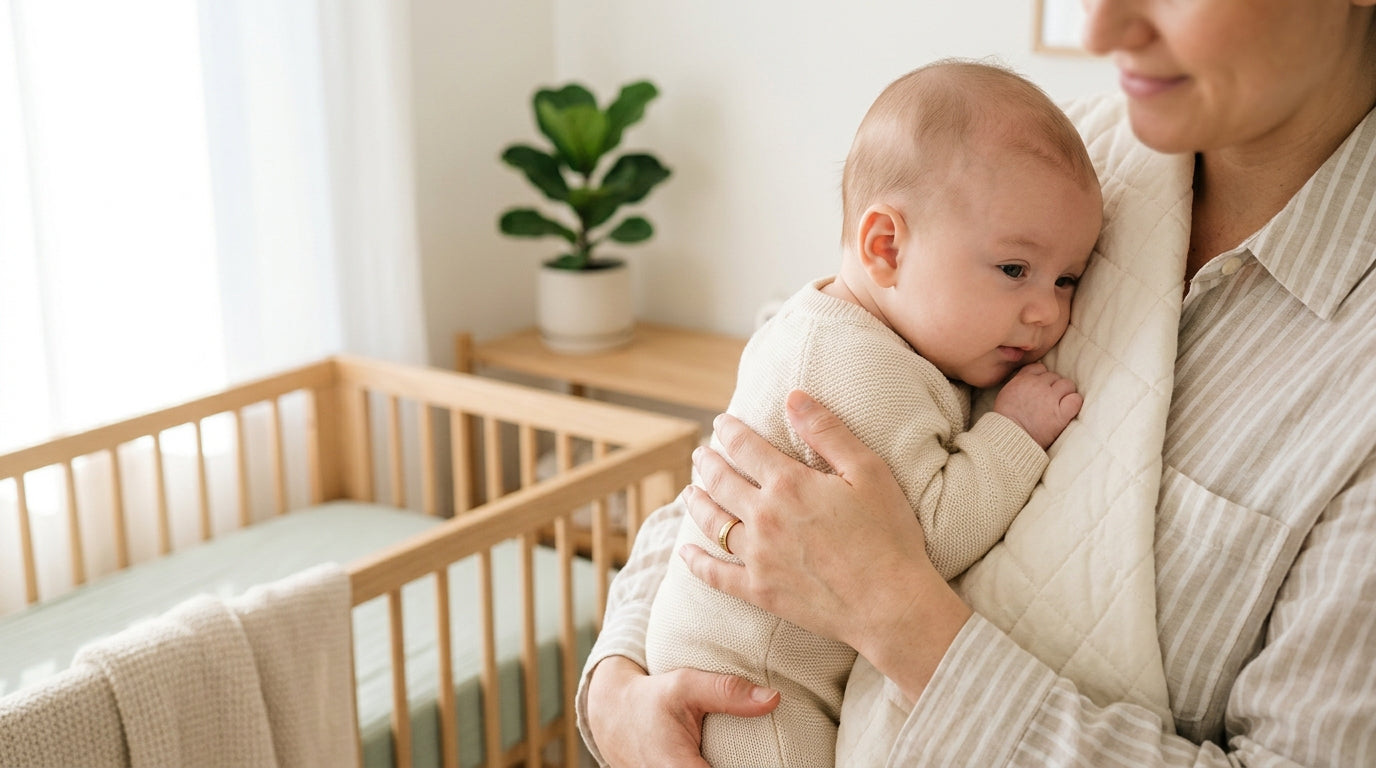
I was sitting cross-legged on our hideous beige living room rug at 2:14 PM on a Tuesday, wearing maternity sweatpants that hadn't seen the inside of a washing machine since my water broke. Leo was exactly three weeks old and asleep on my chest, and I was staring at his little face, which had suddenly erupted overnight into something resembling a hormonal teenager working a deep-fryer.
I'm not exaggerating. He looked like a tiny, angry tomato. My perfect, pristine newborn who had just been photographed looking like a glowing angel three days prior was suddenly covered in angry red bumps, and I was spiraling. Naturally, I consulted everyone.
My mother-in-law had just called to tell me it was because I was eating too much dairy, which made me want to throw my phone into the ocean because cheese was the only thing keeping me alive. An hour before that, my lactation consultant texted me to literally rub my breastmilk all over his pimples. And the day prior, the FedEx guy—who caught me openly weeping while signing for a bulk package of diapers—told me to slather him in coconut oil. Like, what the hell?
I was so tired my teeth hurt, clutching my third lukewarm coffee of the day, just desperately scrolling on my phone trying to figure out when the newborn breakouts clear up, because nobody warns you about this part. They tell you about the sleepless nights and the explosive poop, but they completely skip over the part where your kid's skin goes completely haywire.
Anyway, the point is, if you're currently staring at your baby's bumpy face and silently panicking that you did something wrong, you didn't.
The timeline nobody actually prepares you for
So I ended up hauling Leo to our pediatrician, Dr. Gupta, because I was convinced I had ruined his skin forever with the laundry detergent I used. She took one look at him, laughed a little bit at my sheer panic, and told me it was completely normal.
She tried to explain the science to me, but I was running on maybe four hours of broken sleep, so I only grasped half of it. Apparently, it has something to do with my hormones? Like, the hormones from my pregnancy were somehow still coursing through Leo's tiny veins, overstimulating his oil glands. Or maybe it was an irritated reaction to some kind of yeast that naturally lives on the skin. She said a bunch of medical words that sounded like a spell from Harry Potter, but the main takeaway was that it wasn't my fault.
But of course, I immediately wanted to know exactly how long this was going to last. She told me that standard neonatal acne—which is what Leo had, the kind that shows up around two to four weeks—usually clears up on its own by the time they hit three or four months old. Three or four months! I nearly choked on my spit. That sounded like an eternity when I was measuring time in two-hour feeding increments.
But then she warned me about the other kind. She said if he was getting new, deep, severe pimples after six weeks of age, that's when we needed to look at it differently, because that's considered infantile acne. Infantile acne is much rarer and can stick around for like, a year, and sometimes leaves scars, so you actually have to get a pediatric dermatologist involved. I remember my husband Dave frantically pulling out his phone in the exam room trying to calculate exactly how many days old Leo was, muttering under his breath. Men are so dramatic.
My breastmilk is not a magical skin potion
Let me just rant for a second about the whole breastmilk thing.

The internet is absolutely obsessed with breastmilk as a cure for everything. Pink eye? Breastmilk. Ear infection? Breastmilk. Mortgage rates too high? Probably breastmilk. So when three different people told me to put it on Leo's face, I thought, okay fine, it's free, I'll try it. I expressed some milk into a tiny plastic medicine cup and gently dabbed it onto his cheeks with a cotton ball while he was sleeping.
You guys, it did absolutely nothing except make him incredibly sticky. He woke up an hour later, rubbed his face against my dark gray t-shirt, and left a crusty white streak across my shoulder. And worse, the milk dried in his little neck rolls and started to smell like old cheese by the end of the day. Dr. Gupta actually rolled her eyes when I confessed I had tried it, mentioning that there's no real medical proof it helps and the sugars in the milk can sometimes just feed the yeast on their skin and make the soreness worse.
Please don't put coconut oil on your newborn
I also tried the FedEx guy's coconut oil trick once because I was desperate, and it just clogged Leo's pores ten times worse and made him slippery like a greased pig, so seriously just skip the heavy oils entirely.
Things that honestly sort of helped us survive the bumpy phase
So if you can't use adult acne cream (oh god, please never put salicylic acid on a baby, their skin is paper-thin) and you shouldn't use milk or oil, what do you do? Honestly, mostly you just wait. But I did learn pretty quickly that reducing friction and keeping things clean made the bumps look way less angry.

When Maya was born a few years later, she had the exact same breakouts. By then I was a seasoned veteran and didn't panic. But she had insanely sensitive skin. Someone had gifted us this cheap, fuzzy polyester blanket from a big box store, and I noticed that whenever I laid her down on it, her face would get bright red and the pimples would flare up immediately. It wasn't breathable at all and was just trapping all her body heat and spit-up against her cheeks.
I ended up tossing it in the back of the closet and switching entirely to the Blue Flowers Spirit Bamboo Baby Blanket. I'm generally pretty skeptical of expensive blankets, but this one honestly saved my sanity. It's woven from organic bamboo fibers, so it's ridiculously soft, but more importantly, it's temperature-regulating. It didn't trap her sweat. Whenever she was having a bad skin day, I'd just lay this blanket down on the floor or over her lounger, and because bamboo is naturally hypoallergenic and smooth, it didn't irritate the breakouts at all. Plus, the blue floral pattern is just really pretty, which is a nice bonus when everything else in your house is covered in milk stains. I still use it as a light throw for her now, three years later.
Speaking of keeping things natural, if you're overhauling your nursery to get rid of scratchy synthetics, you should explore the whole organic blanket collection because getting the harsh fabrics away from their face is half the battle.
Another huge issue we had was that both my kids loved to violently rub their faces when they were tired. They have these tiny, razor-sharp fingernails that grow at the speed of light, and they would scratch the little pustules and make them bleed. I tried mittens, but Leo figured out how to rip them off by week four.
So I started giving him things to hold to keep his hands occupied while he was awake. We got the Panda Silicone Baby Teether. Honestly? It's fine. It's just a silicone teether. It works, it's easy to wash, and it doesn't harbor mold like those gross hollow rubber toys. Leo mostly just used it to hit the dog, but when he did genuinely hold onto it, it kept his little daggers away from his face long enough for the redness to calm down. It didn't change my life, but it served its purpose.
What did genuinely help a lot was keeping them off my chest 24/7. When they sleep on you constantly, your body heat makes them sweat, and sweat makes the breakouts worse. I needed a safe place to put Leo down where he wouldn't scream, so his skin could literally just breathe.
Dave ordered the Nature Play Gym Set, and my husband absolutely loved this thing because it wasn't made of obnoxious neon plastic that played aggressive electronic music. It's just this beautiful, minimalist wooden A-frame with these soft, botanical-inspired hanging toys. I'd lay Leo underneath it on his bamboo blanket, and he would just stare up at the little crocheted leaves and wooden beads, totally mesmerized. The cool air in the room would finally hit his face, the sweat would dry, and the bumps would look fifty percent better in half an hour. It was my designated "sweat-free zone" for him.
The doctor visit that finally calmed me down
It's so hard to look at your baby's imperfect skin and not feel like you're failing them somehow. Every time I scrolled Instagram, I was bombarded with these heavily filtered, perfectly smooth babies, and there was Leo, looking like he needed an aggressive skincare routine and a dermatologist.
But Dr. Gupta really brought me back down to earth. She told me that as long as he wasn't running a fever, the bumps weren't oozing yellow pus, and he was eating normally, I just needed to chill out. I had to learn to just gently wash his face with lukewarm water once a day, pat it dry with a super soft cloth instead of scrubbing, and accept that his skin was going to be a mess for a little while until his system balanced out.
And she was right. Right around three and a half months, Leo woke up one morning and the bumps were just... fading. A week later, his skin was completely smooth again. Maya's cleared up even faster, right around the ten-week mark. No scars, no lasting damage, just soft, squishy baby cheeks.
It's just a phase. A really annoying, highly un-photogenic phase, but a phase nonetheless.
If you're dealing with sensitive newborn skin and need to upgrade to softer, non-irritating essentials, definitely check out the organic nursery collection before their next breakout.
The messy questions everyone asks
Can I pop the whiteheads on my baby's face?
Oh god, please don't do this. I know it's incredibly tempting, especially if you're a habitual pimple-popper yourself (no judgment, Dave is the same way). But Dr. Gupta specifically warned me that popping them pushes bacteria deeper into their very fragile skin. It hurts them, it causes severe soreness, and it can honestly lead to a terrible infection or permanent scarring. Just leave them alone, even when they look super "ready."
Does this mean my kid is going to have terrible skin in high school?
I asked this exact question because Dave had terrible acne as a teen and was convinced he passed on a curse. But apparently, there's zero correlation. Having newborn breakouts doesn't mean your child is destined to be the spotty kid in middle school. It's strictly a temporary hormonal and yeast reaction to being born and adjusting to the outside world, totally unrelated to adolescent puberty.
Should I change my diet if I'm breastfeeding?
If I had a dollar for every time someone told me to stop drinking coffee or eating cheese to fix Leo's skin, I could pay for his college. My doctor was very clear that standard newborn breakouts are not caused by maternal diet. Unless your baby has other things to watch for of a food allergy—like bloody stools, severe colic, or an eczema rash on their body—you don't need to cut out dairy or gluten just because they've pimples on their cheeks. Eat your cheese.
How do I know if it's eczema instead of regular breakouts?
This tripped me up a lot with Maya. Basically, the newborn pimples look like actual teenage acne—red bumps, sometimes with little whiteheads, mostly on the cheeks, nose, and forehead. Eczema looks more like dry, scaly, intensely itchy red patches that can show up anywhere, including the creases of their elbows and knees. Eczema usually makes them super fussy because it itches like crazy, whereas the pimples generally don't bother the baby at all. They only bother us.




Share:
The agonizing wait for a tiny flutter: early pregnancy heartbeats
When Should A Baby Start Crawling? A Dad's Messy Timeline