

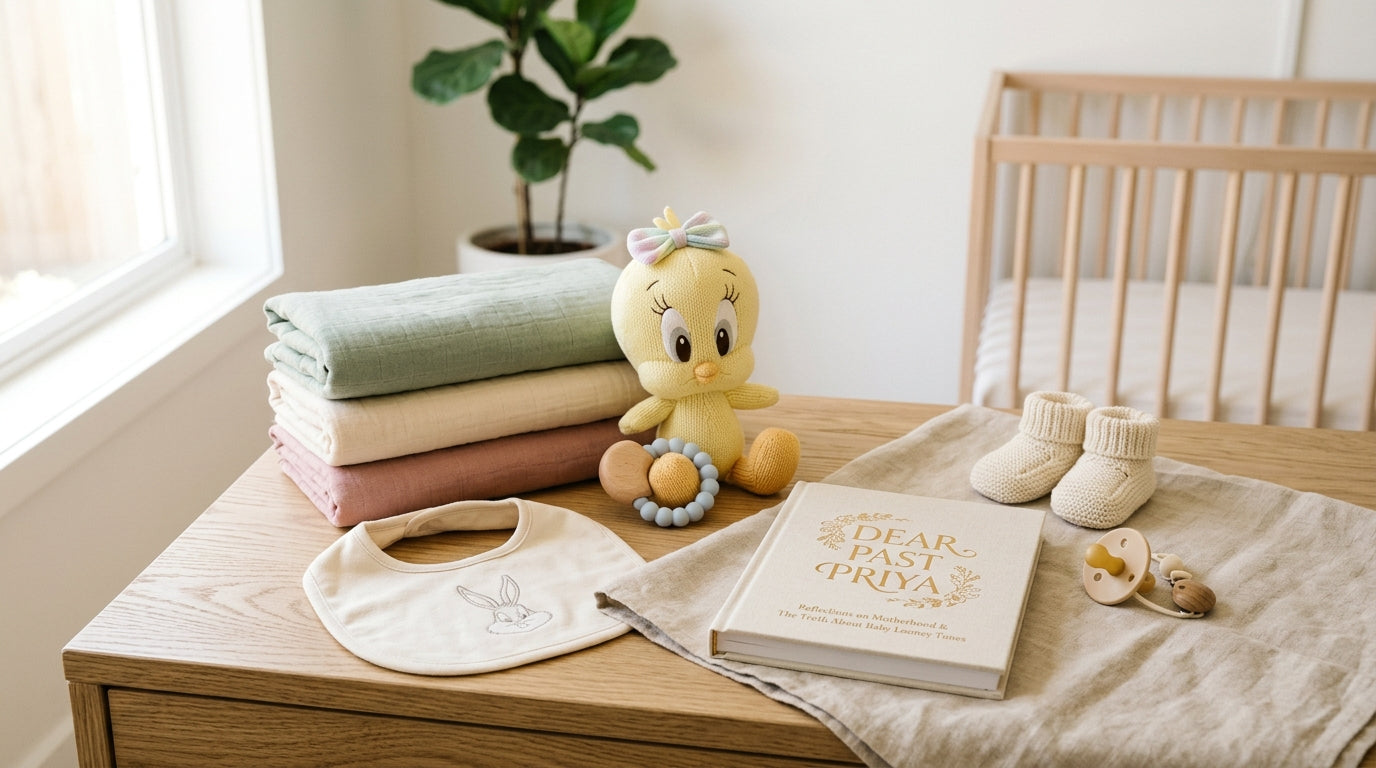
Dear Priya from last November. You're currently sitting on the floor of the nursery in our Logan Square apartment at three in the morning. The radiator is making that terrifying clanking noise again. The baby has a mild fever from teething, her cheeks are bright red, and she's thrashing around like a tiny, angry alligator. You're crying. She is crying. You're gripping your phone, staring at a blank screen, absolutely paralyzed by the guilt of potentially turning it on to distract her. You swore you'd be a zero-screen-time mother until she was at least two. You read the books. You bought the monochromatic wooden toys. You thought you were better than this.
Listen, you need to hear this from me. Put the phone down, turn on the television, and find an episode of Baby Looney Tunes. Yes, the one from 2002. Yes, the one you vaguely remember watching when you were supposed to be doing your middle school homework. Just do it, yaar. The purity complex is going to break you before her molars even come in.
I know what you're thinking. You're remembering your clinical rotations in pediatric neurology. You're thinking about dopamine receptors and shortened attention spans. But I'm writing this to tell you that all screen time is not created equal, and right now, you're treating a television like it's a biohazard. Survival is a valid parenting strategy, and sometimes survival looks like a pastel-colored cartoon rabbit learning how to share a tricycle.
The sensory assault of modern children's television
I need to talk to you about what happens when you turn on modern cartoons. I've seen a thousand of these kids in the ER waiting room, clutching iPads that are flashing at them like a Las Vegas slot machine. We call it overstimulation in the hospital, but that word is too sterile for what's actually happening. These new shows are engineered in a lab to hold a toddler's gaze hostage. The scene changes happen every three seconds. The colors are so hyper-saturated they practically burn your retinas. The music never stops, and there's always a disembodied voice shrieking a nursery rhyme at 120 beats per minute.
It's exhausting. When you put a teething, feverish baby in front of that kind of media, you're basically handing them a double espresso. Their nervous systems are already on edge. Their little bodies are fighting swelling in their gums. Bombarding them with fast-paced cuts and neon flashing lights is like walking into a crowded trauma bay and turning on a strobe light. It just makes the chaos worse. The brain can't process the visual input fast enough, so it just short-circuits. You end up with a child who's hypnotized while the screen is on, and an absolute terror the second you turn it off.
The pacing is the real crime here. There's no quiet. There's no white space. Characters don't walk from one side of the room to the other, they just teleport. It teaches the developing brain that reality is supposed to move at warp speed, which is a massive problem when they eventually have to exist in the real world where it takes ten minutes just to put on a pair of winter boots.
Skip the 2003 direct-to-video puppet special though, because those things look like sleep paralysis demons and will give you both nightmares.
Why Granny's house is a neurological safe haven
This is where Baby Looney Tunes comes in. I stumbled across it purely by accident when I was too tired to get through a streaming menu. The aesthetic of this show is something modern animation studios have completely forgotten how to do. The backgrounds are literal watercolors. The colors are muted pastels. When a character moves across the room, it actually takes them a few seconds to get there. It's slow.
My pediatrician, Dr. Gupta, told me once that the AAP guidelines about screen time are less about the screen itself and more about what the screen is replacing. She muttered something about how the research is always changing anyway, and maybe we don't really understand the long-term effects of any of this. But she did say that if you're going to use a screen, find something that mimics the pace of real life. Baby Looney Tunes does that. There are long, quiet pauses. Sometimes characters just sit there and look at each other. There's no chaotic background music forcing an artificial sense of urgency.
Granny is essentially running a pediatric triage unit in that house. She is calm, she sets firm boundaries, and she never raises her voice. She just hands out consequences with the detached professionalism of a charge nurse who has been on the floor for twenty years. It's incredibly soothing to watch as an adult who feels completely out of control.
Sweaty babies and wardrobe changes
Let's talk about that feverish, thrashing baby of yours. By the time the episode is over, her fever is going to break, and she's going to be covered in sweat. You're going to have to change her clothes in the dark.

Stop putting her in those stiff synthetic pajamas that trap heat like a greenhouse. I know they look cute, but she's miserable. My absolute favorite thing we own right now is the Flutter Sleeve Organic Cotton Baby Bodysuit. I bought it because I liked the little ruffled sleeves, but it ended up being the only thing I put her in when she's sick or teething. The organic cotton actually breathes. It doesn't cling to her when she's sweaty, and the fabric has enough give that I can peel it off her without waking her up completely. It survives the washing machine when she inevitably smears pureed sweet potato all over the collar. It's not going to cure her teething pain, but it makes the physical reality of being a hot, uncomfortable baby a little more bearable.
Plus, the lap shoulders mean when the inevitable diaper blowout happens, you can pull it down over her legs instead of over her head. I can't tell you how many times that feature alone has saved us from a midnight bath.
A masterclass in toddler pathology
If you genuinely sit and watch an episode of this show, you'll realize it's basically a textbook on early childhood behavioral psychology. The writers didn't just shrink the adult characters down, they accurately mapped out toddler personality types. It's fascinating.
Daffy Duck is a menace. He is a textbook narcissistic toddler who lacks impulse control and believes everything in the house belongs to him. He is the kid who will steal a toy directly out of another child's hands and then cry when he gets reprimanded. But the beauty of the show is that Daffy never gets away with it. The narrative always forces him to face the consequences of his actions. He has to sit in his uncomfortable feelings, apologize, and make it right.
Then you've Tweety, who's riddled with anxiety and constantly tattletaling on the others. Bugs is the smug older sibling type who thinks he knows everything. Sylvester is just trying his best but has terrible hand-eye coordination. It models actual conflict. When they fight over a toy, the show spends ten minutes working through the emotional fallout.
Explore Kianao's gentle, sustainable baby essentials for a calmer nursery environment.
Managing the actual teeth
Of course, the television doesn't fix the fact that she has two sharp little rocks trying to push their way through her gums. Screen time is a distraction, not an analgesic.
You have that whole basket of teethers you got from the baby shower. Most of them are useless. The Panda Silicone Baby Teether is the one we use. It's fine. It's not some magical artifact that stops the crying instantly, but it does the job. It's flat enough that she can really get it to the back of her mouth where the pain is, and the silicone has enough resistance to give her some counter-pressure. I usually throw it in the fridge for ten minutes while I'm setting up the cartoon. It gives me exactly enough quiet time to drink half a cup of lukewarm coffee while she gnaws on a panda's ear.
Bringing the pastel aesthetic into the real world
There's a reason the aesthetic of Baby Looney Tunes feels so comforting to us. It reminds us of a time before everything in childhood was branded, loud, and made of cheap plastic. That soft, muted world is exactly what we're trying to create in our own homes now, just with better materials.

When the screen finally goes off, you need the physical environment to match that same low-stimulation energy. This is why we eventually got rid of that massive plastic activity center that played electronic circus music every time she bumped it. We replaced it with the Wooden Rainbow Play Gym. It has the same gentle, earthy tones as the show's backgrounds. It gives her something to reach for and focus on, but it doesn't demand her attention. The wooden rings just make a quiet clacking sound. It lets her brain rest while her hands do the work. It's the physical equivalent of a slow-paced watercolor cartoon.
How to seriously use the screen
Please stop turning on the television and then running into the kitchen to aggressively scrub bottles out of guilt. If you're going to use the screen, use it as a tool.
Grab your lukewarm coffee, sit on the floor next to her while she chews on her silicone panda, and just narrate what's happening on the screen. Ask her why Daffy is being ridiculous and point out that Granny is setting a boundary, even if your baby is only eight months old and has absolutely no idea what you're saying. Co-viewing takes away the weird isolation of screen time. It makes it a shared experience. You're wrapping the media in your own voice, which softens the impact.
You're a good mother, Priya. You're tired, your clinical knowledge is currently fighting with your maternal instincts, and you haven't slept more than four consecutive hours since August. Turn on the watercolor rabbits. Let Granny handle things for twenty minutes. The dopamine receptors will be fine, and your sanity is worth the compromise.
The messy truth about screen time and teething
Is any screen time really safe for a baby under two?
Honestly, the science is a moving target and most studies group high-quality programming in with unboxing videos. My pediatrician says zero is best, but if you're losing your mind, ten minutes of a slow-paced, low-contrast show like Baby Looney Tunes is not going to ruin their frontal lobe. Just don't make it a daily crutch.
Why does my baby seem to hyper-fixate on modern cartoons but get bored with older ones?
Because modern shows are practically weaponized. They use rapid scene cuts and high-contrast colors to trigger an involuntary dopamine response. Older shows require the child to really follow a narrative at a normal human pace. If they get bored, that's honestly a good thing. Boredom means their brain is not being artificially hijacked.
How do I know if teething is causing the sleep regression or if it's just a phase?
You never really know for sure, which is the most frustrating part of this job. But if she's drooling through three bibs a day, pulling at her ears, and suddenly refusing to lie flat on her back, it's probably the teeth. The pressure changes in their head when they lie down make the gum pain worse.
Can I wash the organic cotton bodysuit in hot water to sanitize it?
You can, but you're going to ruin the elastane and it'll shrink. I wash mine at 40 degrees Celsius with a gentle detergent and line dry it. If there's a blowout, I rinse it in cold water first. Hot water just bakes the protein stains directly into the cotton fibers anyway.
At what age do babies honestly understand the behavioral lessons in these shows?
They don't grasp the moral nuance of sharing until they're closer to three. But babies are incredibly perceptive with tone and volume. They recognize that Daffy is agitated and Granny is calm. They absorb the cadence of conflict resolution long before they understand the vocabulary.




Share:
The Messy, Scary Truth About Your Favorite Baby Lounger Pillow
Why the wild baby lion parenting trend is completely exhausting