

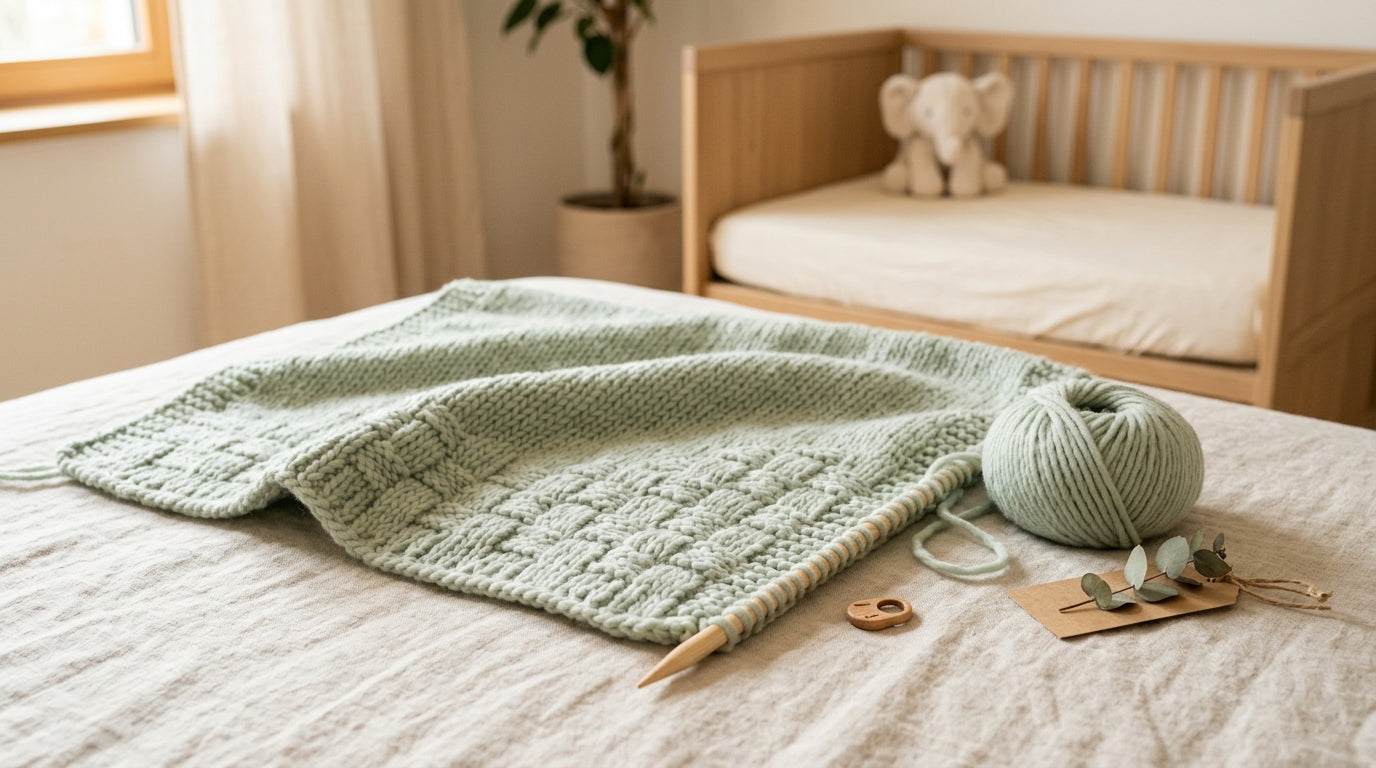
My mother-in-law slapped a skein of neon acrylic on our kitchen island and told me it was indestructible. Three hours later, the guy at the local Portland yarn shop looked at me like I'd asked to poison the water supply when I mentioned polyester. Then Dave, my coworker who acts like he invented fatherhood, swore by this fluffy angora stuff that looked exactly like a tribble from Star Trek. Three people, three completely different design specs for a simple square of fabric meant to keep a baby warm.
I'm a software engineer, which means I approach problems by gathering documentation. When it came to prepping for our baby, I figured knitting a blanket would be easy—it's basically 3D printing with a continuous filament, right? Your hardware is just two wooden sticks, and your binary code is just knits and purls. You loop the filament until you've a blanket.
My wife, who appreciates European minimalism and was tired of looking at neon American baby gear, started searching for European patterns. She fell down a Swiss rabbit hole, searching for babydecke stricken (which is literally just German for knitting a baby blanket) to find something that didn't look like a radioactive cupcake. What we found wasn't just a list of patterns, but an entirely different philosophy on infant textiles that made me realize I was about to wrap our kid in a highly flammable plastic bag.
Dr. Miller ruins my fluffy angora dreams
At our two-month checkup, our pediatrician, Dr. Miller, basically terrified me about the concept of infant thermoregulation. Apparently, babies ship with a fundamentally broken internal thermostat. They can't sweat properly to cool down, which means their firmware for temperature control is completely useless for the first few months.
She mentioned that overheating is a massive risk factor for SIDS. From what my sleep-deprived brain could understand, if you wrap a baby in non-breathable synthetic fibers, their tiny bodies just trap the heat against the fabric until their internal temperature spikes dangerously. That instantly ruled out the indestructible acrylic my mother-in-law bought. And as for Dave's fluffy angora tribble? Dr. Miller casually pointed out that babies put literally everything in their mouths. Those long, shedding fibers are a massive choking hazard and can get inhaled straight into their sensitive little respiratory systems.
So, you basically just have to throw away all the cheap yarn, buy expensive stuff from sheep that haven't been tortured, and pray you don't drop a stitch before the kid outgrows it.
Why plastic yarn is a software bug
Let's talk about acrylic yarn for a second, because I've a lot of feelings about it. Acrylic is just spun petroleum. It's wearable plastic. When you knit a blanket out of acrylic, you're essentially creating a static-charged microplastic generator.

Every time you throw it in the wash because the baby inevitably spit up on it, it sheds thousands of microscopic plastic fibers into the water supply. On top of that, it doesn't breathe at all. I tried wearing an acrylic beanie once on a hike in the Gorge and my forehead felt like a terrarium. Putting a newborn in that material is an absolute thermal nightmare.
Cotton is fine for summer if you don't mind washing it constantly and dealing with zero elasticity.
What you actually want is merino wool. Specifically, organic, mulesing-free merino. Apparently, sheep secrete this stuff called lanolin, which is essentially a natural waterproof coating. It makes the wool magically self-cleaning to an extent. When our baby spills milk on merino, it kind of just beads up, and if it does soak in, you just air it out and the smell vanishes. It's like the fabric has an auto-cache-clearing feature. Plus, it keeps stable temperature perfectly, keeping the baby warm in the winter but miraculously preventing them from overheating when the sun comes out.
If you're browsing the Kianao site looking for inspiration, you can see how they approach this whole sustainable baby blanket architecture with their natural fiber options.
The car seat compression problem
Here's a horrifying physics lesson I learned from a random late-night Reddit spiral. I used to think you just bundled the baby up and strapped them into the car seat. But any thick material sitting under the harness compresses instantly during a crash impact.
If you've a bulky blanket tucked under the straps, the crash force flattens the material, the straps are suddenly two inches too loose, and your kid becomes a projectile. It's a fatal flaw in winter travel logic.
While looking into the whole moderne babydecke stricken aesthetic, I found a genius European hack. You literally knit a buttonhole slit right into the middle of the blanket. You strap the baby into the seat normally so the harness is tight against their chest, then you pull the buckle through the slit in the blanket and snap it. The baby gets the full warmth of the blanket over the straps, and the crash physics simulation doesn't end in disaster. It's such a simple patch to a critical safety bug.
Binary code with wooden sticks
Actually executing the whole babydecke strick process is where my hubris caught up with me. I figured I'd knock out a blanket in a weekend. I was wrong. Knitting takes a highly unreasonable amount of time.

If you're looking for a babydecke stricken anleitung gratis (a free pattern), I highly advise against anything involving cables, lace, or multiple colors. You want the Garter stitch. It's literally just the "knit" stitch repeated infinitely. It's a loop. `while(true) { knit(); }`. It creates this incredibly squishy, textured fabric that won't curl up at the edges like a cheap poster.
- The size constraints: Don't make it too big. A 50x50 cm square is perfect for a stroller or car seat. If you go up to 80x100 cm, you're building a crib blanket, which is going to take you until the kid is in college to finish.
- The hardware specs: Don't use straight needles. The weight of a growing blanket on straight needles will destroy your wrists. Get an 80cm circular needle. The cable holds the weight of the project in your lap, which is way more ergonomic.
- The tension issue: I knit extremely tight when I'm stressed. My first few rows looked like bulletproof Kevlar. You have to actively relax your hands, which is difficult when the baby monitor is flashing orange.
What to do when your compiler crashes
Look, around week three of trying to knit this thing, I dropped half my stitches off the needle, couldn't figure out how to pick them back up, and aggressively threw my bamboo needles into the laundry basket. I surrendered.
If you hit that wall, I highly suggest just buying the Kianao Knitted Merino Baby Blanket. We bought it in the oat color after my DIY project failed. It's wildly soft, it actually breathes, and surviving a blowout just required wiping it down and letting the wool's weird natural self-cleaning properties handle the rest. I legitimately wish they made it in adult sizes. It's my favorite piece of gear we own.
On the flip side, we also tried their Organic Cotton Swaddle. It's perfectly fine. It does the job of wrapping the baby up like a burrito, but it wrinkles if you look at it wrong and just doesn't have that heavy, comforting squish of the merino blanket. It's good, just not life-changing.
Ultimately, whether you manage to manually compile a blanket out of raw yarn yourself or you outsource the production to people who really know what they're doing, the material is what matters. Stick to natural fibers. Avoid the plastic. And seriously, look into that car seat slit hack.
If you're ready to bypass the knitting-induced carpal tunnel entirely, grab a proper merino wool layer that's already built right.
The messy FAQ about making baby blankets
Does the yarn material seriously matter that much?
Yeah, horribly so. I thought it was just a snobby crafting thing, but apparently, acrylic traps heat and sheds microplastics, while fuzzy stuff like angora can literally get stuck in your baby's throat. Sticking to smooth, organic merino wool or organic cotton is the only way I can sleep at night without worrying about them overheating.
How big should I make this thing?
If you're making it for a newborn in a car seat, aim for around 50x50 cm. If you go much bigger, it just drags on the floor and gets caught in the stroller wheels. I tried to make an 80x100 cm one and gave up at roughly 14%. Keep the scope small for version 1.0.
Can I just use the straight needles my grandma gave me?
I mean, you can, if you hate your wrists. Straight needles force you to hold the entire weight of the blanket in your hands. Circular needles let the bulk of the fabric rest in your lap on the plastic cable. It's a massive hardware upgrade.
What happens if I drop a stitch?
You panic, obviously. Or you watch a grainy YouTube video from 2008 where a very patient woman explains how to use a crochet hook to pull the loop back up. If you're using fuzzy yarn, you won't even see the dropped stitch. If you're using smooth merino, it looks like a glaring typo in your code.
Is wool going to give my kid a rash?
That was my biggest fear, but there's a huge difference between the scratchy wool sweaters from the 90s and high-quality merino. Good merino is incredibly fine and soft. Unless your baby has a specific, rare lanolin allergy, it's generally considered hypoallergenic and much safer for sensitive skin than synthetic dyes on polyester.




Share:
The Truth About Building a Target Registry for Your Baby
Finding the Best Kinder Spielzeug Without Losing Your Mind