

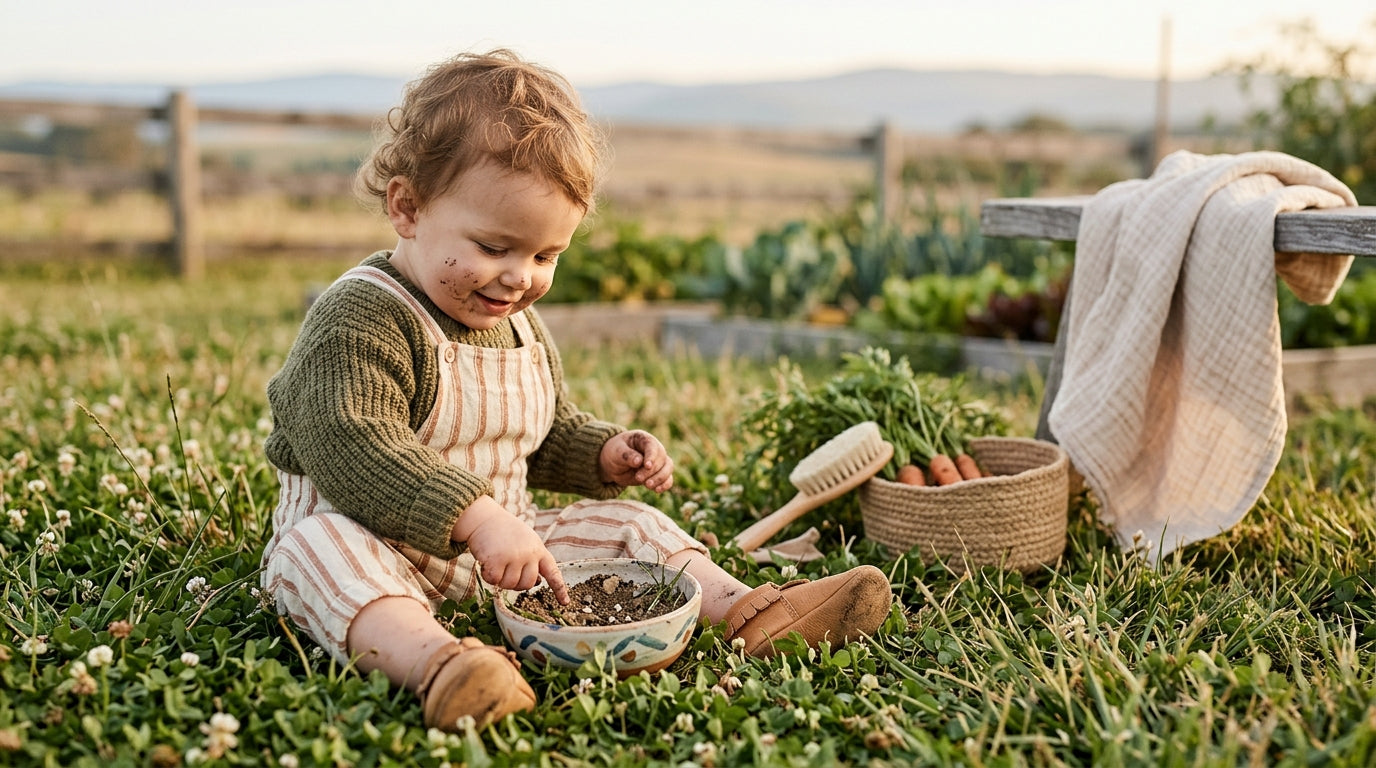
I'm sitting on a slightly damp bench in Lincoln Park watching my fourteen-month-old son actively consume a handful of topsoil. He pauses to chew, looks thoughtfully at a passing golden retriever, and goes back for seconds. A year ago, I'd have sprinted across the grass with a handful of chlorhexidine wipes and a panic attack. Today, I just take a sip of my cold coffee and wonder if earthworms count as a lean protein. This is what personal growth looks like.
My transition from a sterile, terrified first-time mother to someone who casually embraces the farm baby aesthetic wasn't graceful. It was forced upon me by sheer exhaustion and a pediatrician who was tired of looking at my meticulously logged symptom charts.
The late night algorithm trap
Before we get into the medical merits of dirt, I need to address the absolute landmine that's searching for nature-inspired baby content on the internet. A few months ago, I was looking for some wholesome, sensory television for my son. I had this vision of him watching cows chew cud while I drank a hot beverage in peace.
Listen, if you type baby farm netflix into your search bar at two in the morning, you won't get cute animations of piglets. You will get true crime. The algorithm assumes you're a millennial woman with a morbid curiosity, so it bypasses the nursery rhymes and serves up historical documentaries about Victorian baby farming. I spent three hours reading about how nineteenth-century women took in infants for cash and subsequently abandoned them. It's a deeply dark corner of history that I was entirely unprepared for postpartum.
I then checked baby farm rotten tomatoes just to see if the documentaries were even medically accurate or just sensationalized trauma porn. The reviews were bleak. It turns out the phrase baby farm has two entirely different meanings depending on whether you're shopping for organic onesies or looking for a thriller to ruin your weekend. If you're just trying to find videos of baby farm animals to teach your kid what a sheep says, type carefully. The internet is a dark place, yaar.
My negative pressure apartment
To understand why I now let my son marinate in mud, you've to understand my background. I spent five years working on a pediatric floor. I know exactly what RSV sounds like when a six-month-old is retracting. I know the distinct, metallic smell of rotavirus. My brain is basically a medical encyclopedia of worst-case scenarios.
When I brought my son home to our Chicago apartment, I treated the place like an infectious disease ward. Visitors were instructed to scrub up to their elbows like they were prepping for a craniotomy. Pacifiers that grazed the carpet were sent straight to a boiling water bath. I was determined to keep his environment perfectly sterile. I thought I was protecting him from the invisible pathogens that I had spent my entire career fighting.
Instead, I was just making his immune system lazy.
The pediatrician who broke me
At his nine-month checkup, my son had his third mild, unexplained skin rash. His eczema was constantly flaring up, and he seemed to catch a low-grade fever every time the wind changed direction. I sat in the clinic holding a spreadsheet of his bath times and the exact pH of the soaps I was using.

Dr. Patel looked at my spreadsheet, closed the laptop, and sighed. She told me, listen Priya, beta, you're keeping him too clean. His immune system is bored, and when white blood cells get bored, they start attacking things like regular cotton and trace amounts of dust.
She explained her version of the hygiene hypothesis. It's this idea that children who grow up in overly sanitized environments have higher rates of allergies and autoimmune issues. Our bodies evolved to interact with microbes, dirt, and animal dander. When we remove all of those natural triggers, the immune system turns inward. She basically wrote me a prescription to take him outside, let him get filthy, and stop bathing him every single night.
I wrap a lot of this science in my own vague understanding of gut flora, but the core message was clear. I needed to loosen my grip on the bleach wipes.
Embracing the dirt
We don't live on a hundred-acre working ranch. We live in a concrete jungle. Getting my son exposed to nature requires a bit of logistical effort. We started small. I let him touch the bark of the trees on our street without immediately sanitizing his hands. Then we moved up to sitting in the grass. Now, we frequent petting zoos just so he can inhale the ambient dander of baby farm animals.
A holistic mom in my playgroup told me the smell of manure is good for their respiratory tract. I've absolutely no medical data to back that up, and it sounds faintly ridiculous, but I nod anyway. My son definitely sleeps longer on the days he comes home smelling like a petting zoo, so maybe there's a strange truth to it.
When we do these park excursions, I usually throw down the Organic Cotton Baby Blanket with Bunny Print. It's currently my favorite piece of gear. It's woven densely enough that the damp soil doesn't instantly soak through to my jeans, and the organic cotton means I'm not adding synthetic microplastics to his already questionable dirt diet. I wash it on the hottest cycle my machine allows, and it hasn't disintegrated or lost its shape yet. In my house, surviving the hot wash is the only metric for success that matters.
You can browse through the rest of the organic baby blankets if you need something that withstands both toddler mud and aggressive laundering.
The skin barrier situation
Let's talk about the stratum corneum for a second. That's the outermost layer of the skin. It's supposed to act like a brick wall, keeping moisture in and pathogens out. In babies, this wall is highly permeable and frankly terrible at its job.

When I was bathing my son every night to wash off the day's nonexistent grime, I was stripping away the natural lipids that hold those skin cells together. That's why he was constantly breaking out in dry patches. The water in Chicago is hard enough as it's, and my constant scrubbing was just deteriorating his natural defenses.
Dr. Patel told me to drop the baths down to twice a week unless he was visibly caked in something offensive. She also told me to reconsider his wardrobe. Regular cotton is heavily treated with pesticides during the growing process, and synthetic fabrics trap heat and moisture against that fragile skin barrier.
Wardrobe adjustments for an outdoor kid
Transitioning to the farm baby lifestyle meant I needed clothes that could handle being dragged through the local flora without causing contact dermatitis. I swapped out most of his polyester blends for organic cotton.
I bought the Organic Baby Romper Henley Button-Front for our warmer park days. It's just okay. I'll be completely honest with you here. The fabric itself is phenomenal. It breathes well, it's soft, and his eczema patches on his legs cleared up within a week of switching to pure organic materials. But putting three tiny buttons on a garment designed for a creature that arches its back like a feral cat during diaper changes is an interesting design choice. I usually leave the bottom button undone because I simply don't have the fine motor skills required when my child is actively trying to crawl away into the bushes.
For the colder months, when the lake effect wind makes the park feel like a tundra, I use the Long Sleeve Henley Winter Bodysuit. It has the same frustrating button situation, but the long sleeves are major. They protect his arms from getting scraped up on the pavement when he inevitably trips over his own feet while chasing a pigeon. The stretch in the fabric is generous enough that I can layer it over thicker leggings, which is a necessity in this climate.
The psychological shift
Letting go of the clinical need for cleanliness is a daily struggle. Every time my son picks up a mysterious stick from the dog park and tries to put it in his mouth, the pediatric nurse inside me screams. I mentally calculate the incubation period for whatever parasites might be living on that wood.
But then I look at him. He is robust. His cheeks are ruddy from the wind, his immune system is finally getting a proper workout, and he hasn't had an unexplained fever in months. He is building his microbiome one handful of dirt at a time.
Raising a baby is largely an exercise in managing your own anxiety. You can try to sterilize the world, or you can buy a decent organic blanket, sit on the grass, and let them figure out how gravity and mud work. I highly think the latter.
If you're ready to let your kid get a little dirty while protecting their skin barrier, grab some organic baby clothes that can take a beating in the wash.
The messy questions
Are farm animals actually safe for babies to be around?
Listen, common sense applies here. You don't hand a six-month-old to a full-grown horse. But supervised visits to petting zoos or farms are generally fine and actually good for their immune development. My pediatrician said early exposure to animal dander helps prevent asthma. Just make sure they wash their hands before they inevitably put their fingers back in their mouth.
What's the deal with the baby farm true crime stuff?
If you search for baby farming online, you'll run into a horrifying slice of Victorian history where people took in infants for profit and neglected them. It has spawned a bunch of dark documentaries. It has absolutely nothing to do with modern sustainable parenting or farm-themed nurseries. Save yourself the late-night anxiety spiral and just avoid the search term altogether.
How much dirt is too much dirt?
I draw the line at animal feces and obvious chemical runoff. If it's just regular topsoil from our backyard or a clean park, I let him explore. If he eats a pinch of sand, I offer him water. If he tries to eat a cigarette butt off the sidewalk, I intervene. It's a highly scientific triage system.
Why bother with organic cotton if they just get it filthy anyway?
Because the dirt washes out, but the chemical finishes on cheap fabrics sit right against their sweaty skin all day. I don't care if the clothes get stained with mud. I care that the fabric itself is not triggering an eczema flare-up when he gets overheated running around outside.
How do you get mud stains out of organic clothes?
I don't have a magical eco-friendly solution for this. I just throw them in the hottest wash cycle with a regular free-and-clear detergent and hope for the best. Sometimes the knees stay slightly brown forever. I just consider it a permanent record of a good afternoon.




Share:
The Day My Toddler Tried To Steal A Baby Emu At The Local Texas Farm
My Bizarre Search for a Baby Firefly Costume and What I Learned